By
By 
Healthcare leaders are under pressure from every direction.
Patient demand keeps growing. They expect faster access, shorter waits, and a smoother experience from start to finish.
That’s one reason why patient flow optimization has moved to the top of the priority list for many clinics, hospitals, and healthcare systems.
The organizations getting this right are finding ways to make better use of the ones they already have.
So, where should you start?
Next, we’ll break down what patient flow optimization means. Also, we’ll share the strategies and tools healthcare organizations are using to improve flow across the patient journey.
Let’s begin.
- TL;DR
- Patient Flow Optimization Explained: From Concept to Care Delivery
- Why Patient Flow Optimization Has Become a Strategic Priority
- Where Patient Flow Breaks Down: Common Bottlenecks and Gaps
- How to Optimize Patient Flow: A Practical Framework
- Patient Flow Metrics That Matter
- Best Patient Flow Optimization Tools by Category
- How to Choose the Right Patient Flow Solution for Your Organization
- What Patient Flow Optimization Looks Like in Practice
- Bottom Line: Turn Patient Flow Into a Competitive Advantage
- FAQs
TL;DR
If you’re short on time, here are the key takeaways:
- Patient flow optimization focuses on moving patients through the care journey with fewer delays, bottlenecks, and handoff issues.
- Poor patient flow affects more than wait times. It impacts patient satisfaction, staff workload, care quality, and financial performance.
- The biggest flow problems typically happen during scheduling, intake, care transitions, discharge, and cross-team communication.
- Improving patient flow starts with understanding the patient journey and identifying where delays occur.
- Metrics like wait time, length of stay, throughput, no-show rates, and utilization help uncover operational inefficiencies.
- Standardized workflows, real-time visibility, smarter scheduling, and better communication are some of the highest-impact improvements.
- Technology plays a major role, but tools only work when paired with clear processes and accountability.
- Hospitals and clinics don’t always need more capacity. In many cases, they need better flow efficiency.
Patient Flow Optimization Explained: From Concept to Care Delivery
Most healthcare organizations measure productivity. But fewer measure flow.
That’s a problem because patients don’t experience your organization as a collection of departments, schedules, and workflows. They experience it as a journey.
Every delay, handoff, missed communication, or bottleneck becomes part of that experience.
Patient flow optimization focuses on reducing those points of friction. The goal is simple: help patients move through the healthcare system as efficiently as possible while maintaining high-quality care.
That might sound straightforward. In practice, it requires coordination across scheduling, intake, clinical operations, discharge planning, staffing, communication, and technology.
Key Insight: A BMC Health Services Research review emphasizes that real-time dashboards, predictive analytics, bed management, discharge optimization, and resource allocation are key for flow improvement. In other words, patient flow is a strategic capability.
Patient Flow vs Throughput: Why the Difference Matters
These terms are frequently used interchangeably. They shouldn’t be.
Patient throughput focuses on volume and speed. Questions around throughput usually sound like this:
- How many patients can we see?
- How many admissions can we process?
- How quickly can patients move through the system?
Those are important questions.
But patient flow looks at the bigger picture.
It focuses on coordination, patient movement, resource availability, and the overall patient experience across the care journey.
A hospital can improve throughput by processing more patients per day. But that doesn’t automatically mean patients experience efficient care.
In short:
- Throughput measures output.
- Patient flow measures how effectively the entire system works together.
The strongest healthcare organizations focus on both.
The Full Patient Journey, Step by Step
Before you can improve patient flow, you need visibility into the journey itself.
While every organization operates differently, most patient journeys include the following stages:
- Pre-visit (booking and intake): Patients schedule appointments, complete paperwork, verify insurance, and receive pre-visit instructions.
- Arrival and check-in: Registration, eligibility checks, consent forms, and administrative tasks are completed before care begins.
- Waiting and triage: Patients wait to be assessed, prioritized, and routed to the appropriate provider or care pathway.
- Consultation and treatment: Clinical evaluation, diagnostics, treatment, procedures, and care delivery take place.
- Discharge and follow-up: Patients receive instructions, prescriptions, referrals, and ongoing care coordination after the visit.
Most patient flow challenges don’t come from a single stage. They happen in the gaps between them.

Why Patient Flow Optimization Has Become a Strategic Priority
Patient flow used to be viewed as an operations issue. Today, it’s a business issue.
Healthcare organizations are being asked to serve more patients, improve outcomes, enhance the patient experience, and control costs at the same time. That’s a difficult balancing act when demand continues to rise.
Consider the scale involved.
According to the CDC, U.S. emergency departments handle approximately 155.4 million visits annually. Of those visits, 17.8 million result in hospital admission and another 3.1 million result in critical care admission.
That’s why patient flow optimization has become a priority across healthcare organizations.
Key benefits include:
- Better patient experience and shorter wait times. Long delays remain one of the biggest drivers of patient dissatisfaction. Smoother flow helps patients access care faster and reduces frustration throughout the visit.
- Improved patient outcomes and timely care delivery. Patients who receive the right care at the right time are less likely to experience delays in diagnosis, treatment, and follow-up.
- Greater operational efficiency across staff and resources. Efficient patient flow helps organizations make better use of providers, rooms, equipment, and support staff without constantly adding capacity.
- Stronger financial performance and growth capacity. Reduced bottlenecks, improved throughput, and better resource utilization can increase revenue opportunities while helping control operational costs.
The organizations seeing the strongest results are treating patient flow as a core part of healthcare delivery. And that shift is becoming harder to ignore.
Where Patient Flow Breaks Down: Common Bottlenecks and Gaps
If you’ve ever looked at a packed waiting room and thought, We need more capacity, you might be right.
But you also might be looking in the wrong place. Because a lot of patient flow problems have nothing to do with how many providers, rooms, or beds you have available.
Some of the most common bottlenecks include:
- Appointment scheduling that creates friction: The day can go off track before the first patient even arrives. Overbook one provider, underestimate appointment length, or ignore capacity constraints, and you’re already playing catch-up.
- Intake and check-in delays: Nobody enjoys arriving for a 9:00 appointment only to spend the next 20 minutes filling out paperwork. The same goes for your staff. Manual processes slow everyone down before care even begins.
- Care delivery bottlenecks inside the facility: Waiting for diagnostics, a room, a specialist, or discharge approval. None of those delays seem dramatic on their own. Put enough of them together and patient flow starts grinding to a halt.
- Lack of real-time visibility across teams: Ever had one department say a room is available while another says it isn’t? That’s what happens when teams are working from different versions of reality.
- Fragmented systems and data silos: Scheduling lives in one platform. Patient communications live somewhere else. Operational data sits in another system entirely. Meanwhile, staff are stuck connecting the dots manually.
- Demand variability and unplanned visits: Healthcare doesn’t operate in a controlled environment. Flu season doesn’t care about your staffing plan. Neither does a sudden surge in emergency department (ED) visits.
Key Insight: A University of Michigan analysis of 46 million emergency department visits across the US found that more than one in four admitted patients waited over four hours for an inpatient bed. During winter surges, that number climbed even higher.
How to Optimize Patient Flow: A Practical Framework
Most patient flow problems aren’t mysteries.
The bottlenecks are usually sitting in plain sight. The challenge is that healthcare teams are busy dealing with the consequences.
That’s why the most successful patient flow initiatives start with visibility.
Let’s look at a practical framework you can use:
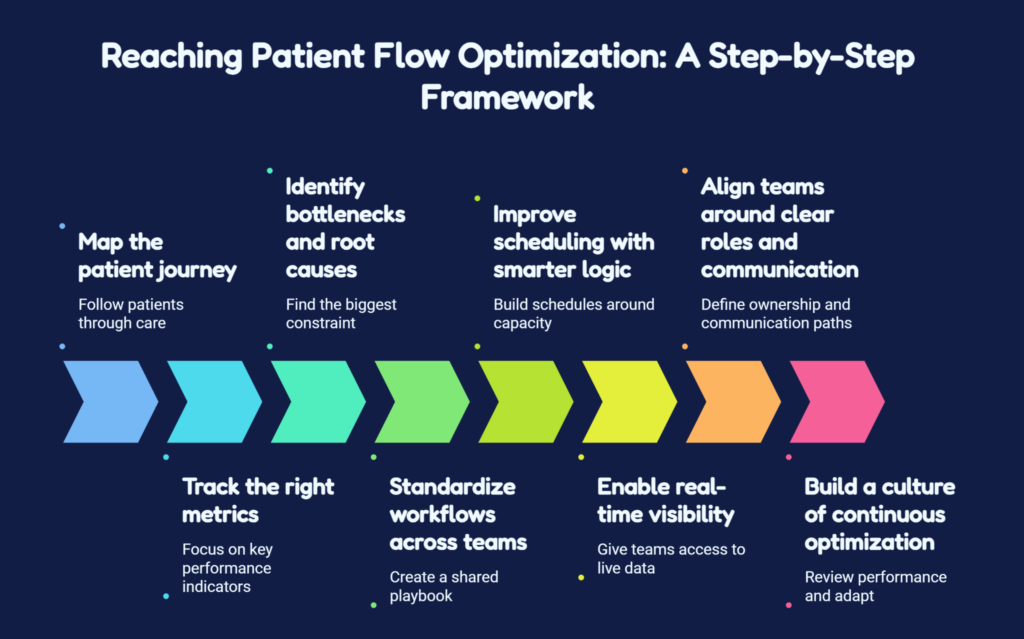
1. Map the Patient Journey to Expose Friction Points
If you want to improve patient flow, start by following the patient.
- What happens between scheduling and check-in?
- Where do patients spend the most time waiting?
- Which handoffs depend on emails, calls, or manual follow-ups?
That’s usually where the story gets interesting.
Because the biggest delays are rarely caused by a single broken process. More often, they’re hiding in the gaps between teams, systems, and responsibilities.
2. Track the Right Metrics to Understand Performance
If you’re relying on gut feeling, you’re probably missing part of the picture.
One team thinks scheduling is the problem. Another points to staffing. Someone else blames patient demand.
The numbers help cut through those assumptions.
Start with metrics like wait time, length of stay, no-show rates, throughput, and utilization. They won’t tell you everything, but they’ll quickly show where patients are slowing down and where capacity is being lost.
3. Identify Bottlenecks and Root Causes
Here’s a trap many organizations fall into. They fix what’s visible, not what’s causing it.
A crowded waiting room feels like the problem. But what if the real issue is delayed room turnover? Or discharge delays? Or appointment templates that overload certain providers while leaving others underutilized?
Before you jump into solutions, spend time identifying the constraint that’s creating the most downstream friction.
Fixing that bottleneck can create improvements across the entire patient journey.
4. Standardize Workflows Across Teams
Ever had two teams handle the same process in completely different ways?
Patients notice, and staff notice too.
Every extra variation creates opportunities for confusion, delays, and missed handoffs.
That doesn’t mean every workflow needs to be rigid. It means teams need a shared playbook for key processes like intake, triage, care coordination, and discharge.
Key Insight: A quality-improvement study published in Hospital Pediatrics introduced a dedicated patient-flow provider focused on discharge coordination. The percentage of discharges completed before noon increased from 19% to 34%. Even better, length of stay and seven-day readmission rates remained stable.
5. Improve Scheduling with Smarter Logic
Patient flow starts when someone books, not when someone arrives.
That’s why scheduling decisions have such an outsized impact on the rest of the patient journey.
Overbook a provider, underestimate appointment complexity, or ignore capacity constraints, and your team spends the rest of the day trying to recover.
Smarter scheduling models help prevent those problems before they happen.
The potential upside is substantial. A study published in Scientific Reports found that AI-driven scheduling reduced emergency patient wait times by roughly 40%.
No, AI won’t solve every scheduling challenge. But it does highlight how much flow efficiency depends on getting the schedule right from the beginning.
6. Enable Real-Time Visibility for Staff
Here’s a simple question. How many operational decisions in your organization still depend on someone making a phone call?
If the answer is “quite a few,” visibility may be one of your biggest opportunities.
Teams move faster when everyone has access to the same information at the same time. That involves:
- Bed availability.
- Room status.
- Pending discharges.
- Patient location.
- Capacity constraints.
Without that visibility, people spend their day searching for updates. With it, they spend more time moving patients through care.
7. Align Teams Around Clear Roles and Communication
Patient flow is a team sport.
The challenge is that not everyone is always playing from the same playbook.
- A discharge may be ready from a clinical perspective, but transportation hasn’t been notified.
- A room may be available, but housekeeping hasn’t received the update.
- And a patient may be waiting, but nobody realizes the next step belongs to them.
Those delays add up quickly.
Clear ownership, consistent communication, and defined escalation paths help eliminate the confusion that slows patient movement.
8. Build a Culture of Continuous Optimization
Patient flow isn’t something you fix once and move on from. Patient demand, staffing, and technology changes.
And healthcare operations certainly don’t stay still for long.
The organizations that consistently improve patient flow treat optimization as an ongoing habit rather than a one-time project. Instead, they:
- Review performance data regularly.
- Listen to frontline staff.
- Test improvements.
- Adjust when something isn’t working.
Small improvements may not seem dramatic in the moment.
Give them enough time, though, and they can completely change how patients move through your organization.
Patient Flow Metrics That Matter
You can’t improve patient flow by looking at everything.
The organizations that make progress know which numbers deserve attention and which ones are just noise.
Let’s start with the essentials.
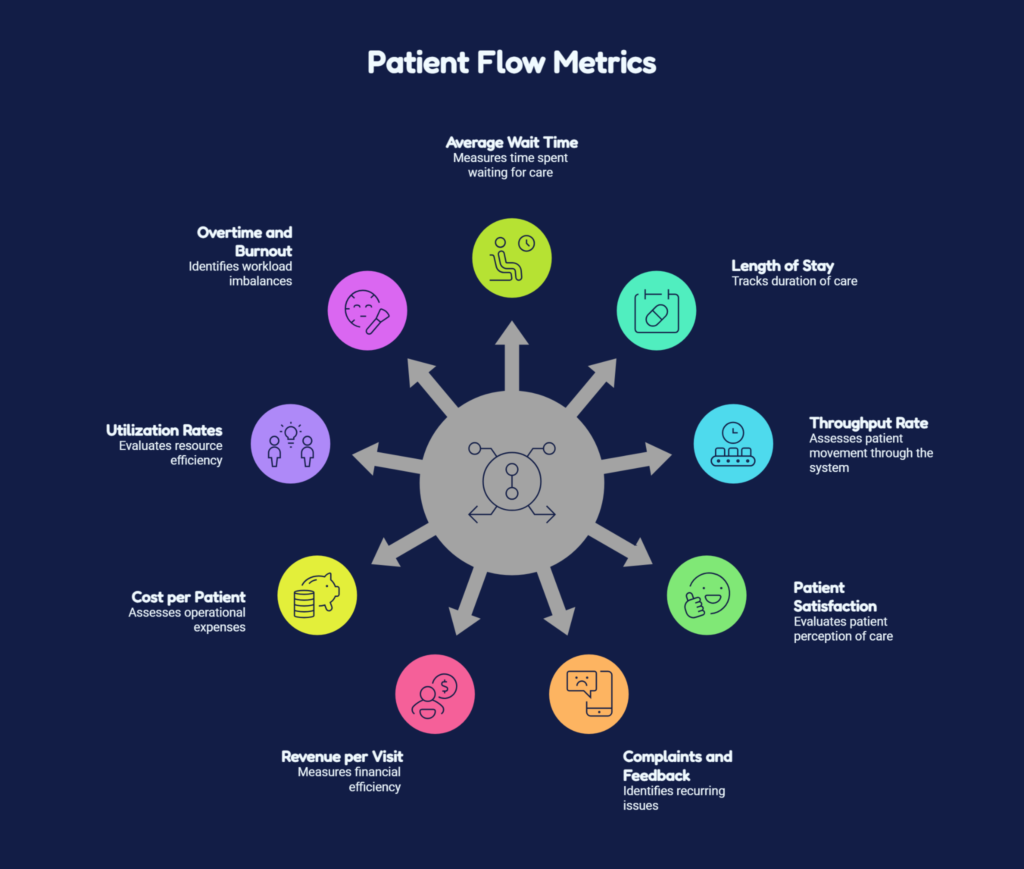
Core Operational Metrics to Track Flow
These metrics give you the clearest view of how efficiently patients move through your organization.
- Average wait time: Measures how long patients spend waiting before receiving care. Rising wait times usually point to bottlenecks in scheduling, intake, triage, or provider availability.
- Length of stay (LOS): Tracks how long patients remain in a care setting. A growing LOS can signal discharge delays, care coordination issues, or capacity constraints.
- Throughput rate: Measures how many patients successfully move through the system during a specific period. Useful for understanding whether operational improvements are translating into greater capacity.
Patient Experience Indicators
Patients don’t see your operational reports. They experience the consequences of them.
These metrics help connect patient flow performance with what patients actually feel during their journey.
- Patient satisfaction scores: Reveal how patients perceive access, communication, wait times, and overall care delivery.
- Complaints and feedback trends: Help uncover recurring pain points that may not appear in dashboards, such as confusing processes, communication gaps, or excessive waiting.
Financial and Capacity Metrics
Poor patient flow creates more than operational headaches; it creates financial ones too.
These metrics help quantify the business impact of inefficiencies:
- Revenue per visit: Measures the value generated from each patient encounter and helps assess whether capacity improvements are creating growth opportunities.
- Cost per patient: Tracks the operational cost of delivering care. Rising costs can indicate delays, inefficiencies, or underperforming workflows.
Staff Efficiency and Workload Balance
Want an early warning sign that patient flow needs attention? Look at your teams.
Staffing metrics often reveal operational friction long before leadership notices it elsewhere:
- Utilization rates: Show how effectively providers, rooms, equipment, and support teams are being used.
- Overtime and burnout indicators: Help identify workload imbalances that can eventually affect retention, morale, and patient care quality.
Best Patient Flow Optimization Tools by Category
At some point, spreadsheets stop being enough. That’s where technology starts pulling its weight.
The right tools won’t fix broken processes on their own. But they can make it much easier to spot delays, coordinate teams, and keep patients moving through the system more efficiently.
Let’s meet the best ones out there:
Scheduling Tools That Match Demand and Capacity
Patient flow starts before the visit.
If scheduling ignores provider availability, room capacity, appointment complexity, or no-show risk, you’re creating tomorrow’s bottlenecks today.
These tools help balance demand before it turns into operational chaos.
- Kyruus Health Schedule / Kyruus Connect: Helps patients book the right type of care with the right provider the first time. That reduces scheduling friction and helps health systems align patient demand with available capacity.
- DexCare Platform: Routes patients toward the most appropriate care setting, provider, or modality based on available clinical capacity. Particularly useful when demand shifts between virtual care, urgent care, and outpatient services.
- LeanTaaS iQueue for Infusion Centers: Uses historical demand patterns to smooth scheduling peaks, improve chair utilization, and reduce resource bottlenecks throughout the day.
Digital Intake and Check-In Solutions
Nobody wants patient flow to stall at the front desk. These tools help remove friction from the beginning of the patient journey:
- Phreesia Patient Intake & Check-In: Handles forms, insurance verification, payments, and mobile check-in so patients arrive ready for care instead of ready for paperwork.
- Clearwave Patient Check-In System: Uses self-service kiosks to reduce front-desk congestion and speed up registration without increasing staff workload.
- Epic Welcome / MyChart eCheck-In: Allows patients to complete registration tasks, questionnaires, and data verification before arriving for care.
Real-Time Patient Tracking Systems
Ever had a patient waiting for a room while another room sat empty? That’s usually a visibility problem.
These platforms provide a clearer operational picture.
- TeleTracking Operations IQ / Capacity IQ: Gives hospitals a live view of admissions, transfers, bed management, environmental services, and patient movement across the organization.
- PatientTrak: Shows where patients are, how long they’ve been waiting, and where delays are building throughout the care journey.
- CenTrak Workflow / RTLS: Tracks patients, staff, and workflows in real time, making it easier to identify bottlenecks before they affect patient care.
Analytics Platforms That Turn Data into Decisions
Dashboards are useful, but actionable insights are even better.
These tools help turn operational data into better decisions.
- Qventus Inpatient Capacity Solution: Uses AI to improve discharge planning, reduce excess patient days, and free up capacity that would otherwise remain tied up.
- LeanTaaS iQueue for Inpatient Flow: Combines predictive analytics and AI to help hospitals anticipate demand, manage capacity, and allocate resources more effectively.
- GE HealthCare Command Center: Provides real-time and predictive insights across beds, transfers, staffing, and patient throughput, helping leaders make faster operational decisions.
Communication Tools That Keep Teams Aligned
Patient flow depends on coordination. These tools help reduce the dead time between steps.
- TigerConnect / CareConduit: Routes alerts, tasks, and clinical updates to the right person, helping teams respond faster and avoid communication bottlenecks.
- Artera: Helps organizations automate patient communication, reminders, intake coordination, and engagement throughout the care journey.
- Spok Care Connect: Combines secure messaging, alerting, on-call management, and care-team collaboration in a single communication platform.
EHR Integration and Interoperability Layers
Here’s a common problem. One system knows the appointment status, another has the clinical information, and a third contains operational data.
Interoperability platforms help solve that problem. Here are some of them:
- Redox: Uses a standardized API framework to connect healthcare applications with EHRs and support seamless data exchange.
- Rhapsody Integration Engine: Helps healthcare organizations connect systems using standards such as HL7, FHIR, APIs, and other interoperability frameworks.
- Health Gorilla: Provides real-time access to clinical data across connected networks, helping organizations build more connected workflows.
The goal here? Creating a workflow where information moves as smoothly as patients are supposed to.
How to Choose the Right Patient Flow Solution for Your Organization
There’s no shortage of vendors promising to fix patient flow. The challenge is figuring out which solution will solve your bottlenecks.
Here’s what you should keep in mind.
Selection Criteria That Matter in Healthcare Environments
Before comparing platforms, start with the fundamentals.
Pay close attention to:
- Usability: If frontline teams find the platform difficult to use, workarounds will appear quickly.
- Integration capabilities: The tool should work with your EHR, communication systems, scheduling platforms, and operational workflows.
- Scalability: Today’s requirements may look very different a year from now. Choose a solution that can grow with patient demand and organizational complexity.
- Real-time visibility: The best platforms help teams make decisions in the moment, not after the fact.
- Implementation requirements: Some solutions can be deployed quickly. Others require significant operational and technical resources.
A good rule of thumb: prioritize workflow impact over feature count.
Key Questions to Ask Vendors Before You Decide
Most vendor demos focus on capabilities. You should focus on execution.
Before making a decision, ask questions like:
- How long does implementation typically take?
- What internal resources are required?
- How does the platform integrate with our existing systems?
- What level of customization is available?
- How is staff training handled?
- What reporting and analytics capabilities are included?
- What support is available after implementation?
- Can you provide healthcare-specific case studies or customer references?
The answers usually tell you more than the product demo.
Build vs Buy: What Makes Sense for Your Team
Some healthcare organizations consider building internal solutions. In certain cases, that makes sense.
If you have highly specialized workflows, strong technical resources, and unique operational requirements, a custom approach may offer more flexibility.
For most organizations, though, buying is the faster path.
Established platforms already include years of development, healthcare-specific workflows, security controls, interoperability support, and implementation experience.
The trade-off comes down to three factors:
- Cost: Building can reduce licensing fees but often increases development and maintenance expenses.
- Speed: Commercial solutions can typically be deployed much faster.
- Control: Custom-built systems offer greater flexibility but require ongoing ownership and support.
There’s no universal answer here. The best choice depends on your resources, timeline, and operational goals.
What Patient Flow Optimization Looks Like in Practice
Patient flow optimization doesn’t look the same everywhere. The bottlenecks affecting a five-provider clinic are very different from those affecting a large hospital network.
Here’s how that typically plays out across different healthcare environments.
- Small clinics and outpatient centers: These organizations often focus on scheduling efficiency, digital intake, no-show reduction, and patient communication. Even relatively small improvements can reduce wait times and create room for additional appointments without extending operating hours.
- Hospitals and high-complexity environments: Flow initiatives usually center around bed management, discharge planning, patient tracking, care coordination, and emergency department throughput. The operational complexity is higher, but so is the potential impact.
- Multi-location healthcare organizations: These systems often prioritize standardizing workflows, improving visibility across sites, balancing patient demand, and creating a more consistent patient experience regardless of location.
One of the most interesting examples comes from the University of Michigan.
According to a summary of a NEJM Catalyst study, the organization’s command center improved bed-use efficiency to the equivalent of adding 63 adult inpatient beds without physically expanding capacity.
The initiative also:
- Reduced bed wait times by 33%.
- Decreased ED-to-bed assignment times by 37%.
- Improved transfer acceptance rates.
- Generated an estimated $19.5 million positive financial impact.
The takeaway here? Patient flow improvements can unlock capacity that’s already there but currently hidden behind operational friction.

Bottom Line: Turn Patient Flow Into a Competitive Advantage
Patient flow isn’t one of those operational topics that only matters to administrators. Patients, providers, and staff feel it. And eventually, your bottom line feels it too.
The organizations making the biggest gains aren’t necessarily building new facilities or hiring massive teams. More often, they’re removing the friction that’s slowing patients down in the first place.
That’s what makes patient flow optimization worth the effort, because it helps you create a healthcare experience that works better for everyone involved.
The good news? You don’t have to redesign your entire organization to get started. Sometimes the biggest improvements come from fixing a bottleneck that’s been hiding in plain sight.
If you’re evaluating ways to improve patient flow, streamline operations, or build a more connected care experience, Medical Flow can help. Reach out to us and let’s talk.
FAQs
What is patient flow optimization in healthcare?
At a simple level, it’s about helping patients move through care without unnecessary delays. However, the reality is that patients can get stuck at dozens of points along the journey, from scheduling and check-in to diagnostics, treatment, and discharge.
Patient flow optimization focuses on removing that friction so care happens faster, smoother, and with fewer operational headaches. In practice, effective patient flow management helps organizations deliver care more efficiently across the entire patient journey.
Why is patient flow optimization important in healthcare?
Because every delay has a ripple effect. A delayed discharge affects bed availability. A bottleneck in intake affects wait times. And a communication gap slows down care delivery. Patients, staff, and leadership notice it too.
For many organizations, the goal is to enhance patient flow without adding unnecessary strain on staff or resources.
What factors affect patient flow in healthcare settings?
More things than most people expect. Scheduling, staffing, communication, discharge planning, bed management, patient demand, technology, and care coordination all influence how patients move through the system.
The challenge becomes even greater as patient volume increases, putting additional pressure on teams, resources, and capacity throughout the day.
What are the most effective patient flow optimization strategies?
Start by finding where patients are getting stuck. From there, focus on the fundamentals: map the patient journey, track the right metrics, improve scheduling, standardize workflows, and give teams better visibility into what’s happening in real time.
You don’t need to fix everything at once. The most successful organizations focus on practical ways to manage patient flow before expanding capacity or investing in major operational changes.
How does technology support patient flow optimization?
Technology helps healthcare teams spend less time chasing information and more time acting on it. The right tools can improve scheduling, streamline intake, increase visibility, strengthen communication, and uncover bottlenecks before they become bigger problems.
Just don’t expect software to solve patient flow on its own. The best results happen when technology supports a well-designed workflow, not when it tries to replace one.