
If you’re running a clinic or overseeing operations inside a healthcare organization, you don’t need another article telling you “technology is the future.”
You’re already living the pressure.
Here’s the uncomfortable part: most healthcare providers already have digital tools in place: electronic health records, billing software, scheduling platforms, telehealth systems. The stack exists.
So why does everything still feel fragmented?
Because having tools is not the same as having alignment across your healthcare system.
This is where digital transformation in healthcare becomes a real conversation. Not as a trend or a tech upgrade, but as a structural shift in how your healthcare delivery model works day to day.
Let’s break down what actually changes.
- TL;DR
- Digital Transformation in Healthcare, Explained in Practical Terms
- The Operational and Clinical Pressures Behind the Shift
- What Are the Benefits of Digital Transformation in Healthcare?
- Where These Benefits Show Up in Daily Healthcare Operations
- Common Barriers and Trade-Offs to Consider
- How Healthcare Organizations Approach Transformation Successfully
- Bottom Line: Digital Transformation Is a Structural Choice
- FAQs
TL;DR
If you’re short on time, here’s the quick breakdown:
- Fragmented systems drain clinical time and create operational friction across your healthcare organization.
- Digital transformation in healthcare works when workflows align, not when tools simply accumulate.
- Integrated systems improve care consistency and reduce breakdowns during handoffs.
- Administrative strain decreases when documentation, scheduling, and billing connect cleanly.
- Capacity expands when teams stop compensating for system gaps.
- Leadership gains clearer visibility into performance across departments.
Digital Transformation in Healthcare, Explained in Practical Terms
Let’s make this simple.
Digital transformation in healthcare isn’t about installing something new and hoping it fixes everything. Actually, the point is how your systems behave together on a normal Tuesday.
Just think about your current setup:
- A patient schedules an appointment.
- Your admin team logs it.
- The clinician prepares.
- Billing gets involved later.
- Follow-up happens somewhere else.
Now ask yourself: how many manual steps are happening in between? And how many times does your team re-enter information that already exists?
That friction is where time disappears. And it adds up faster than most leaders realize.
Well, digital transformation addresses that structural issue. It connects clinical, administrative, and operational systems so information moves with the patient instead of lagging behind them.
The technologies behind modern healthcare systems
You already know the names of these tools. The question is how well they’re working together inside your healthcare organization:
- Electronic health record systems (EHRs). These are the backbone of clinical documentation. When properly integrated, they give your team a unified view of patient history, medications, lab results, and care plans. When isolated, they become just another screen to check.
- Telehealth platforms. They extend healthcare delivery beyond your physical location. Virtual visits, follow-ups, remote access. But if telehealth runs parallel to your in-person workflows instead of inside them, coordination suffers.
- Remote patient monitoring tools. These track patient data outside the clinic. Vital signs, adherence, recovery indicators. They support earlier intervention, but only if that data feeds directly into your clinical decision processes.
- Predictive AI integrated into EHR systems. Used for risk scoring, early deterioration alerts, and population health management.
- Interoperability layers. These allow different systems to exchange structured health information.
- Workflow automation tools. Scheduling automation, documentation support, billing coordination, task routing. When aligned with your operations, they reduce repetitive work and cut down manual duplication.
So the technology layer isn’t theoretical anymore.
The real question is this: Are your systems coordinated, or are they just coexisting?
Why digitization alone does not produce results
Here’s where many healthcare organizations hit a wall.
A new platform gets rolled out, training sessions are scheduled, and dashboards look impressive.
But the workflow underneath stays the same:
- Your staff still double-documents.
- Scheduling still sits outside clinical planning.
- Data still needs manual cleanup before reporting.
Adding digital tools without redesigning processes increases complexity. It doesn’t reduce it.
Real progress shows up when:
- Your workflows are rebuilt so information flows cleanly from intake to discharge to follow-up.
- Healthcare professionals don’t need side spreadsheets or workaround emails to get through the day.
- Your healthcare delivery model feels coordinated instead of patched together.
That’s the difference between digitization and true digital transformation in healthcare.
And yes, your team feels that difference immediately.

The Operational and Clinical Pressures Behind the Shift
This shift didn’t start because healthcare suddenly got excited about digital tools. Actually, that was because the pressure kept stacking up.
If you’re leading operations, you don’t need a trend report to confirm that. You feel it every week:
- Higher expectations around access and convenience. Patients expect fast scheduling, digital communication, and flexible care options. If the process feels slow or disconnected, they won’t wait around. They’ll look elsewhere.
- Administrative overload and workforce constraints. Your clinicians didn’t sign up to spend hours reconciling information. Yet disconnected systems force them into coordination work that eats into clinical time and energy.
- Limited visibility across systems and departments. When scheduling, billing, and clinical documentation live in separate environments, leadership operates with blind spots. Capacity feels tighter than it actually is. Small delays quietly snowball.
And here’s the part that doesn’t show up in a single metric. Longer wait times start to feel normal, teams get tired, and retention begins to slip.
That’s why digital transformation keeps resurfacing at the executive level in healthcare; because fragmentation has a real cost.
Key insight: Philips Future Health Index 2025 report found that more than 3 in 4 healthcare professionals lose clinical time due to incomplete or inaccessible patient data. About one-third lose over 45 minutes per shift, which is 23 full working days per clinician each year. That’s capacity walking out the door, not a minor inefficiency.
What Are the Benefits of Digital Transformation in Healthcare?
So what changes when systems stop competing and start aligning?
Well, let’s look at where the impact becomes visible:
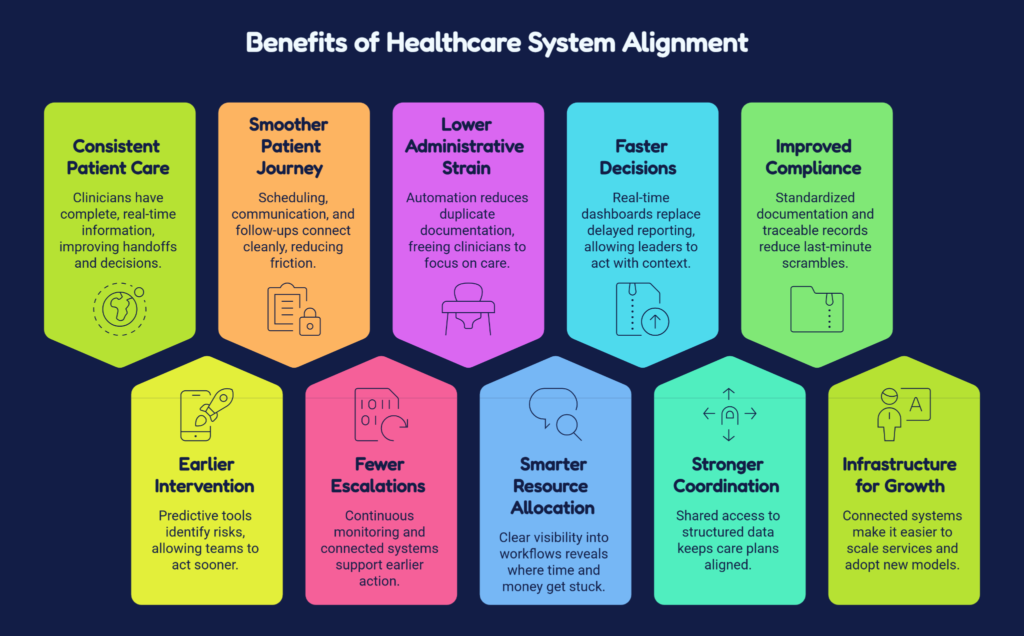
More consistent and accurate patient care
Consistency starts with access to reliable information.
When medication history, lab results, and care plans are visible at the point of care, clinicians don’t rely on memory or partial notes. Handoffs feel cleaner. Decisions feel grounded.
The numbers back this up. A systematic review of 116 randomized clinical trials found that EHR-based interventions reduced 30-day readmissions by 17% and 90-day readmissions by 28%. That’s coordinated information translating into measurable outcomes.
The Philips global survey adds another layer:
- 82% of healthcare professionals believe AI and predictive analytics can save lives through earlier intervention.
- 75% believe digital health technologies can reduce hospital admissions in the future.
That’s what improvement looks like inside a healthcare system that shares information effectively.
A more accessible and predictable patient journey
If scheduling is simple, communication is clear, and follow-ups don’t depend on manual reminders, the experience changes immediately.
Telehealth plays a big role here. Patient no-shows cost the U.S. healthcare industry an estimated $150 billion each year, and telehealth significantly reduces no-show rates.
Remote monitoring supports that continuity. A meta-analysis published in JMIR found that remote patient monitoring may reduce hospitalization risk and shorten hospital stays by about 0.84 days.
Less friction across the journey stabilizes both care quality and operational capacity.
Reduced administrative burden across teams
Administrative strain is one of the fastest ways to lose good clinicians. Documentation, coding, reporting… And the workload keeps expanding.
When automation is integrated properly, that pressure eases.
Scheduling flows automatically. Billing aligns with documentation. Ambient documentation tools capture conversations during visits instead of after hours.
That shift affects morale. It affects retention. It affects long-term stability inside your healthcare organization. And stability is hard to rebuild once it’s gone.
Key Stat: A study published in JAMA Network found that ambient documentation technology was associated with reduced burnout. At Mass General Brigham, burnout fell from 52.6% to 30.7% within 84 days. That’s what operational relief looks like.
Better use of resources and tighter cost control
As systems begin to align, something shifts quickly: visibility. You gain a clear view of where time goes, where capacity gets stuck, and where money leaks.
That clarity changes how you allocate staff, schedule rooms, and plan expansion.
AI is already influencing this layer.
Per the 2025 report by Philips, healthcare professionals reported that AI can help automate repetitive tasks (84%), expand capacity (78%), improve patient throughput (77%), reduce wait times (76%), and increase face-to-face time with patients (68%).
When repetitive coordination tasks decrease, your teams operate at the top of their license.
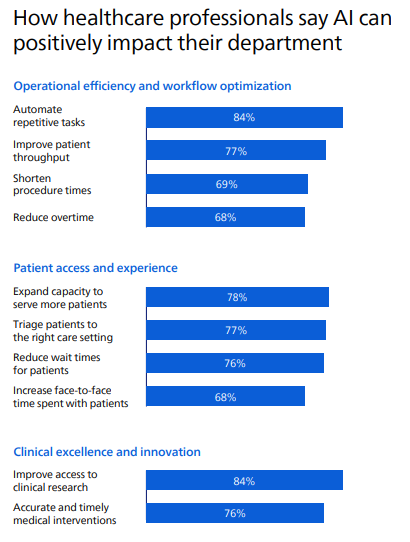
Source: Philips Future Health Index 2025 report
Clearer decisions supported by real-time data
In many healthcare organizations, reporting is delayed. Data gets pulled, cleaned, consolidated. By the time leadership sees it, the situation has already evolved.
Integrated digital systems reduce that lag.
When predictive analytics live inside your electronic health record, risk alerts don’t sit in a separate dashboard. They surface during care.
Operational leaders can forecast demand more accurately. Clinical teams can intervene earlier. And financial teams can track performance without waiting for month-end reconciliation.
Real-time visibility doesn’t eliminate uncertainty. But it reduces blind spots, and that leads to better calls.
Key Stat: By 2024, 71% of hospitals reported using predictive AI integrated with their EHR systems. That level of adoption changes expectations.
Stronger coordination between providers and departments
Fragmentation is expensive during handoffs.
Patients don’t stay in one setting. They move between primary care, specialty visits, inpatient units, and rehabilitation. Every transition becomes risky when information lags.
Interoperability has improved significantly in recent years. In 2025, 76% of U.S. hospitals engaged in all four key interoperability domains: sending, receiving, finding, and integrating electronic patient health information (ONC).
That matters because coordination depends on shared context.
When providers across departments access the same structured data, fewer details get lost. Follow-up instructions are clearer, duplicate testing decreases, and care plans stay aligned.
Improved compliance and audit readiness
Compliance pressure isn’t slowing down.
Yes, we’re talking about HIPAA requirements, data protection standards, reporting obligations, and documentation audits.
When information is scattered across systems, preparing for review becomes a scramble.
Structured digital records change that dynamic:
- Standardized documentation improves traceability.
- Access logs provide visibility into data handling.
- Automated reporting reduces manual preparation time.
For leadership, this lowers regulatory risk. For teams, it reduces the stress that comes with last-minute audits.
Infrastructure that supports growth and change
Growth exposes weak infrastructure.
If your systems are tightly connected, scaling services doesn’t multiply chaos. You can add locations, introduce new specialties, or expand telehealth without rebuilding your foundation each time.
AI adoption reflects this forward shift. A 2026 survey report by NVIDIA found that:
- 70% of organizations are actively using AI, up from 63% the previous year.
- 69% are using generative AI or large language models.
- 65% apply AI for analytics and data science.
- 42% use AI to support clinical decision-making.
Those numbers point to something bigger. Healthcare organizations are restructuring how they operate.
And once that infrastructure is in place, adapting to new care models becomes less disruptive.
Where These Benefits Show Up in Daily Healthcare Operations
All of this sounds strategic. But if nothing changes inside your organization, it’s just theory.
So where does alignment actually make a difference? Let’s see that:
- Hospitals and health systems. Inside a hospital, coordination defines everything. When systems connect, discharge planning doesn’t stall because someone couldn’t access the latest note. Surgical schedules reflect real capacity. And during handoffs, providers rely on shared data. That’s where throughput stabilizes.
- Clinics and outpatient environments. Outpatient settings feel the shift quickly. When scheduling aligns with clinical calendars, the day flows better. Automated reminders reduce empty slots. And telehealth runs inside the same workflow.
- Administrative and operations teams. Now think about your ops team. When documentation connects directly with revenue cycle data, reporting stops being a monthly scramble. Forecasting becomes grounded in patterns instead of patchwork.
- Patient-facing interactions. From the patient’s side, the difference is simple. Digital intake reduces repeated paperwork. Communication stays in one place, and follow-ups trigger without someone manually chasing them.
Common Barriers and Trade-Offs to Consider
Now let’s be real: transformation doesn’t feel smooth at the beginning.
It creates tension before it creates clarity:
Organizational alignment and adoption challenges
New technologies can go live quickly. But behavior change takes longer.
Some clinicians worry about losing efficiency. And some admin teams worry about shifting responsibilities.
If the “why” isn’t clear, people default to old habits. And when that happens, the system looks integrated on paper but not in practice.
Adoption is what determines if improvement sticks.
Legacy infrastructure and integration limits
Many healthcare organizations are building on foundations that weren’t designed to connect deeply. That includes older platforms, inconsistent data structures, and limited interoperability.
You can’t ignore that.
Transformation requires discipline in architecture and sequencing. Without that, new tools just stack on top of old complexity.
Data protection and regulatory requirements
The more connected your systems become, the more disciplined governance must be. Yes, that includes access controls, audit logs, and structured data handling.
Handled well, integration strengthens compliance.
Investment decisions and return timelines
And yes, there’s cost. Technology, training, workflow redesign. None of it is free.
Returns build as inefficiencies shrink and coordination improves. Meanwhile, fragmentation keeps generating quiet losses: missed appointments, duplicated work, and avoidable delays.
The question here is how long the current structure can carry mounting pressure.
How Healthcare Organizations Approach Transformation Successfully
If you’re leading this shift, the order matters.
Too many organizations start with the platform. But the ones that see real impact start with the problem.
Here’s what that looks like in practice:
- Define outcomes before selecting technology. Get specific. Are you trying to reduce discharge delays? Cut documentation time? Improve retention for chronic care patients? If you can’t measure the goal, every tool starts looking “good enough.” Clarity protects you from expensive detours.
- Focus on high-impact workflows first. You don’t need to modernize everything at once. Start where the friction is costing you the most. Maybe it’s scheduling instability, revenue cycle leakage, or messy care transitions. Fix one pressure point well. Momentum builds from there.
- Select systems that integrate and scale. This is non-negotiable now. If your platforms can’t connect cleanly, you’re building future bottlenecks into your infrastructure.
- Support adoption across teams. New workflows feel disruptive at first. If teams don’t understand how the changes make their day easier, they’ll revert to old habits quietly. Adoption is about reducing daily friction, not feature training.
- Track performance and adjust continuously. Implementation isn’t the finish line. Watch throughput, monitor readmissions, measure documentation time, and review financial indicators. If results stall, refine the workflow before expanding it.
What is needed for a successful digital transformation in healthcare?
Bottom Line: Digital Transformation Is a Structural Choice
As you can see, technology alone won’t fix operational strain. Structure will.
When clinical, administrative, and financial workflows align, performance stabilizes. But when they don’t, friction compounds.
So, digital transformation in healthcare comes down to one decision: keep patching gaps, or redesign how your system works under pressure.
For those organizations looking for a proper partner in digital transformation, Medical Flow can help build that structure.
If you’re rethinking how your organization operates, let’s talk.
FAQs
What is digital transformation in healthcare?
It’s what happens when your systems stop working in isolation.
Instead of scheduling in one place, documentation in another, and billing somewhere else, everything connects. Information moves with the patient. And your team doesn’t have to stitch it together manually.
Why is digital transformation a priority for healthcare organizations today?
When workflows don’t connect, small inefficiencies multiply. Over time, they turn into real operational strain. Integration reduces that drag. That’s why leadership teams are treating it as a structural priority.
How does digital transformation improve patient care?
Care improves when clinicians have the full picture: complete data, real-time access, and predictive insights inside their workflow. That’s coordinated information that helps to improve patient outcomes.
How does digital transformation improve operational efficiency in healthcare?
Think about where time gets lost. Manual data entry, duplicate documentation, rebuilding reports, and fixing billing mismatches.
When systems share structured data, those tasks shrink. Efficiency improves when teams stop compensating for system gaps.
How is digital transformation shaping the future of healthcare?
It’s becoming baseline infrastructure. By 2024, 71% of hospitals reported using predictive AI integrated into their electronic health record systems. So, adoption isn’t experimental anymore.
Healthcare organizations building integrated systems today will adapt faster as care models evolve. Those that don’t will keep operating around friction.