
For years, artificial intelligence (AI) felt like one of those technologies that generated more headlines than operational results in healthcare settings.
Now, that’s getting harder to argue.
According to McKinsey’s 2026 survey, 50% of organizations in the healthcare sector have already implemented generative AI, more than 80% have deployed use cases to end users, and 82% expect positive ROI.
In other words, AI is no longer sitting inside innovation labs or pilot programs. Now, it’s showing up in scheduling workflows, revenue cycle teams, patient communications, capacity planning, and dozens of other operational functions.
That’s exactly why the adoption of AI in healthcare operations has become such a major focus for healthcare leaders over the last few years. Let’s see that in depth up next.
- TL;DR
- What AI in Healthcare Operations Means (and What It Doesn't)
- What counts as healthcare operations in practice
- Where Operations Break Down Today (and Why AI Becomes Relevant)
- High-Impact Use Cases Where AI Drives Real ROI
- The Tech Behind It (Without Making It Overly Complex)
- What You Gain from AI in Operations
- What Slows Down AI Adoption in Healthcare Operations
- How to Approach AI Adoption in Your Healthcare Operations Without Complications
- How to Evaluate AI Solutions (Without Getting Distracted by Trends)
- The Future of Healthcare Operations Is Already Here
- FAQs
TL;DR
Short on time? Here are the biggest takeaways from this guide.
- AI in healthcare operations is being used to improve scheduling, revenue cycle management, staffing, patient communication, and capacity planning.
- Healthcare leaders are moving beyond experimentation. 50% of organizations have already implemented generative AI, and 82% expect positive ROI.
- The biggest opportunities are usually found in administrative workflows, not clinical decision-making.
- Common use cases include reducing no-shows, preventing claim denials, forecasting staffing needs, improving patient flow, and automating repetitive administrative work.
- AI works best when applied to a specific operational bottleneck with clear success metrics.
- Most healthcare organizations still face adoption challenges tied to integration, data quality, compliance, and workflow changes.
- The strongest results typically come from a phased approach: identify a problem, run a pilot, measure outcomes, then scale.
What AI in Healthcare Operations Means (and What It Doesn’t)
Most healthcare organizations aren’t using AI to reinvent their entire operation.
Instead, they’re using it to solve specific problems, such as:
- Reducing no-shows.
- Preventing claim denials.
- Improving staffing decisions.
- Helping patients get answers faster.
- Giving teams better visibility into what’s happening across the organization.
That’s what implementing AI in healthcare operations looks like in practice; just better ways to handle the operational work that keeps healthcare running.
What counts as healthcare operations in practice
Healthcare operations include all the moving parts that determine how efficiently a healthcare organization functions.
Patients may never see many of these workflows directly, but they feel the impact when something breaks.
Think about areas like:
- Appointment scheduling
- Front-desk operations
- Call centers
- Revenue cycle management
- Staffing and workforce planning
- Capacity management
- Patient intake
- Care coordination
- Prior authorizations
Together, these functions influence patient access, operational costs, staff productivity, and overall healthcare delivery.
They also play a major role in improving healthcare operational efficiency. When these workflows run smoothly, organizations can serve patients faster, allocate resources more effectively, and reduce unnecessary administrative burden.
However, a scheduling bottleneck can increase wait times. A coding error can delay reimbursement. And poor staffing visibility can leave teams overwhelmed during busy periods.
That’s the challenge. Small operational issues rarely stay small for long.
Key Stat: The 2025 CAQH Index Report found that more than 50% of health plans and 25% of provider organizations already use AI tools in administrative workflows. This proves that adoption is becoming part of how many organizations manage day-to-day operations.
Where AI fits into these workflows
For most healthcare organizations, AI supports operations in three main ways:
- Prediction (what will happen): AI can identify patterns in large volumes of operational data, helping teams anticipate no-shows, forecast patient demand, spot capacity issues, and identify claims that may be denied before they’re submitted.
- Automation (what can be done faster): Repetitive tasks can be completed faster with less manual effort. Those tasks include appointment reminders, patient intake, eligibility verification, documentation support, and routine communications.
- Decision support (what should happen next): AI helps teams prioritize actions by surfacing operational risks, recommending staffing adjustments, highlighting high-risk claims, and identifying patients who may need follow-up attention.
And that’s where many healthcare leaders see the biggest opportunity.
Key Insight: Per McKinsey’s 2026 survey, administrative efficiency was the area most frequently identified as having the greatest potential for both generative AI and multiagent workflows. That says a lot about where AI in healthcare is headed.
Why this is not about replacing teams
Let’s address the elephant in the room.
Every time AI enters the conversation, people start wondering if it’s coming for their jobs.
That’s not what most healthcare organizations are focused on right now. They’re trying to solve a much more immediate problem: teams are overloaded.
Too much time gets spent on tasks that don’t require expertise, judgment, or human interaction. That includes things like:
- Sending appointment reminders and follow-up messages.
- Verifying eligibility and handling intake paperwork.
- Looking for information across disconnected systems.
- Reworking claims that could have been flagged earlier.
That’s where AI is making the biggest difference, taking some of the repetitive work off the team’s plate.
The goal is pretty simple:
- Spend less time on administrative busywork
- Spot operational issues earlier
- Give staff more time to focus on patients and higher-value work
However, human oversight still matters.
Someone still has to make staffing decisions, manage scheduling priorities, and handle complex revenue cycle issues when they show up.

Where Operations Break Down Today (and Why AI Becomes Relevant)
Most healthcare organizations start looking at AI because something in operations isn’t working as well as it should.
This is usually when AI enters the conversation:
Access bottlenecks and long wait times
Here’s a frustrating reality: a long wait time doesn’t always mean a provider shortage.
Sometimes it means the organization can’t see demand clearly enough:
- Schedules fill up weeks in advance.
- Patients cancel at the last minute.
- No-shows leave gaps nobody expected.
- Meanwhile, other patients are stuck waiting for available appointments.
The result? One part of the healthcare system is overloaded while another part sits underutilized.
That’s a difficult problem to solve manually, especially when demand changes constantly.
Revenue leakage across the revenue cycle
Revenue cycle issues rarely arrive with a warning label attached. Most of the time, money slips away through dozens of small mistakes.
Incomplete documentation, coding errors, missing information, claims that require rework after submission… None of those issues look dramatic on their own.
But together they can have a significant impact on financial performance.
According to a survey by HFMA and AKASA, 89% of healthcare organizations said missed or inaccurate codes significantly affect revenue. Respondents also estimated that 8.49% of revenue is at risk because of incomplete or inaccurate documentation.
That’s a tough number to ignore. Especially when many of those problems could have been identified much earlier in the process.
Constant pressure on patient flow and capacity
Patient flow has a way of exposing weaknesses across an entire organization.
One delayed discharge can affect bed availability. This leads to slow admissions and pressure elsewhere in the system.
Before long, multiple teams are dealing with the consequences of a problem that started hours earlier.
That’s what makes capacity management so challenging. Everything is connected. And when visibility is limited, teams end up reacting to bottlenecks instead of preventing them.
Overloaded staff and fragmented tools
Let’s talk about something almost every healthcare professional can relate to.
Too many systems and logins, and too much time spent hunting for information.
Most healthcare organizations aren’t suffering from a lack of data. If anything, they have the opposite problem.
The information exists. It’s just scattered across different systems, workflows, and teams. That creates a surprising amount of friction.
In that regard, Philips’ 2025 Future Health Index found that:
- More than 75% of healthcare professionals lose clinical time because patient data is incomplete or difficult to access.
- One-third reported losing more than 45 minutes per shift.
- That adds up to roughly 23 full days per year for each professional.
Think about that for a second. Nearly an entire month of productivity lost every year, just because finding the right information takes longer than it should.
That’s exactly the type of operational friction AI is being asked to address.
High-Impact Use Cases Where AI Drives Real ROI
This is where the conversation gets practical. The strongest cases of the use of AI tend to focus on operational problems first.
Here’s how.
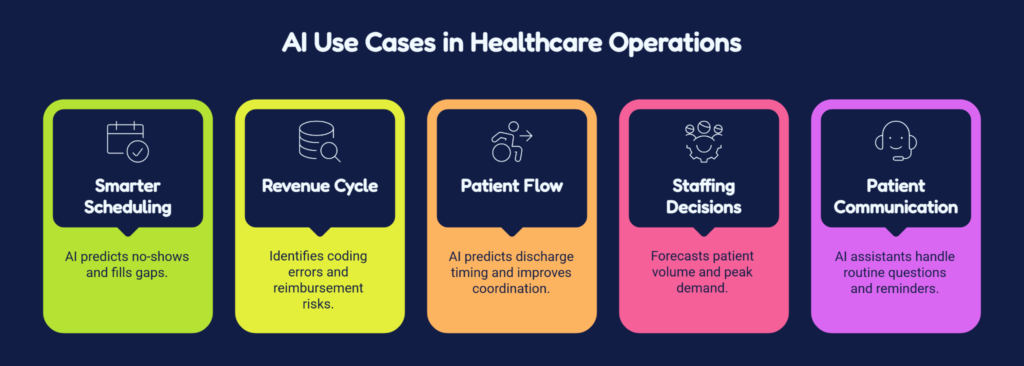
Smarter scheduling that reduces no-shows
Every empty appointment slot comes with a cost. Lost revenue is part of the problem, while reduced access is another.
When patients cancel at the last minute or don’t show up at all, schedules become harder to manage and wait times can grow even when capacity is technically available.
This is where AI can help. Many organizations are using AI models to:
- Predict which patients are most likely to miss appointments.
- Identify scheduling patterns that increase no-show risk.
- Automatically trigger reminders and follow-ups.
- Reallocate available slots when cancellations occur.
The goal here? To make scheduling a lot more predictable.
Revenue cycle that fixes issues before they happen
Revenue cycle management has become one of the busiest areas for AI adoption. And honestly, that’s not surprising.
Instead of waiting for claims to be rejected, AI can help teams identify potential issues before submission. Common use cases include:
- Coding assistance and documentation review.
- Prior authorization support.
- Denial prediction.
- Claim validation before submission.
- Revenue risk identification.
The opportunity is significant. Per the mentioned HFMA/AKASA survey, 80% of health systems were already exploring, piloting, or implementing GenAI-powered tools for revenue cycle management.
This makes sense when you look at the numbers. As noted before by the same survey, 89% of organizations believe missed or inaccurate codes significantly affect revenue.
That’s a revenue problem. And those problems tend to get leadership’s attention very quickly.
Key Stat: A PayZen survey found that 37% of health systems were already using generative AI in revenue cycle workflows, while 45% were applying AI to denial-related processes. In other words, many organizations are figuring out how far they can scale AI in their revenue cycle.
Patient flow with better timing and visibility
Patient flow can feel like a domino effect.
One delayed discharge creates capacity issues. This affects admissions, and after that, can affect scheduling and resource allocation too. Before long, multiple teams are dealing with the consequences.
AI helps create better visibility across those moving parts. For example, organizations are using AI to:
- Predict discharge timing more accurately.
- Identify patient flow bottlenecks earlier.
- Monitor real-time capacity across facilities.
- Improve coordination between departments.
The value isn’t just efficiency. Better patient flow can improve patient access, reduce delays, and help teams use existing resources more effectively.
Staffing decisions based on demand
Healthcare staffing has always involved a balancing act.
Schedule too many people and labor costs rise. But schedule too few and staff burnout starts creeping in.
AI helps organizations make those decisions using actual demand patterns instead of educated guesses.
Common applications include:
- Forecasting patient volume.
- Predicting peak demand periods.
- Optimizing shift schedules.
- Identifying staffing gaps before they become operational issues.
Nobody can predict demand perfectly. But having better visibility into what’s likely coming next puts operations teams in a much stronger position.
Patient communication without constant call volume
Let’s be honest. A large percentage of patient calls involve questions that don’t necessarily require staff intervention:
- Appointment confirmations.
- Basic scheduling questions.
- Directions.
- Preparation instructions.
- Insurance-related questions.
AI-powered assistants can handle many of these interactions automatically while still escalating more complex situations to human staff when needed.
That helps organizations:
- Reduce call volume
- Improve response times
- Support patients outside normal business hours
- Free up staff for higher-priority conversations
Patients get answers faster, and staff spend less time handling repetitive requests.
That’s a win on both sides.
The Tech Behind It (Without Making It Overly Complex)
It’s easy to make AI sound more complicated than it needs to be.
Under the hood, most healthcare AI solutions rely on a combination of technologies that perform three different jobs.
Predictive models that spot patterns in your data
These models analyze historical information and look for patterns humans might miss.
For example, they can estimate:
- Which patients are likely to miss appointments.
- Expected patient volume next week.
- Claims that may be denied.
- Areas where capacity constraints could emerge.
The more relevant data available, the more useful these predictions become.
Language models that handle text, calls, and documentation
This is the type of AI receiving the most attention right now.
Language models can understand and generate text, summarize information, answer questions, and assist with documentation.
In healthcare operations, they’re commonly used for:
- Patient communications.
- Documentation support.
- Call center assistance.
- Intake workflows.
- Knowledge management.
These tools help reduce administrative workload without requiring teams to completely redesign existing processes.
Automation layers that remove repetitive tasks
Some AI systems don’t just analyze information. They take action.
For example:
- Sending reminders automatically.
- Routing requests to the right team.
- Triggering follow-up workflows.
- Updating operational records.
- Escalating issues that need human review.
This helps eliminate repetitive steps that consume valuable staff time.
How these capabilities work together in practice
Here’s the important part. Healthcare organizations rarely use these technologies separately.
The strongest AI solutions combine prediction, automation, and decision support into existing workflows.
- A scheduling platform might predict no-shows, automatically send reminders, and recommend schedule adjustments.
- A revenue cycle tool might identify a documentation issue, flag the claim, and suggest corrective action before submission.
From the user’s perspective, it feels less like “using AI” and more like having better tools. And that’s usually the goal.
What You Gain from AI in Operations
Let’s be honest: nobody wakes up excited about improving administrative workflows. What gets people excited are the results.
That’s where AI starts earning its keep:
- Less manual work: Healthcare teams spend a lot of time doing things that could be handled faster. Appointment reminders, documentation support, eligibility checks, and routine administrative tasks are some of the first areas organizations target.
- Fewer surprises: No organization can predict everything. But it’s a lot easier to manage staffing, scheduling, and capacity when you can spot potential problems before they turn into operational fires.
- Better patient access: Patients don’t care what technology sits behind the scenes. They care about getting appointments, receiving answers, and accessing care without unnecessary delays.
- More control over costs: Administrative work is expensive, so is rework. Per the 2025 CAQH Index Report, U.S. healthcare avoided $258 billion in administrative costs through electronic transactions and improved data exchange. Researchers also identified another $21 billion in savings opportunities through further automation.
- More time for meaningful work: One of the most overlooked benefits of AI has to do with people. A study published in JAMA Network found that clinician burnout dropped from 51.9% to 38.8% after 30 days of using ambient AI scribes.
That’s a pretty good reminder that operational improvements affect the people doing the work.
What Slows Down AI Adoption in Healthcare Operations
If implementing AI were easy, every healthcare organization would already be doing it at scale.
That obviously isn’t happening, because healthcare operations are complicated.
Some of the biggest roadblocks include:
- Messy data: AI depends on good information. Unfortunately, healthcare data isn’t always complete, consistent, or easy to access.
- Disconnected systems: Scheduling platforms, EHRs, billing tools, and communication systems weren’t always designed to work together. That creates friction before an AI project even begins.
- Integration challenges: As McKinsey’s 2026 healthcare survey also noted, some of the biggest barriers preventing organizations from scaling AI initiatives are integration, capabilities, risk, and safety.
- Workflow resistance: Even the best tool can struggle if teams don’t understand how it fits into their day-to-day work.
- Compliance requirements: HIPAA, GDPR, cybersecurity standards, governance reviews… healthcare organizations have more boxes to check than most industries.
- Pilot purgatory: Per PayZen’s survey, 53% of organizations are still running AI pilots in selected areas, while only 27% have deployed AI across multiple revenue cycle functions.
That last point is worth paying attention to.
Trying AI isn’t the hard part anymore. Scaling it successfully is.
How to Approach AI Adoption in Your Healthcare Operations Without Complications
One reason some AI projects succeed while others stall has very little to do with the technology itself.
The organizations seeing the strongest results usually start small, solve a real problem, and expand from there.
That approach is becoming increasingly common across healthcare. A study by Bain & Company found that 70% of providers and 80% of payers had an AI strategy in place or under development in 2025, up from 60% the previous year.
The momentum is real, but the challenge is turning strategy into results.
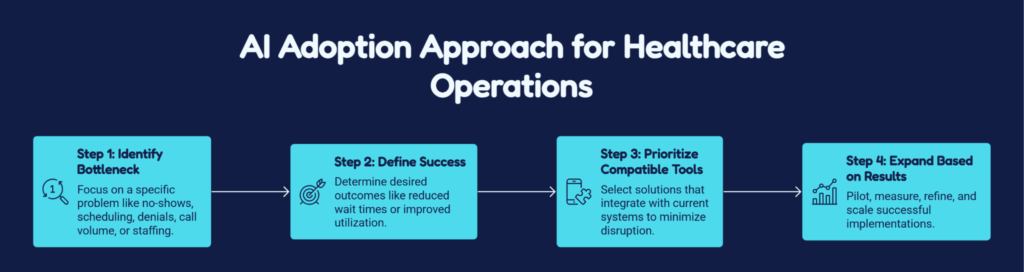
Start with one operational bottleneck
Trying to fix everything at once is usually where things go sideways.
A better approach is to start with one problem that’s creating measurable friction.
That might be:
- High no-show rates.
- Long scheduling delays.
- Excessive claim denials.
- Heavy call center volume.
- Staffing inefficiencies.
The more specific the problem, the easier it is to measure the impact.
Define success before choosing a solution
This sounds obvious, yet plenty of organizations evaluate tools before deciding what success looks like.
Flip that process around. Start by identifying the metric you want to improve.
For example:
- Reduce wait times by 15%.
- Lower denial rates by 10%.
- Improve appointment utilization.
- Reduce administrative workload.
- Increase patient response rates.
A clear target makes it much easier to determine if an AI solution is working.
Prioritize tools that fit your current setup
Sometimes the biggest win comes from a tool that integrates cleanly with systems your team already uses.
Less disruption usually means faster adoption. It also means fewer surprises during implementation.
That’s particularly important in healthcare, where operations rarely have the luxury of stopping while a new platform gets rolled out.
Expand based on proven results
This is where many successful organizations separate themselves from the rest.
They don’t start with a massive transformation project. Instead:
- They start with a pilot.
- Measure the results.
- Fix what’s not working.
- Then expand.
Pilot → validate → scale.
It’s not the most exciting approach. But it creates lasting operational improvements without overwhelming teams.
Pro Tip: Some of the biggest wins happen when AI is paired with better processes, cleaner handoffs, and fewer workflow bottlenecks. If you’re looking at the bigger picture, our guide to AI in healthcare workflow optimization is a good next stop.
How to Evaluate AI Solutions (Without Getting Distracted by Trends)
AI vendors are very good at making their products sound impressive.
The challenge is figuring out which solutions will create real operational value and which ones are simply adding another tool to the stack.
A few questions can make that decision much easier.
- Does it solve a real operational problem? Start with the problem, not the technology. A tool should address an existing bottleneck, such as scheduling inefficiencies, staffing challenges, claim denials, or administrative workload.
- How quickly can you see impact? Some initiatives take longer than others, but organizations usually gain momentum when they focus on use cases where results can be measured relatively quickly.
- How well does it integrate with your current systems? Even the most powerful AI solution can become a headache if it doesn’t work smoothly with your EHR, scheduling platform, billing tools, or existing workflows.
- What level of transparency and control do you have? Teams should understand how recommendations are generated, when human review is needed, and what decisions remain under their control. Healthcare operations require visibility, not black-box decision-making.

The Future of Healthcare Operations Is Already Here
The conversation around AI in healthcare has changed.
Organizations are no longer asking if AI has a place in operations. Now, they’re trying to figure out where it creates the most value.
And the strongest results usually come from the least glamorous use cases.
If you’re looking for practical ways to optimize operations, improve patient access, or implement AI without creating unnecessary complexity, our team at Medical Flow can help.
Ready to explore what’s possible? Let’s talk.
FAQs
How is artificial intelligence used in healthcare operations?
Most healthcare organizations are using AI to solve everyday operational problems. That includes scheduling, revenue cycle management, patient communication, staffing, capacity planning, documentation support, and other administrative workflows that consume time and resources.
How does AI improve efficiency in healthcare operations?
A lot of operational work is repetitive. AI helps automate routine tasks, identify patterns in large datasets, improve forecasting, and surface issues before they become bigger problems.
That means less time spent on manual work and more time focused on patients and high-value activities.
What challenges do healthcare providers face when implementing AI in operations?
The technology is usually the easy part. The bigger challenges tend to involve messy data, disconnected systems, integration projects, compliance requirements, and getting teams comfortable with new workflows.
Many organizations also struggle to move beyond pilots and scale AI successfully across operations.
How does AI integration affect patient care and outcomes in healthcare settings?
Most operational AI tools aren’t diagnosing patients or making clinical decisions.
What they are doing is helping patients get appointments faster, reducing delays, improving communication, and giving staff more time to focus on care instead of administrative work.
Sometimes better patient outcomes start with better operations.