By
By 
Artificial intelligence is everywhere in healthcare right now.
Still, adding new tools hasn’t fixed the underlying issues.
Plenty of organizations already run on EHRs, scheduling platforms, and billing systems. Yet delays keep happening. Work gets duplicated. Teams go back and forth just to move simple tasks forward.
That friction isn’t because of a lack of technology. It comes from how workflows are set up.
AI is gaining traction because of that. Not as another layer to stack on top, but as a way to improve how work moves across the organization. And using AI in healthcare workflow optimization is quickly becoming part of how teams fix those gaps.
In fact, adoption is already moving fast. A recent survey by NVIDIA showed that 70% of healthcare organizations were using AI in 2026, up from 63% in 2025.
So the conversation has shifted.
The question isn’t if AI has a place in your workflows. Instead, it’s where it makes a difference, and how to apply it without adding more complexity.
Let’s break that down.
- TL;DR
- Why Are Healthcare Organizations Prioritizing Workflow Optimization?
- How AI in Healthcare Workflow Optimization Actually Works
- Meet The Healthcare Workflows Seeing the Biggest AI Impact Today
- What AI in Healthcare Workflow Optimization Looks Like in Practice
- Not Every Process Needs AI: Where to Start First
- What to Evaluate Before Investing in AI for Healthcare Workflows
- AI Works Better When Your Healthcare Workflows Do
- FAQs
TL;DR
If you just want the short version, here’s what matters:
- Healthcare workflows are the real bottleneck, not the lack of tools.
- Administrative burden is one of the biggest drivers of inefficiency and burnout.
- AI reduces friction across scheduling, documentation, billing, and patient communication.
- 70% of healthcare organizations are already using AI, and adoption keeps growing (NVIDIA).
- 57% of physicians see automation of administrative tasks as the top AI opportunity (AMA).
- The biggest gains come from high-volume, repetitive workflows.
- Better workflows lead to faster patient access, improved outcomes, and more predictable revenue.
Why Are Healthcare Organizations Prioritizing Workflow Optimization?
Most healthcare organizations are dealing with workflows that don’t hold up under pressure, not with a technology gap as many may think.
As demand grows, small inefficiencies stop being small. They compound across departments, slow everything down, and create constant friction for both staff and patients.
There are a few clear reasons why workflow optimization is now a top priority:
- Administrative work keeps expanding. Documentation, prior authorizations, billing, compliance checks, and patient communication add up fast. And much of it still relies on manual input or fragmented systems.
- Teams are stretched thin. Staffing shortages haven’t gone away. At the same time, patient demand keeps increasing. That leaves existing teams handling more work with the same (or fewer) resources, which directly impacts performance and morale.
- Patient expectations are higher than ever. Fast scheduling, clear communication, minimal waiting. That’s the baseline now. When workflows can’t support that experience, drop-offs, no-shows, and dissatisfaction follow quickly.
- Inefficiencies hit revenue and care quality at the same time. Workflow issues don’t stay isolated. They spread across the organization:
- Lost revenue from denied or delayed claims.
- Lower patient throughput.
- Higher operational costs.
- Increased pressure on clinical and administrative teams.
That’s why workflow optimization is becoming a core operational priority. And AI is moving into that space because it can address these issues at scale.
Key Stat: 57% of physicians say cutting administrative workload through automation is the biggest AI opportunity, according to the American Medical Association (AMA). That’s a clear signal of where AI is expected to make an impact first.
How AI in Healthcare Workflow Optimization Actually Works
AI in healthcare workflows changes how teams handle everyday tasks.
Traditional automation follows fixed rules. If something happens, the system reacts in a predefined way. Useful, but rigid. Once things get messy or unpredictable, those rules start to fall short.
AI handles that variability better. Here’s how that shows up inside operations:
- Data gets connected across systems: Scheduling, EHRs, billing, patient communication. AI pulls signals from all of them instead of treating each step as isolated.
- Risks are identified earlier: Missed appointments, claim denials, delays in care. Teams gain visibility ahead of time and can step in sooner.
- Decision-making becomes faster and more informed: Instead of digging through multiple systems, clinicians and admin staff get relevant insights surfaced at the right moment.
- Workflows adjust as conditions change: Schedules shift, priorities evolve, new data comes in. AI helps keep everything aligned without constant manual intervention.
This is why AI fits into existing healthcare systems. It works alongside your current stack and helps everything run more smoothly together.
Adoption reflects that shift. As NVIDIA’s survey also showed:
- 69% of healthcare organizations are using generative AI or LLMs.
- 65% are applying AI to analytics and data science.
- And 42% are using it for clinical decision support.
That spread across use cases shows something important: AI is already embedded across multiple layers of healthcare operations, without being limited to a single function.
Key Insight: Per a McKinsey industry report, half of healthcare leaders report active implementation of generative AI, and over 80% have rolled out initial use cases to end users. The focus now is on expanding those use cases without creating more operational friction.
Meet The Healthcare Workflows Seeing the Biggest AI Impact Today
Not every workflow improves at the same pace. Some areas show quick gains, while others take longer to justify the effort.
Here’s where that impact is already visible:
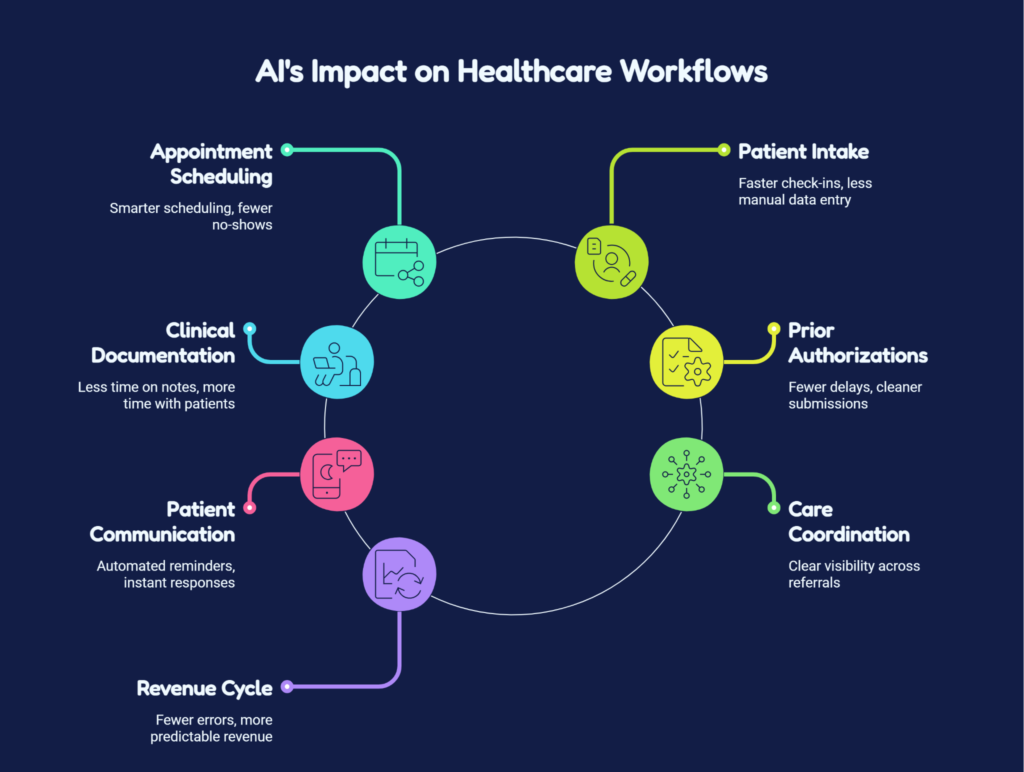
Appointment Scheduling and Patient Access
Scheduling gets complex fast. Cancellations, no-shows, last-minute changes. Staff spend a lot of time trying to keep calendars full and balanced.
AI helps bring structure to that chaos:
- Patient-provider matching improves based on availability, urgency, and care needs.
- No-show risk gets flagged in advance, allowing teams to intervene early.
- Waitlists update dynamically to fill last-minute gaps.
- Capacity planning becomes more accurate without constant manual adjustments.
This translates into fewer empty slots, faster access, and less back-and-forth for your team.
Patient Intake and Registration
The intake process sets the tone for the entire visit. If it’s slow or confusing, everything that follows gets delayed.
AI helps clean that up early in the process.
- Patient data is collected digitally before the visit.
- Information from forms is automatically extracted and structured.
- Insurance and eligibility checks run in the background.
That means shorter check-ins and fewer bottlenecks before care even starts.
Clinical Documentation and AI Medical Scribing
Documentation keeps pulling clinicians away from patient care.
Notes, charts, updates. It adds hours to the workday, and a lot of it happens after the last patient leaves.
Healthcare teams can also summarize long documents to review patient reports, administrative records, and policy updates more efficiently.
AI scribes reduce that load. They capture conversations during the visit and turn them into structured clinical notes without manual input.
Their impact is clear, as reported by Sully:
- 2–3 hours of physician time recovered daily from documentation.
- 38% to 75% reduction in documentation time per encounter.
- 387% to 600% ROI in the first year when replacing human scribes.
- More than $44,000 saved annually per scribe replaced.
Clinical studies back that up.
A study published in JAMA found that AI scribes reduced EHR time by 13.4 minutes and documentation time by 16 minutes per 8-hour schedule, while also allowing 0.49 additional visits per week.
Also, adoption data points in the same direction:
- A survey of 43 health systems reported 100% adoption of clinical documentation AI, with 53% reporting strong results.
- As noted by United States of Care & Athenahealth, 68% of physicians report increased use of AI for documentation tools.
This remains one of the most immediate opportunities to reduce administrative workload without disrupting clinical care.

Prior Authorizations and Insurance Workflows
Prior authorizations are one of those processes everyone complains about, and for good reason. They slow down care, create extra work for staff, and introduce delays that patients feel immediately.
A typical request involves gathering documentation, checking requirements, submitting forms, and then following up multiple times. If something is missing, the whole process resets.
Well, AI helps reduce that friction.
Instead of relying on manual input, systems can pull required data directly from patient records and structure it for submission. Errors drop because fields are validated before anything goes out.
The difference shows up quickly. Fewer delays and resubmissions, and less time spent chasing approvals.
Patient Communication and Follow-Ups
A lot of operational gaps happen around every visit. Patients forget appointments, questions go unanswered, and follow-ups fall through.
That’s where consistency matters. Instead of relying on staff to manage every interaction, communication becomes continuous:
- Reminders go out across SMS, email, or apps.
- Common questions get handled instantly through chat interfaces.
- Follow-ups are scheduled and sent without manual intervention.
This keeps patients engaged without increasing workload for your team. And when communication improves, so does adherence.
Care Coordination and Referral Management
Referrals sound simple on paper. In reality, they’re easy to lose track of.
A patient gets referred out. Then what? Did they schedule the visit? Did the specialist send results back? Is anyone following up?
Without visibility, gaps start to appear.
AI helps bring structure to that process. Instead of relying on manual updates, systems track referral progress automatically and flag when something stalls.
Revenue Cycle and Claims Processing
Revenue cycle issues don’t come from one big failure.
They come from small mistakes repeated at scale. A missing code here, incomplete data there, and a delayed submission that turns into a denial. Over time, that adds up.
AI helps tighten those weak points before they create bigger problems:
- Claims are checked before submission to catch missing or incorrect data.
- Coding suggestions improve accuracy earlier in the process.
- Denial patterns become visible, making prevention easier.
- Submission timelines become more consistent.
Instead of reacting after revenue is lost, teams can step in earlier and reduce rework.
Augmented intelligence: Pros and cons of AI in health care and clinical workflow optimization
What AI in Healthcare Workflow Optimization Looks Like in Practice
All of this sounds good in theory.
What matters is how it changes day-to-day operations:
Clinicians Spend Less Time on Administrative Work
Administrative work doesn’t disappear, but it takes up less space in the day:
- Clinicians spend less time switching between systems.
- Documentation gets done closer to real time.
- Fewer tasks spill over after hours.
That shift creates room for more focus during patient interactions.
Patients Move Through the System Faster
Most delays come from everything around clinical care: Scheduling gaps, slow intake, missed follow-ups.
When those points improve, the entire experience speeds up. Patients get seen sooner, wait times drop, and transitions between steps feel smoother.
That’s something patients notice right away.
Teams Can Handle Higher Volumes Without Adding Headcount
Growth usually means hiring. But when workflows improve, capacity increases without expanding the team at the same pace.
Less time spent on repetitive tasks frees up time for higher-value work.
That changes how teams operate under pressure. Instead of constantly catching up, they stay in control of the workload.
Revenue Becomes More Predictable
Revenue instability usually traces back to workflow issues. That includes delays in documentation, errors in coding, and missing details in claims.
Once those points are tightened, variability starts to drop.
Fewer surprises and delays, and more consistency in how revenue flows.
Burnout Starts to Decrease
When administrative pressure drops, the day-to-day experience changes.
Here’s proof of that. A Yale University study found that AI scribes reduced burnout odds by 74%, with prevalence dropping from 51.9% to 38.8% among physicians.
Less after-hours work makes a difference. So does spending more time on patient care instead of documentation.
Over time, that impacts retention, satisfaction, and overall team stability.
Not Every Process Needs AI: Where to Start First
One of the biggest mistakes teams make is trying to apply AI everywhere at once. That usually leads to complexity, slow adoption, and unclear results.
A better approach is to start where the impact is easier to measure and easier to implement:
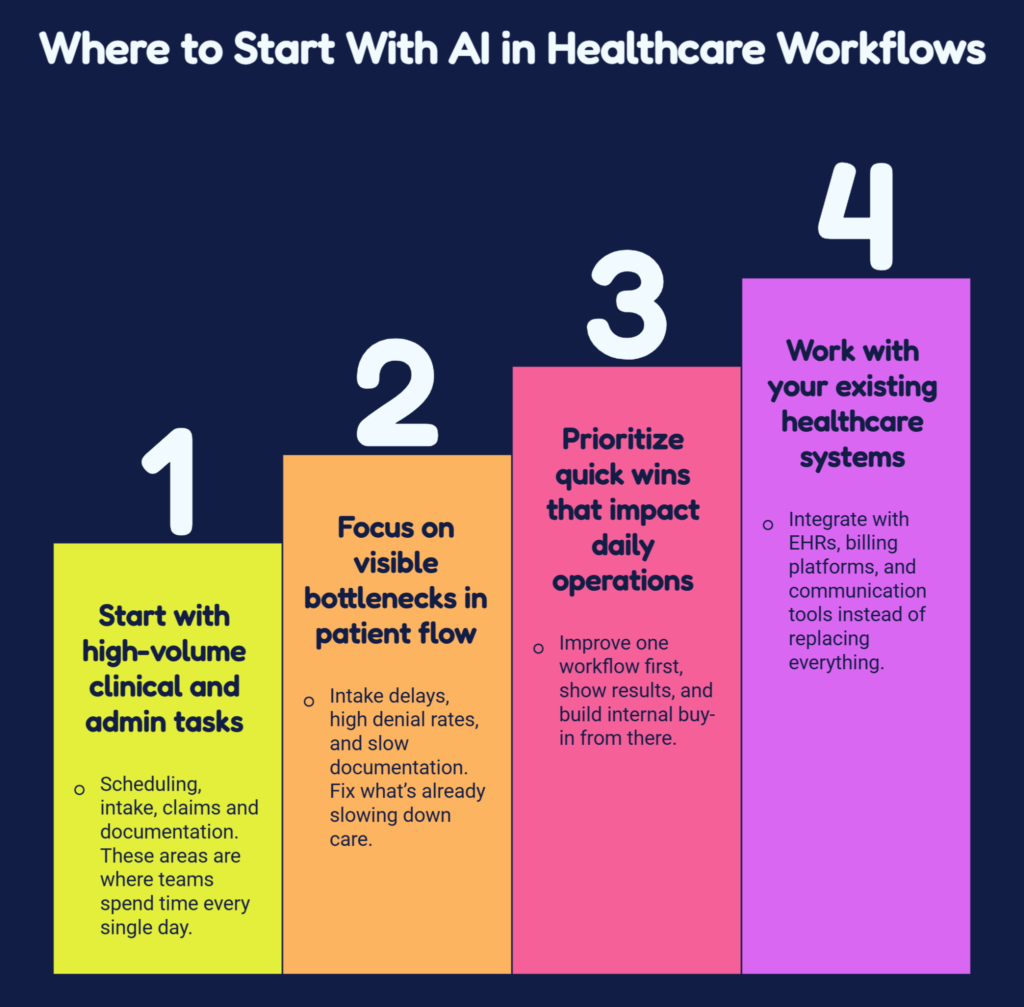
Look for High-Volume, Repetitive Tasks
Some workflows happen dozens or hundreds of times per day. Those are your starting points.
Tasks like scheduling, intake, documentation, and claims processing follow predictable patterns and involve structured data. That makes them easier to improve with AI.
If a process repeats constantly and takes up staff time, it’s worth evaluating.
Prioritize Workflows With Measurable Bottlenecks
Not every inefficiency is worth fixing first. So, focus on the ones you can clearly see:
- Delays in patient intake.
- High denial rates.
- Long documentation times.
These are areas where improvement shows up quickly in metrics you already track.
Focus on Quick Wins Before Larger Transformations
Large-scale changes take time. But starting small builds momentum.
Improving a single workflow, like documentation or scheduling, gives teams a chance to see results early. That helps with internal buy-in and reduces resistance to further changes.
Once those wins are visible, expanding becomes easier.
Build Around Existing Systems Instead of Replacing Them
Most healthcare organizations already have a complex tech stack. So, replacing everything isn’t realistic.
AI works best when it integrates with what’s already in place. EHRs, billing platforms, communication tools. The goal is to improve how they work together, not start from scratch.
That approach reduces disruption and speeds up implementation.
What to Evaluate Before Investing in AI for Healthcare Workflows
Not every AI solution improves your workflows.
Some add unnecessary layers. Others fail because the foundation isn’t ready.
Before moving forward, it’s worth taking a closer look at a few key areas:
- Technical compatibility with existing systems. If the solution doesn’t integrate with your EHR, billing tools, or scheduling platform, it creates extra steps instead of removing them.
- Data quality and accessibility. AI depends on clean, structured, and accessible data. If your data is fragmented or inconsistent, results will break down quickly.
- Security and compliance requirements. Patient data comes with strict rules. Any solution needs to align with HIPAA, privacy standards, and internal governance from the start.
- Expected operational impact. What should improve? Documentation time, patient throughput, denial rates. If success isn’t clearly defined, it’s difficult to measure progress or justify the investment.
- Vendor capabilities and long-term support. Implementation plays a big role in outcomes. As Sully also noted, organizations using unified AI platforms see 3.5x higher ROI compared to fragmented setups. That difference usually comes down to better integration and consistent support over time.
Skipping these checks is where most AI initiatives start to lose direction.
Key Insight: Gartner predicts that 60% of AI projects will be abandoned by 2026 due to a lack of AI-ready data. That means most failures don’t come from the technology itself, but from trying to build on data that isn’t ready to support it.

AI Works Better When Your Healthcare Workflows Do
As you can see, AI is already part of healthcare operations. The difference isn’t access to the technology; actually, it’s how you apply it.
So, focus on the workflows that slow your team down. Fix those first. Then build from there.
What matters is making those improvements part of your day-to-day operations.
And that’s exactly where Medical Flow can help, bringing structure to your workflows and making sure the technology works in practice.
Want to know how this could work in your organization? Let’s talk.
FAQs
What is healthcare workflow optimization, and why is it necessary?
Start with a simple question: where does work slow down in your organization? That’s usually across multiple steps that don’t connect well, not only in one place.
Healthcare workflow optimization focuses on fixing that flow. When those gaps are reduced, teams move faster, errors drop, and allows to improve patient outcomes more easily.
What is the role of AI in healthcare workflow optimization?
AI steps in where manual processes start to struggle. Instead of relying on people to track everything, it helps surface patterns, flag risks, and handle repetitive work in the background.
Many AI tools also rely on predictive analytics to anticipate issues before they escalate.
That gives teams more time to focus on decisions that require judgment, especially for healthcare professionals managing complex workflows.
How does AI help reduce errors and delays in clinical workflow processes?
Most delays come from missing or incorrect information. AI helps catch those issues earlier. It checks data before it moves forward, flags inconsistencies, and highlights where something might slow down. That reduces rework and keeps processes moving without constant manual checks.
In many cases, systems can automate repetitive validation steps and provide real-time feedback as data moves across workflows.
What are the benefits of using AI over traditional methods in healthcare workflow management?
Traditional workflows rely on fixed rules and manual input. That works up to a point. Then volume increases, variability shows up, and things start to break.
AI handles that variability better. It adapts as conditions change and processes more information at once, which helps stabilize operations without adding more workload.
This makes it easier to optimize workflows and enhance patient experiences across different stages of care.
Can AI integrate with existing EHR systems?
In most cases, yes. Modern AI solutions are built to connect with existing systems through integrations or APIs.
That means you don’t need to replace your infrastructure. Instead, you improve how everything works together and automate key processes that previously required manual coordination.
This also supports more advanced use cases, like enabling personalized treatment plans based on integrated patient data.