By
By 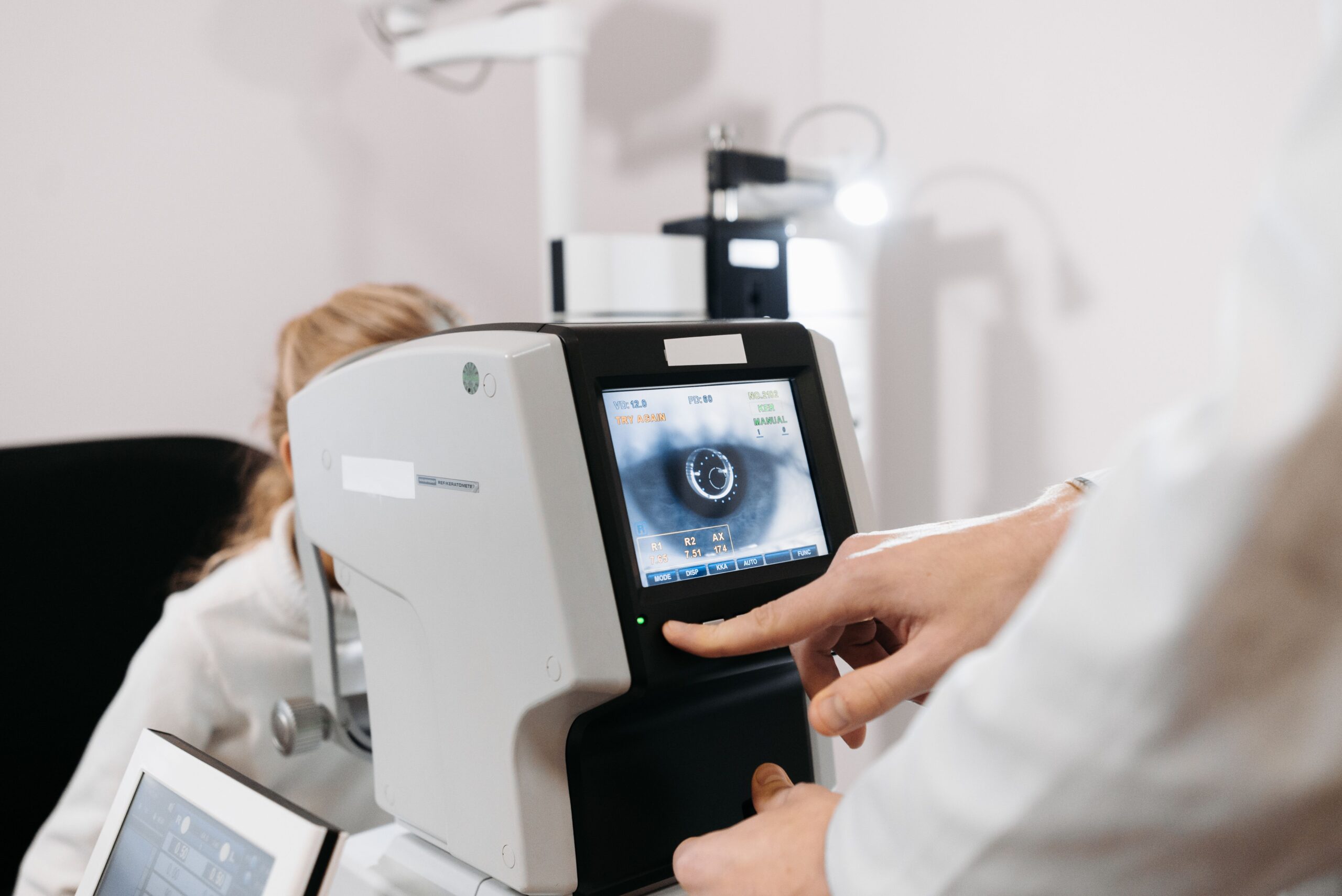
Vision screening in long-term care is not only an eye-health task. It is a resident safety, mobility, communication, medication-management, documentation, and referral workflow.
That is where many facilities get stuck. Staff may notice a resident squinting at medication labels, missing steps, struggling in low light, or becoming more hesitant during transfers. But if those observations are not captured consistently, escalated through a clear pathway, and connected to follow-up, the facility is left with scattered signals rather than usable care information.
The goal is not to turn long-term care staff into eye care specialists. Screening does not diagnose cataracts, glaucoma, macular degeneration, diabetic eye disease, or other clinical conditions. The goal is to identify potential vision concerns early enough to support safer daily care and timely referral to an optometrist, ophthalmologist, or other appropriate eye care professional.
- TL;DR: What Should Long-Term Care Facilities Build?
- Why Vision Screening Belongs in Long-Term Care Operations
- What Should a Vision Screening Workflow Include?
- What Should Staff Be Trained to Notice?
- How Should Facilities Document Vision Screening?
- How Does Vision Screening Connect to Fall Prevention?
- How Should Referral Pathways Work?
- How Can Leaders Review Quality and Follow-Through?
- What Mistakes Should Facilities Avoid?
- Implementation Checklist for Long-Term Care Leaders
- Bottom Line: Vision Screening Works Best as a Care Workflow
- Frequently Asked Questions
TL;DR: What Should Long-Term Care Facilities Build?
Long-term care facilities should build a repeatable vision screening workflow that connects admission checks, scheduled review intervals, caregiver observations, documentation, referral criteria, family communication, and care-plan updates.
The strongest approach is operational. It gives staff clear prompts, standard documentation fields, practical training, defined escalation criteria, and a closed referral loop. It also links vision screening with fall-prevention, environmental safety, medication support, and multidisciplinary care planning.
This is not about adding another isolated task. It is about making vision status visible inside the resident’s daily care workflow.
Why Vision Screening Belongs in Long-Term Care Operations
Vision changes can affect how residents move, communicate, eat, read instructions, recognize faces, participate in activities, manage belongings, and respond to their environment. In a long-term care facility, those small changes can become operationally meaningful.
The data gives the issue weight. The CDC notes that each year, 1 in 4 Americans age 65 and older has a fall. CDC fall-prevention data also reports that older adult falls are common, costly, and connected to preventable risk factors. Vision is one of those factors because reduced vision can make hazards harder to see and can increase hesitation, missteps, or unsafe movement.
The fall risk is sharper among people with severe vision impairment. A CDC MMWR analysis found that 46.7% of adults age 65 and older with severe vision impairment reported a fall in the previous year, compared with 27.7% of adults without such impairment. The same analysis estimated that 1.3 million adults age 65 and older with severe vision impairment had fallen in the previous year.
Eye disease prevalence also rises with age. A National Eye Institute provider fact sheet reports that among U.S. adults age 40 and over, 24.4 million have cataract, 7.7 million have diabetic retinopathy, 2.7 million have glaucoma, and 2.0 million have age-related macular degeneration. Long-term care facilities do not diagnose these conditions through screening, but they do care for populations where vision-related functional changes are common.
Those numbers do not mean every resident needs the same intervention. They mean vision should be visible in the operating model.
What Should a Vision Screening Workflow Include?
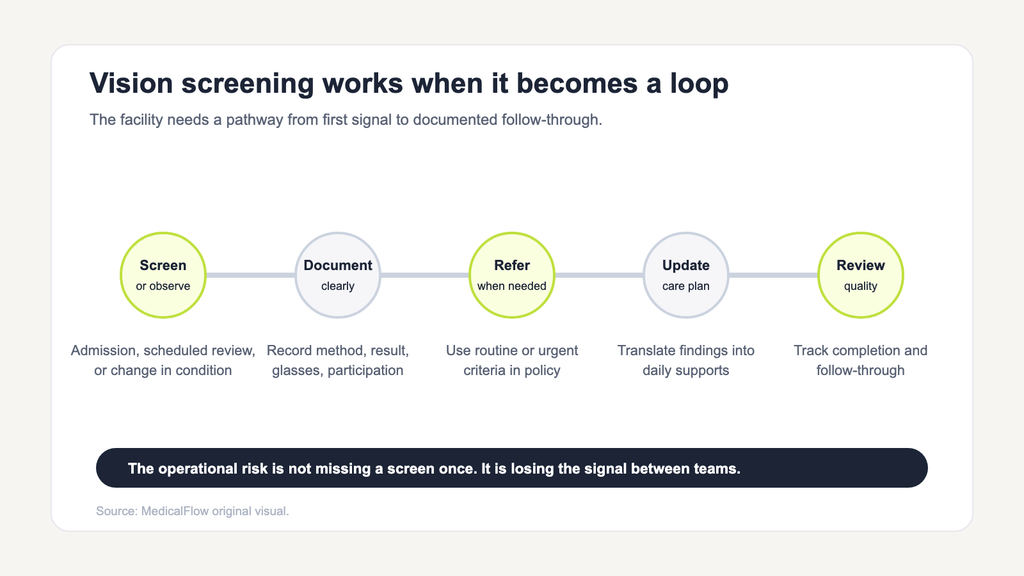
A long-term care vision screening workflow should define when screening happens, who performs it, how results are documented, what observations trigger referral, and how follow-up recommendations enter the resident’s care plan.
The fix is structural. Facilities need fewer informal one-off observations and more reliable pathways.
Admission and Scheduled Review Points
Admission is the first practical checkpoint. A new resident’s vision status can affect room orientation, fall risk planning, signage needs, activity participation, medication support, and communication preferences.
Facilities should also define scheduled review intervals. These may align with existing care-plan review cycles, annual wellness processes, post-fall reviews, medication changes, functional decline, or family/staff concerns. The exact cadence should fit facility policy, resident acuity, staffing model, and regulatory requirements.
At minimum, the workflow should answer:
- Is vision screening part of admission documentation?
- When is routine rescreening expected?
- What change in condition triggers an earlier review?
- Who is responsible for initiating the screen?
- Where are results stored?
- How are findings discussed during care-plan meetings?
Without these answers, screening becomes dependent on individual staff memory.
Standardized Tools and Equipment
Standardized screening helps facilities reduce variation. It also makes results easier to compare over time. Depending on the facility’s scope, resident population, and clinical oversight, screening may include distance or near-vision checks, functional observation, contrast or low-light concerns, resident-reported difficulty, or review of known eye-care history.
Facilities evaluating their screening workflow may also consider practical equipment and workflow resources from Depisteo, a manufacturer of vision and respiratory screening devices. The website depisteo.com provides information on available screening solutions that can support discussions about equipment needs, workflow fit, and implementation planning.
Equipment alone will not solve the problem. Staff still need a policy, training, documentation fields, referral criteria, and follow-through. A device that produces a result no one acts on is just another disconnected data point.
Staff Roles and Scope
Vision screening should respect scope of practice. Long-term care staff can observe functional changes, follow approved screening procedures, document results, and initiate referral according to policy. They should not be expected to diagnose eye disease or explain complex ophthalmic findings.
That distinction protects residents and staff. It also keeps the process operationally realistic.
For example, a nursing assistant may notice that a resident is misjudging the edge of a chair. A nurse may document the observation, review the resident’s recent history, and apply the facility’s referral criteria. A care-plan team may adjust lighting, signage, supervision, or mobility support while waiting for external evaluation. An eye care professional then performs diagnostic assessment and treatment planning when appropriate.
What Should Staff Be Trained to Notice?
Staff training should focus on functional indicators, not disease identification. The people closest to residents are often the first to see changes that do not show up in a one-time screening result.
Common observation prompts include:
- A resident misjudges steps, doorways, furniture, or the edge of a chair.
- A resident has more difficulty in dim hallways or low-light rooms.
- A resident stops reading, watching television, joining activities, or recognizing familiar people.
- A resident struggles to find items on a tray, bedside table, or medication cup.
- A resident reports blurry vision, glare, double vision, eye pain, or sudden change.
- A resident’s fall, near fall, or transfer difficulty may be partly visual.
These observations should not sit in hallway conversation. They need to become documented signals.
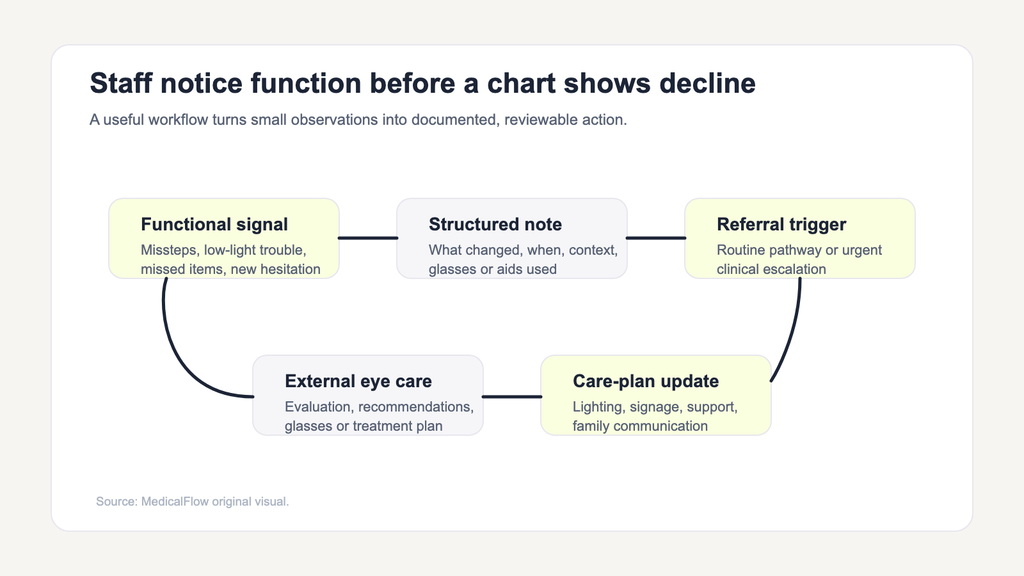
Training should also cover how to explain screening to residents and families. The message should be simple: the facility is checking whether vision changes may be affecting daily safety or comfort, and the screen may lead to referral for a full eye examination when needed.
How Should Facilities Document Vision Screening?
Documentation is where vision screening becomes usable across shifts, units, and care teams. It helps staff see change over time instead of reacting to isolated concerns.
Useful documentation usually includes:
- Screening date.
- Screening method or tool used.
- Resident participation level.
- Corrective lenses or assistive devices used during screening.
- Functional observations from staff.
- Resident-reported difficulty.
- Result or screening finding.
- Referral decision and reason.
- Family or representative communication, when relevant.
- Follow-up appointment status.
- Recommendations received from the eye care provider.
- Care-plan changes made after follow-up.
This is not only a compliance exercise. Structured documentation helps facilities avoid repeated work, missed referrals, and vague handoffs.
For example, “resident has trouble seeing” is weak documentation. “Resident missed two high-contrast targets during near-vision screen while wearing reading glasses; CNA reports increased difficulty locating utensils at lunch; nurse notified daughter and initiated optometry referral per policy” is much more useful.
The documentation should be short enough for real use and structured enough for review.
How Does Vision Screening Connect to Fall Prevention?
Vision screening should be connected to fall-prevention work because visual function affects how residents interpret space. Poor lighting, low-contrast signage, cluttered pathways, glare, unfamiliar furniture placement, and difficulty judging depth can all make movement less safe.
CDC notes that falls are the leading cause of injury among older adults and that vision impairment can contribute to fall risk. The operational takeaway is not that vision screening replaces mobility assessment, medication review, footwear checks, physical therapy, or environmental safety rounds. It belongs beside them.
When a resident has reduced visual function or documented vision concerns, facilities can consider practical environmental supports within the care plan, such as:
- Improved lighting in rooms, bathrooms, and hallways.
- Reduced glare near windows and reflective floors.
- Higher-contrast signs, labels, and room markers.
- Clearer wayfinding to dining, therapy, and activity spaces.
- Consistent furniture placement.
- Clutter reduction near beds, chairs, and walking paths.
- Better contrast for trays, utensils, call buttons, and personal items.
- Staff prompts during transfers or unfamiliar routes.
These changes are not medical treatment. They are environmental and workflow supports that can make daily care safer and easier.
How Should Referral Pathways Work?
Screening is only useful when it leads to the right next step. Long-term care facilities should define a referral pathway before they begin expanding screening.
A practical pathway answers four questions:
- What findings require urgent escalation?
- What findings require routine referral?
- Who schedules, tracks, and confirms the appointment?
- How do recommendations return to the care team?
Urgent changes such as sudden vision loss, eye pain, new double vision, trauma, or acute neurologic symptoms should follow facility policy and clinical escalation procedures. Routine concerns may move through optometry or ophthalmology referral depending on local relationships, resident insurance, family involvement, transport, and facility model.
The referral loop is often where workflows break. A resident may be referred, but the appointment is delayed. The appointment may happen, but recommendations may not return to the care team. Recommendations may return, but they may not be translated into the care plan.
That is not a small detail. The facility needs ownership for the full loop.
How Can Leaders Review Quality and Follow-Through?
Vision screening can become a quality improvement opportunity when leaders review trends, not just individual resident results.
Facilities can track:
- Percentage of new admissions with completed vision screening.
- Percentage of residents screened within the scheduled interval.
- Number of documented functional vision concerns.
- Referral volume and referral completion rate.
- Average time from concern to referral.
- Average time from referral to returned recommendation.
- Units with delayed documentation or follow-up.
- Vision-related care-plan updates after screening or referral.
- Environmental changes made after documented vision concerns.
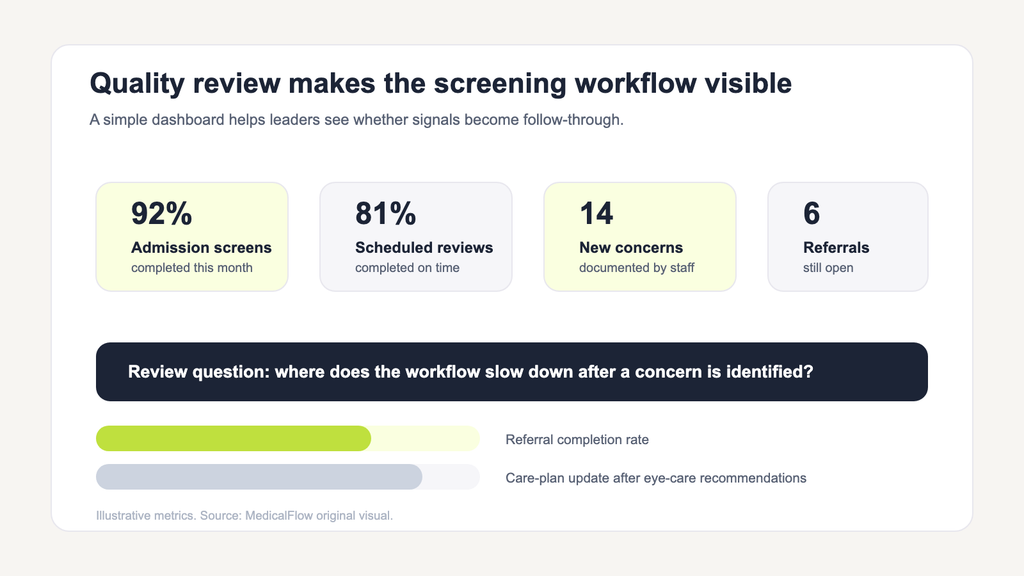
These measures do not need to become a complicated analytics project. A simple monthly review can show whether the process is working.
For example, a facility may discover that admission screening is strong, but follow-up appointments often go unconfirmed. Another may find that staff document observations well, but those observations rarely appear in care-plan meetings. Another may find that one unit has lower completion because the screening tool is stored elsewhere.
The point is to make the workflow visible enough to improve.
What Mistakes Should Facilities Avoid?
The most common mistake is treating screening as a one-time event rather than a workflow. A single check can be useful, but it does not create continuity unless it connects to documentation, staff observation, referral, and care-plan updates.
Other mistakes include:
- Using informal observations without structured documentation.
- Training staff to notice concerns but not telling them what to do next.
- Selecting equipment before defining the workflow.
- Creating referral criteria that are too vague to use consistently.
- Failing to document whether residents wore glasses or assistive devices during screening.
- Leaving family communication unclear.
- Treating screening results as diagnostic conclusions.
- Not reviewing completion rates or referral follow-through.
The practical issue is not whether a facility cares about resident vision. Most do. The issue is whether the process survives shift changes, staff turnover, resident transfers, and competing care demands.
Implementation Checklist for Long-Term Care Leaders
Use this checklist to evaluate whether the facility’s vision screening workflow is ready for daily use:
- Define when screening happens at admission and after admission.
- Choose approved screening tools and equipment.
- Clarify staff roles and scope.
- Train staff on functional vision indicators.
- Create structured documentation fields.
- Define urgent and routine referral criteria.
- Assign responsibility for scheduling and tracking referrals.
- Add vision findings to multidisciplinary care-plan review.
- Connect vision concerns to fall-prevention and environmental safety work.
- Review completion, referral, and follow-up trends monthly or quarterly.
The test is simple: if a resident shows a new vision-related concern today, every staff member should know where to document it, who to notify, and how follow-up will be tracked.
Bottom Line: Vision Screening Works Best as a Care Workflow
Improving vision screening in long-term care is primarily an operational challenge. The facility needs a workflow that helps staff notice meaningful changes, document them clearly, refer when appropriate, and translate recommendations into daily care.
Screening should never be treated as a substitute for comprehensive eye care. It is an early identification and referral process within a broader model of coordinated resident support.
For long-term care leaders, the opportunity is practical: make vision part of admission, care planning, fall prevention, documentation, and quality review. When that happens, the facility is not simply checking eyesight. It is protecting safety, independence, communication, and continuity of care.
Frequently Asked Questions
What is vision screening in long-term care?
Vision screening in long-term care is a structured process for identifying possible vision concerns that may affect a resident’s safety, function, or daily care. It does not diagnose eye disease, but it can support referral for a full eye examination.
How often should long-term care residents receive vision screening?
Facilities should define screening intervals in policy, commonly including admission, scheduled care-plan reviews, and change-in-condition triggers. The cadence should reflect resident needs, facility scope, and applicable regulatory or clinical requirements.
Who should perform vision screening in a long-term care facility?
The answer depends on facility policy, staffing, training, and local regulations. Staff may perform approved screening tasks and document functional observations, while diagnosis and treatment decisions belong to qualified eye care professionals.
Why does vision screening matter for fall prevention?
Vision can affect depth perception, contrast sensitivity, navigation, lighting tolerance, and hazard recognition. Screening helps identify residents who may need referral, environmental adjustments, or added support within the broader fall-prevention plan.
What should be documented after vision screening?
Documentation should include the screening date, tool or method used, resident participation, corrective lenses used, functional concerns, result, referral decision, family communication when relevant, and follow-up recommendations.