By
By 
At 7:00 a.m., a patient is ready for an 8:30 infusion appointment. The clinic has already sent two reminders, and the patient confirmed both. Yet no vehicle arrives. At 8:20, the patient calls the front desk, which has no access to the ride request. By the time someone reaches the transportation provider, staff discovers that the trip was entered for the wrong date. The appointment becomes a no-show even though the patient intended to attend and followed every instruction.
This is not a reminder problem. It is a handoff problem between appointment scheduling and non-emergency medical transportation, or NEMT. A clinic can have an accurate calendar while the transportation provider has an incomplete pickup address, an unconfirmed authorization, or no driver assigned. Each system may appear to work until the patient fails to reach the building.
Reducing transportation-related no-shows therefore requires more than sending another text message. Clinics need a connected process that identifies the true cause of a missed visit, captures ride requirements when the appointment is booked, confirms that the trip is operationally ready, and shares useful status updates on appointment day.
How Common Are Transportation Barriers to Care?
National data show that getting to care is an access problem, but they do not tell a clinic how many of its no-shows stem from failed rides.
In an AHRQ analysis of the 2021 Medical Expenditure Panel Survey, 6.2% of U.S. adults reported that unreliable transportation had kept them from medical appointments, work, meetings, or daily necessities in the prior year.
A CDC analysis of the 2022 National Health Interview Survey found that 4.6% of adults delayed or did not get medical care because they could not get to a provider when it was open.
In a study of patients after hospital discharge, those reporting transportation concerns had lower odds of completing physician follow-up (adjusted odds ratio 0.31). These findings justify asking about transportation early.
To learn where appointments are being lost, a clinic still needs to distinguish a patient absence from a failure in the ride workflow.
Separate a Patient No-Show From a Transportation Failure
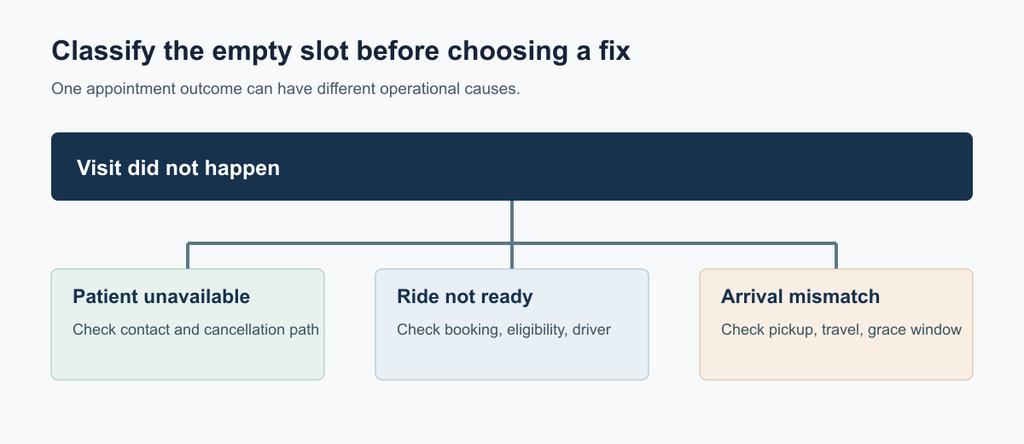
Many practices record every empty appointment slot under one label: no-show. That label is easy to report, but it hides the reason the visit did not happen. A patient who forgot the appointment, a driver who arrived at the wrong address, and a ride that remained stuck in authorization review create the same empty chair for three very different reasons. If the clinic treats them as one problem, its response will be unfocused.
Consider a physical therapy clinic that responds to rising no-shows by increasing appointment reminders. The change may help patients who forget, but it will do nothing for a wheelchair user whose ride was booked without the required vehicle type. It will not fix a return trip that was entered as a fixed pickup even though the visit duration varies. It also will not alert staff when no vehicle has accepted a trip scheduled for the next morning.
The appointment record should distinguish a patient-originated absence from a transportation failure. Useful outcomes include patient cancelled, patient unreachable, patient declined pickup, ride not requested, eligibility or authorization pending, no vehicle assigned, driver late, driver at incorrect address, patient not found at pickup, clinic unable to accept late arrival, and transportation provider cancelled. The labels should be specific enough to support action but simple enough for front-desk and transportation staff to apply consistently.
Timing matters as well. A patient should not be marked absent at the scheduled appointment time if dispatch data shows that a driver is delayed and the clinic has agreed to accept a late arrival. In that situation, the visit is at risk, not yet lost. A defined grace window gives staff time to decide whether the appointment can still proceed, should be adjusted, or must be rescheduled.
Each outcome also needs an owner. Clinic scheduling may own appointment changes. A transportation coordinator may own unresolved ride requests. Dispatch may own driver assignment and pickup exceptions. A care coordinator or designated staff member may own patient follow-up after a failed trip. Without clear ownership, the status becomes a note that everyone can see, but nobody acts on.
Once the categories are accurate, the clinic can see patterns that a single no-show rate conceals. Repeated failures from one pickup location may indicate bad address data or difficult building access. Unassigned early-morning trips may show that requests are being submitted too late. Frequent late arrivals for one service line may mean the ride time was calculated from the appointment start rather than the requested check-in time. The point is not to assign blame. It is to locate the break in the process while there is still a way to fix it.
Connect Appointment Booking With Ride Intake
The safest time to discover that a patient needs transportation is when the appointment is created, not during a reminder call the day before. Scheduling and ride intake do not have to happen in the same software, but they need to function as one workflow. Information should move through defined fields, statuses, and ownership rules rather than handwritten notes and repeated phone calls.
A workable process begins with a simple question during booking: does the patient need help arranging transportation for this visit? If the answer is yes, staff should start the ride workflow immediately or send the case to the person responsible for it. The request must reflect the actual visit, including the required arrival or check-in time, expected duration, origin and destination, pickup instructions, mobility needs, whether an escort is traveling, and how the return ride will be handled.
Small details can decide whether the trip succeeds. A street address may be correct but still be unusable if the driver needs a building number, gate code, side entrance, or facility wing. A patient may be able to walk short distances but still need a vehicle that can carry a folding mobility device. A recurring dialysis schedule may look predictable, yet holiday hours or a temporary appointment change can make a copied trip record wrong. These details should be verified at the point where the clinic has the most reliable appointment information.
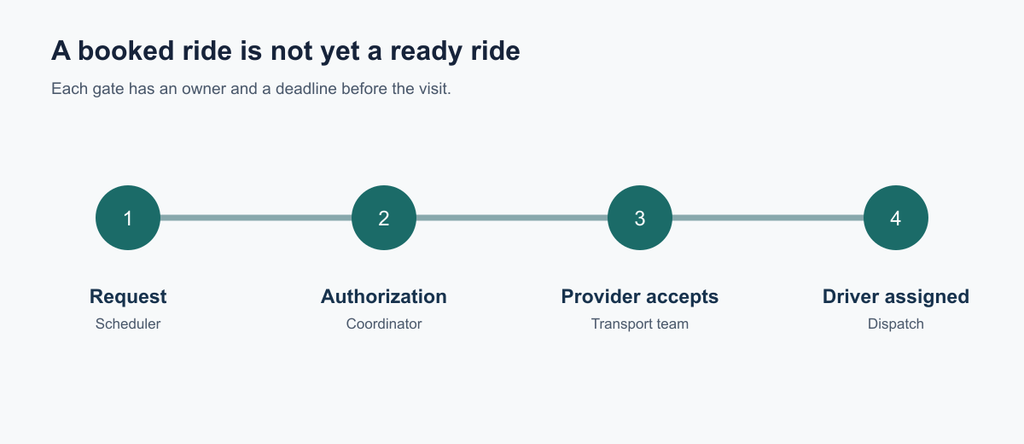
The workflow also needs visible ride statuses. A request marked simply as scheduled can create false confidence because it does not reveal whether eligibility was checked or a provider accepted the trip. Clearer stages include requested, eligibility or authorization pending, ride booked, driver assignment pending, driver assigned, and exception requiring follow-up. The clinic does not need every dispatch detail, but it does need to know whether transportation is ready, unresolved, or likely to fail.
Some organizations keep this coordination in-house. Others use a specialized operations partner when call volume, extended hours, broker portals, or dispatch work exceed the capacity of the front desk. A service such as SS Support Network – Healthcare & NEMT Outsource may support calls, scheduling, NEMT dispatch, driver coordination, and related back-office work inside client systems. The operating model matters more than the staffing label: the external team and clinic must use the same definitions, escalation times, and source of truth.
This connection should also respect patient information boundaries. Staff should share only the data required to coordinate the appointment and ride, use approved communication and record systems, restrict access by role, and preserve logs that show who changed a trip or status. If a vendor handles protected information on the clinic’s behalf, the clinic should follow its own compliance review process and use a business associate agreement where appropriate. Operational convenience should never turn a shared spreadsheet, personal text thread, or open inbox into the unofficial patient record.
A connected intake process has one final requirement: changes must travel in both directions. If the clinic moves an appointment from 10:00 a.m. to 1:00 p.m., the trip cannot remain at the original time. If transportation reports that only a later pickup is available, the scheduler needs that information before the slot is lost. A change is complete only after the appointment and ride records agree.
Confirm the Ride, Not Just the Appointment
An appointment confirmation answers one question: does the patient still plan to come? It does not answer whether a valid ride exists. Clinics that depend on transportation should confirm the patient, the trip, and the receiving schedule as separate parts of the same event.
Several days before the visit, the patient can confirm the date, pickup location, accessibility needs, and best contact number. At the same stage, staff can check whether eligibility or authorization is complete and whether the trip has been accepted. This early review creates time to correct an address, obtain missing information, or look for another approved transportation option under the organization’s procedures.
The day before the visit, the focus should shift from intent to readiness. A useful confirmation tells the patient the pickup window and what to do if the vehicle is late. It also verifies that the transportation side still shows the correct appointment destination and arrival time. For visits with strict check-in requirements, staff should calculate pickup around the required arrival, not the time the clinician is expected to enter the room.
High-risk trips may need a final review on the day of service. These include early pickups, long-distance rides, recurring trips with a recent schedule change, wheelchair-accessible requests, and appointments that are difficult to replace quickly. The purpose is not to call every person repeatedly. It is to direct human attention to trips where a small unresolved issue could waste a valuable appointment slot.
Every confirmation attempt should lead to a status. If the patient does not answer, the record should show whether a voicemail or approved message was left and when another attempt will occur. If no driver is assigned by the clinic’s cutoff time, the case should move to an exception queue rather than remaining quietly marked as booked. If the provider reports a delay, clinic staff need enough notice to decide whether the patient can still be seen.
This approach prevents a common last-minute argument. Without shared confirmation data, the patient may say the ride never arrived, the driver may say nobody answered, and the clinic may see only an empty slot. A timestamped record of patient contact, dispatch status, arrival attempts, and appointment flexibility gives the team facts it can use. It also lets staff address the immediate problem without forcing the patient to repeat the entire story to several departments.
Close the Loop on Appointment Day
Appointment day is where separate workflows either become one coordinated service or fall apart in real time. The clinic does not need to track every turn of the vehicle, but it should receive meaningful milestones: driver assigned, en route to pickup, arrived, passenger onboard, arrived at clinic, return ride requested, completed, cancelled, or transport failure. These updates allow staff to protect the schedule instead of discovering the problem after the appointment has passed.
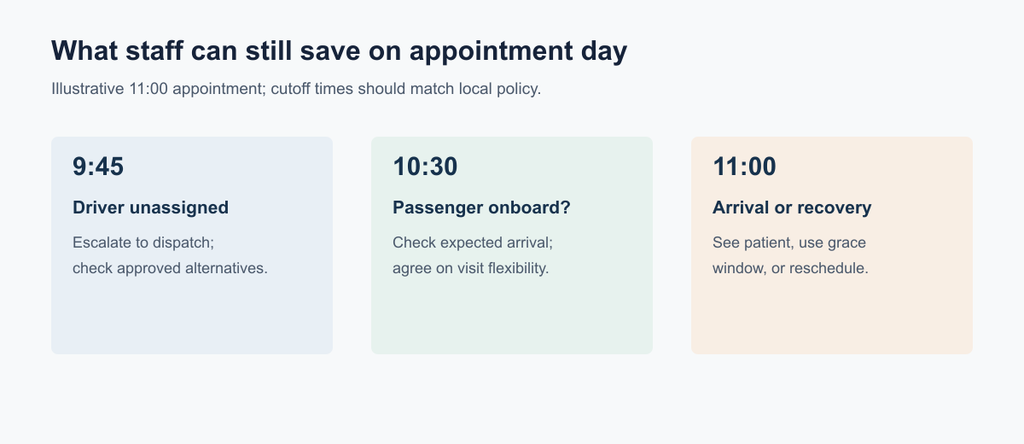
Suppose a patient is due at a specialist clinic at 11:00 a.m. At 9:45, the trip still shows driver assignment pending. That is an actionable exception. A coordinator can contact dispatch, check approved alternatives, and alert the clinic that the visit may be delayed. At 10:30, if the patient is onboard, the clinic can estimate whether the arrival remains workable. If the trip fails, the scheduler can release or repurpose the slot and begin rescheduling before the day ends.
Return transportation deserves equal attention. A patient who reaches the clinic successfully can still face a long, uncertain wait after treatment if the return leg was never booked or the appointment duration changed. The workflow should show whether the return is fixed, scheduled within a window, or requested when the patient is ready. Clinic staff should know who triggers that request and where to report a delay.
When a visit is missed, closing the loop means more than changing the calendar. Someone should contact the patient, confirm that the person is safe and no longer waiting for a vehicle, explain the rescheduling path, and record the operational cause. The appropriate clinic team can then decide how quickly the visit needs to be rebooked according to its normal clinical and scheduling procedures. Transportation and scheduling records should end with matching outcomes.
The clinic should review failures as a workflow, not as isolated complaints. A weekly review can compare the number of ride-dependent appointments with completed arrivals, preventable transport failures, late arrivals accepted by the clinic, and cases recovered before the slot was lost. The most useful measure is not simply how many no-shows occurred. It is how many at-risk trips were identified early enough for staff to intervene.
Over time, this review should change the process. If authorization delays cause repeated failures, the submission deadline may need to move earlier. If drivers often reach the wrong entrance, pickup instructions need a standard format. If appointment changes fail to reach dispatch, the organization needs a mandatory update trigger rather than another reminder to be careful. Each recurring failure should produce a specific correction, an owner, and a date for checking whether the correction worked.
Transportation-related no-shows often look like patient behavior because the clinic sees the final event: an empty chair. The real cause may have appeared hours or days earlier in an unverified request, a mismatched time, or a trip that nobody owned. Clinics reduce these losses when they connect appointment and ride intake, confirm operational readiness, share day-of-service status, and classify every failure accurately. That turns transportation from an external uncertainty into a visible part of patient flow, where teams can act before a planned visit becomes another no-show.