By
By 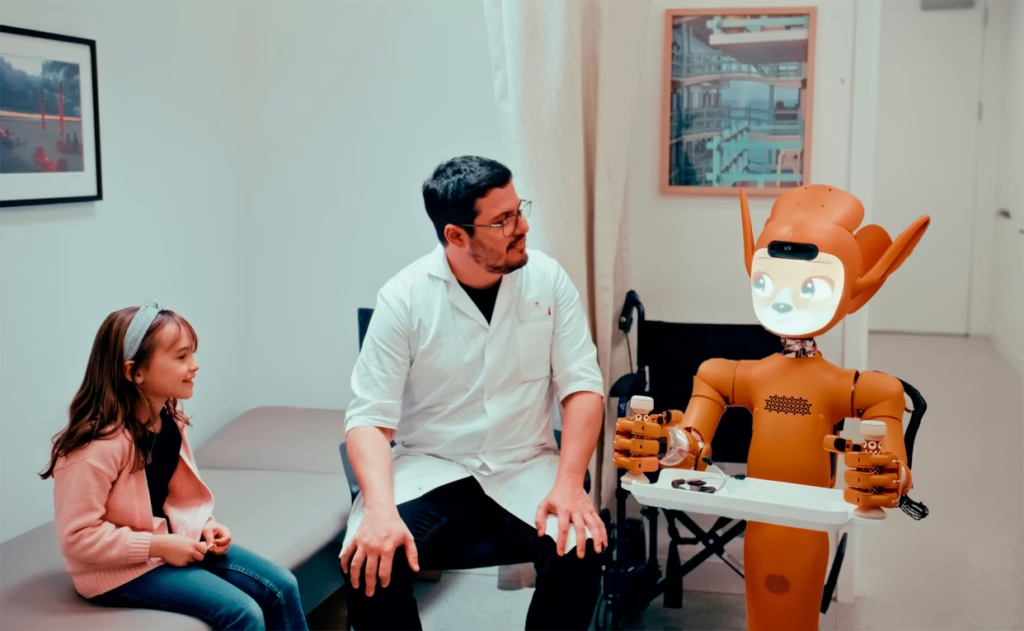
Artificial intelligence is quietly changing how we understand and treat speech disorders in everyday clinical settings. If you have ever struggled with communication challenges, you know how frustrating and isolating they can feel. Thankfully, AI is changing the healthcare landscape and making therapy more accessible and effective than ever before.
Grand View Research reports that the worldwide AI-in-healthcare market, as of 2025, is valued at over $35 billion. The North American market alone accounts for over 54% of the global market share. And, within the next seven years, the global AI-in-healthcare market is set to cross the $500 billion mark.
While AI is already revolutionizing many avenues of the healthcare sector, its impact on helping treat patients with speech disorders often goes unnoticed. From early diagnosis to daily practice, these tools are helping both patients and professionals in meaningful ways.
Here are some of the most effective ways AI is reshaping speech therapy and improving patient outcomes.
Smarter and Earlier Diagnosis
Research published in the European Journal of Cancer shows that AI can achieve over 98% accuracy in early breast cancer detection. Tweaking the models and methods, accuracy was found to stay above 90%. Apart from cancer, AI can successfully help provide diagnoses for various other health problems.
In the case of speech disorders, traditional assessments often depend on observation and manual evaluation, which can take time and vary between clinicians. AI systems can analyze speech patterns, pronunciation, and fluency with impressive precision in a shorter time frame.
It is hard to realize how much subtle data is hidden in everyday speech until AI breaks it down into patterns. These tools can identify markers linked to conditions like stuttering or apraxia with remarkable consistency. As a result, clinicians gain better insights into the root causes of speech difficulties.
Preparing the Next Generation of Speech Experts
Students now have access to advanced simulation tools and data-driven learning platforms that mimic real clinical scenarios. These technologies help them practice diagnosing and treating patients in a controlled environment before entering the field. It creates a stronger foundation and boosts confidence in their clinical skills.
Many aspiring clinicians today are choosing flexible education paths that keep up with modern technology. Programs like online Master’s in Speech Pathology or MA in Communication Sciences and Disorders are becoming increasingly popular. As Cleveland State University shows, these programs can be completed fully online with 100% of coursework done virtually.
A Master’s in Speech Pathology online allows students to learn while managing other commitments. Through an online master’s degree in speech pathology, they can learn the theoretical and practical sides of speech pathology. Afterwards, they can adopt ways to use AI tools for treating speech disorders and speech-related problems. This makes it easier for them to adapt quickly and effectively when working with real patients in the future.
Personalized Therapy That Adapts to Patients
Speech therapy is not a one-size-fits-all process, and AI understands that better than ever. Modern systems can track treatment progress and adjust exercises based on the patient’s specific needs and improvements.
Imagine practicing pronunciation and receiving instant feedback that adapts to a patient’s pace and performance. AI tools can modify difficulty levels, suggest new exercises, and highlight areas needing more attention. This keeps therapy engaging and prevents frustration that often comes from slow progress.
Virtual Assistants for Daily Practice
Consistency is key when it comes to improving speech, but regular clinic visits are not always possible. AI-powered virtual assistants allow patients to practice anytime and anywhere, making therapy more flexible and accessible.
IMARC Group reports that the global intelligent virtual assistant market, in 2025, was worth over $17.1 billion. It is estimated that this market will likely reach $124.9 billion in valuation by 2034. North America is currently dominating this virtual assistant market, holding a market share of over 30%.
What’s more, many virtual assistants can be reprogrammed to work as speech therapy assistants. In practicality, these tools can guide patients through exercises, monitor their speech, and provide feedback in real time. It feels like having a therapist in your pocket, ready whenever you need support.
For many patients, daily practice can feel overwhelming without proper guidance or encouragement. Virtual assistants help break down exercises into manageable steps and keep you on track with reminders.
Enhancing Communication Through Assistive Technology
AI is also playing a major role in assistive communication tools for individuals with severe speech challenges. These technologies can convert text into natural-sounding speech or interpret unclear speech into understandable language.
For someone who struggles to express themselves, this can be life-changing in both personal and professional settings. Communication becomes smoother, more confident, and far less stressful.
Patients can use devices and apps that help them form sentences and speak through digital voices. AI is making these tools smarter and more responsive by learning individual preferences and speech patterns.
This means the output sounds more natural and reflects the user’s unique way of communicating. Over time, this fosters independence and helps individuals participate more fully in everyday conversations.
FAQs
Can AI cure stammering?
AI cannot cure stammering, but it can support improvement. Speech disorders like stuttering often require professional therapy. AI tools can provide practice exercises and feedback, helping users build fluency gradually alongside guidance from qualified speech-language professionals.
Can I use AI for speech therapy?
Yes, AI can be used as a helpful tool for speech therapy practice. Apps and programs offer pronunciation exercises, real-time feedback, and progress tracking. However, they work best as a supplement, not a replacement, for sessions with trained therapists who provide personalized support.
How can AI assist people with speech impairments?
AI assists people with speech impairments through voice analysis, personalized exercises, and assistive communication tools. It can convert speech to text, suggest corrections, and track improvement. These technologies help users practice independently and communicate more effectively in daily life situations.
AI is not replacing human therapists, but it is enhancing the way care is delivered in speech therapy. For someone dealing with speech challenges, AI offers promising support that was not available before. It brings together technology and human care in a way that feels both practical and genuinely hopeful.
As these tools keep evolving, the future of speech therapy looks more inclusive and responsive than ever before.