By
By 
Federal nursing workforce policy took another step forward in late July.
S. 1874, the Title VIII Nursing Workforce Reauthorization Act of 2026, was reported in the Senate on July 28, 2026, after earlier committee movement placed nursing workforce programs back in the policy spotlight. That does not mean the bill has become law. It does mean the proposal has moved far enough to show where federal attention is going: nursing education capacity, faculty recruitment, advanced nursing preparation and better workforce data.
That distinction matters. Workforce policy often sounds abstract until a school turns away qualified applicants, a hospital cannot fill positions, or a rural clinic has too few trained professionals to keep access steady.
Nursing shortages do not begin only when an employer posts a job. They often begin much earlier, inside classrooms, clinical placements, faculty pipelines and state-level planning systems.
Title VIII programs have long supported nursing education and workforce development. The current Senate proposal puts fresh attention on the infrastructure behind nurse supply: who teaches future nurses, how schools expand capacity, and how states understand where nursing shortages are actually forming.
- TL;DR
- Committee Action Linked Nursing Workforce Policy to Access
- Faculty Recruitment Became the Practical Center of the Bill
- Workforce Centers Would Push the Conversation Toward Better Data
- DNP Pathways Align With the Bill’s Larger Priorities
- Healthcare Employers Could Feel the Effects Downstream
- The Bill’s Next Stage Matters
- Frequently Asked Questions
TL;DR
- S. 1874, the Title VIII Nursing Workforce Reauthorization Act of 2026, was reported in the Senate on July 28, 2026, but it had not become law at that stage.
- The bill includes a nurse faculty demonstration program and a state and regional nursing workforce center data collection pilot program, both aimed at different parts of the same capacity problem.
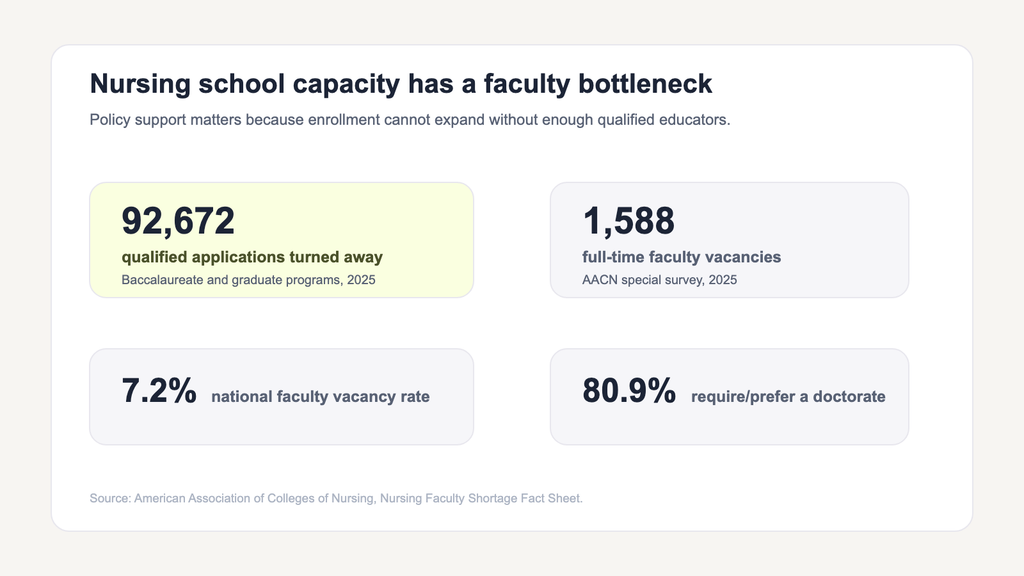
- AACN reports that U.S. nursing schools turned away 92,672 qualified applications from baccalaureate and graduate nursing programs in 2025, and identified 1,588 full-time faculty vacancies in an October 2025 survey.
Committee Action Linked Nursing Workforce Policy to Access
The legislation gained momentum earlier in July when the Senate Health, Education, Labor and Pensions Committee announced that it would vote on a package of bills focused on improving families’ access to quality, affordable healthcare.
The committee notice listed the Title VIII Nursing Workforce Reauthorization Act of 2025 among the bills scheduled for a July 22, 2026 vote.
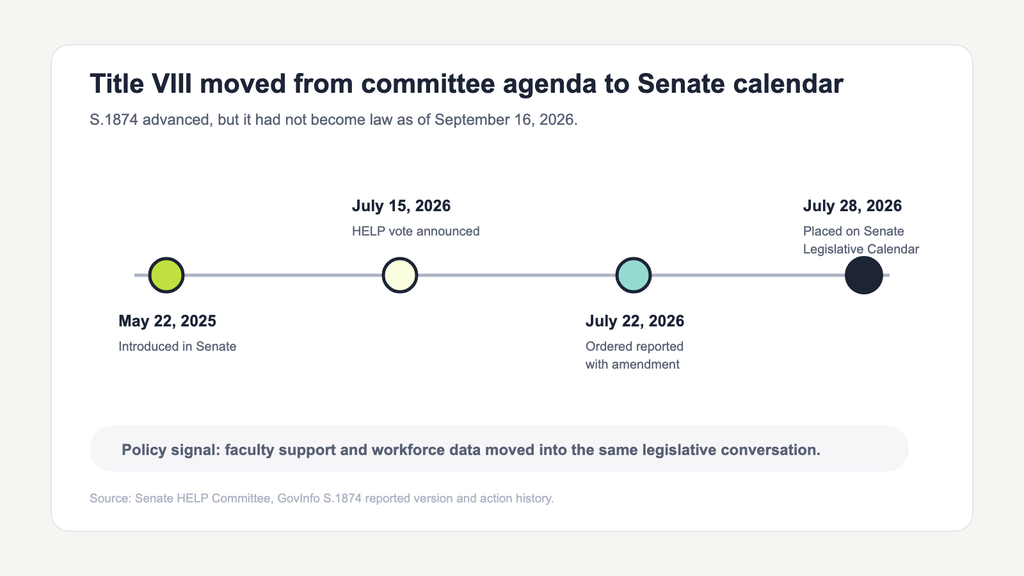
The reported version later appeared as the Title VIII Nursing Workforce Reauthorization Act of 2026. GovInfo lists the bill as S. 1874 reported in the Senate on July 28, 2026, with the short title updated to the 2026 version.
The substance is more important than the naming wrinkle. Nursing workforce policy is being treated as part of access policy, not as a separate education issue. That is the right frame.
A shortage of nurses is not just a hospital staffing problem. It can affect how quickly patients receive care, whether clinics can expand hours, whether rural facilities can keep services open, and whether health systems can safely distribute work across teams. When the training system is constrained, the delivery system feels it later.
At MedicalFlow, we would read this bill as a signal, not a solution. It does not instantly create nurses. It does not instantly solve faculty recruitment. But it does identify where the bottlenecks are: education capacity, faculty supply, clinical education, workforce data and coordination between schools, states and healthcare employers.
Faculty Recruitment Became the Practical Center of the Bill
The nurse faculty issue is not a side note. It is the operating constraint.
Nursing schools cannot expand enrollment simply because more people want to enter the profession. They need faculty, clinical sites, preceptors, classroom capacity, simulation resources, and budget. If any one of those breaks, qualified applicants can still be left outside the door.
AACN reports that U.S. nursing schools turned away 92,672 qualified applications from baccalaureate and graduate programs in 2025 because of constraints including faculty, clinical sites, classroom space, preceptors and budget. AACN’s October 2025 special survey identified 1,588 full-time faculty vacancies across 863 nursing schools, with an 80.3% response rate. The national nurse faculty vacancy rate was 7.2%.
The doctoral-preparation piece is especially relevant. AACN reports that 80.9% of full-time faculty vacancies required or preferred a doctoral degree.
That is why the Title VIII bill’s nurse faculty language matters. The reported version would amend Section 846A of the Public Health Service Act to create a nurse faculty demonstration program. The program would allow grants to accredited schools of nursing to supplement salaries for eligible faculty members, with support available for up to a 3-year grant period.
In plain English: the proposal recognizes that schools are competing for nurses who may earn more in clinical practice than in faculty roles. If faculty pay cannot compete, schools struggle to hire educators. If schools cannot hire educators, they cannot train enough students. Then hospitals and clinics feel the shortage later and wonder why recruiting is so hard.
It is a pipeline problem with a salary problem inside it.
Workforce Centers Would Push the Conversation Toward Better Data
The bill also includes a state and regional nursing workforce center data collection pilot program.
GovInfo’s reported text describes a 3-year pilot program under which the Secretary may award grants or contracts to establish new, or enhance existing, state and regional nursing workforce centers. The purpose is not just to create another administrative layer. The text points to data collection, reporting, technical assistance, workforce capacity recommendations, and public-private partnerships.
That kind of infrastructure can sound dry. It is not.
Healthcare workforce shortages vary by geography, specialty, employer type and education pipeline. A statewide shortage may look different from a rural clinic shortage, a long-term care shortage, a nursing school faculty shortage or an advanced practice shortage. Without better data, policy can drift into averages that do not help the communities under the most pressure.
The bill says recipients could collect, analyze and report data on nursing workforce training programs to the National Center for Health Workforce Analysis and to the public. It also says the pilot would look at ways to reduce shortages among different nursing specialties, rural and underserved areas, geographic distribution problems and shortages among different types of nursing employers.
That is the more serious version of workforce planning. Not “we need more nurses” as a slogan, but where, which roles, trained by whom, and connected to which employers.
DNP Pathways Align With the Bill’s Larger Priorities
The focus on advanced preparation and workforce leadership also creates a connection to doctoral nursing education.
A DNP online degree can provide nurses with a flexible route to doctoral-level study while allowing them to continue working, depending on the program’s structure and requirements. DNP education typically emphasizes advanced clinical practice, evidence-based care, quality improvement, leadership, and applying research to real-world healthcare settings.
Those skills can have uses beyond direct patient care.
Doctorally prepared nurses might move into leadership positions, oversee quality improvement initiatives, contribute to clinical education, or take part in healthcare and nursing program administration. For nurses interested in education, the right doctoral pathway depends on their intended role. A DNP and PhD have different primary purposes, with the DNP gener
Healthcare Employers Could Feel the Effects Downstream
Hospitals and clinics should not expect immediate relief from a reported Senate bill.
Even if legislation becomes law, workforce effects take time. Programs must be funded. Agencies must implement them. Schools must participate. Faculty candidates must apply. Students must enroll, progress, complete clinical requirements, and enter the workforce. Employers still have to retain them.
That lag matters. Healthcare organizations often talk about workforce shortages when they become urgent vacancies. By then, many causes are already upstream.
If nursing schools lack faculty today, employers may feel the shortage years later. If clinical placements are limited today, student throughput slows. If state-level data is weak today, workforce interventions can miss the local problem. If doctoral-prepared nurses are not supported into faculty or leadership roles, schools and systems lose future capacity.
The potential benefit of Title VIII reauthorization is not instant staffing. It is infrastructure.
Better faculty recruitment could eventually allow programs to educate more students. Better workforce centers could help states and employers understand gaps earlier. Better support for advanced nursing education could help prepare leaders who can work across quality, education, clinical practice and administration.
For healthcare employers, this is where the bill becomes relevant even if they never apply for a grant. The nurse pipeline is not somebody else’s issue. It is part of every serious workforce strategy.
The Bill’s Next Stage Matters
S. 1874 has not resolved the nursing workforce challenge.
That is worth saying clearly. A reported bill does not guarantee funding, implementation, or measurable workforce improvement. It also does not remove the practical constraints nursing schools face right now: faculty salaries, clinical placement availability, preceptor capacity, doctoral preparation requirements and budget pressure.
But the bill does bring several important pieces into one policy conversation.
It recognizes that faculty recruitment is central to nursing education capacity. It treats workforce data as a public planning need. It connects education programs to employer and community access problems. And it reauthorizes Title VIII programs in a way that keeps nursing workforce development on the federal agenda.
That is meaningful because the healthcare workforce is not rebuilt at the point of crisis. It is rebuilt through the slower mechanics of education, faculty support, state planning and retention.
For nursing schools, the next stage is about whether proposed support becomes usable. For nurse leaders, it is about how doctoral preparation and faculty pathways fit their career and system goals. For healthcare employers, it is about reading workforce policy early enough to plan around it.
The bill may change as it moves forward. Its impact will depend on what survives, what gets funded, and how well programs are implemented.
Still, the message is already clear: nurse faculty support is no longer a niche academic issue. It is part of the national healthcare access conversation.
Frequently Asked Questions
What is the Title VIII Nursing Workforce Reauthorization Act of 2026?
S. 1874 is a Senate bill that would reauthorize and update federal nursing workforce development programs under Title VIII of the Public Health Service Act. GovInfo lists S. 1874 as reported in the Senate on July 28, 2026.
Has S. 1874 become law?
No. A reported Senate bill is not the same as enacted law. The reported version indicates movement in the Senate, but the bill would still need further congressional action before becoming law.
Why is nurse faculty support so important?
Nursing schools cannot expand enrollment without enough qualified faculty. AACN reports that nursing schools turned away 92,672 qualified applications in 2025, and that 80.9% of full-time faculty vacancies required or preferred a doctoral degree.
How does a DNP relate to nurse faculty and workforce policy?
A DNP can prepare nurses for practice leadership, evidence-based change, quality improvement, policy work, and some education or administrative roles. It is not the same as a PhD, but it can be relevant to the leadership and capacity needs highlighted in nursing workforce policy.
What should healthcare employers watch next?
Employers should watch whether faculty support, workforce center pilots, and Title VIII reauthorization provisions are funded and implemented. The effects will not be immediate, but education capacity and state-level workforce planning can shape future hiring conditions.