By
By 
Somebody sits down, tells you the hardest part of their life, and waits for an answer they can trust. That is a heavy responsibility for a new counselor.
Before anyone handles it safely and professionally, their decisions need to be tested with real clients under proper supervision well before graduation day.
America needs more mental health counselors, but putting more people in counseling rooms only helps when they are prepared. The work can involve a client in crisis and an ethical decision with no easy answer, sometimes in the same afternoon.
Good intentions will only carry a counselor so far. Anyone entering the profession needs academic training supported by supervised contact with clients before taking responsibility for somebody else’s care.
- Mental Health Counseling Requires More Than Academic Knowledge
- The United States Needs More Counselors, But Not at the Expense of Readiness
- A Counseling Degree Has to Reach Beyond the Screen
- Supervised Practice Builds Clinical Judgment
- Supervision Helps Prevent Weak Habits
- Cultural Competence Is Part of Safe Care
- Ethical Preparation Matters in Everyday Decisions
- Graduation Is One Stage of the Licensure Path
- The Workload Should Be Clear Before Enrollment
- Becoming Ready for the First Caseload
- Conclusion
- Frequently Asked Questions
- Sources
Mental Health Counseling Requires More Than Academic Knowledge
Mental health counselors support people experiencing depression, anxiety, trauma, grief, relationship challenges, substance-use concerns, and other difficult circumstances. They may work in community mental health centers, hospitals, schools, private practices, substance-use treatment programs, or integrated healthcare settings.
Every setting presents different pressures. A counselor may need to establish trust with a new client, assess risk, create a treatment plan, maintain accurate records, protect confidentiality, and coordinate care with other professionals.
That work requires more than knowing the names of counseling theories. Counselors must learn how to apply those theories when a client’s situation is unclear, changes during a session, or involves risks that were not immediately visible.
This is why preparation needs to combine:
- Graduate-level academic coursework.
- Skills-based counseling training.
- Supervised practicum experience.
- Supervised internships with real clients.
- Training in ethics, crisis response, assessment, and cultural competence.
- Preparation for the licensing requirements in the state where the graduate plans to practice.
A future counselor should leave a program with more than a degree. They should have a foundation for making careful decisions, recognizing their limits, and seeking supervision when a situation requires additional support.
The United States Needs More Counselors, But Not at the Expense of Readiness
The need for behavioral health professionals is increasing across the United States. The National Center for Health Workforce Analysis projects that the country could be short of 99,780 full-time-equivalent mental health counselors by 2038.
That projection is based on current behavioral health service use. It does not include every person who needs care but cannot access it, which means the actual gap may be larger.
The Bureau of Labor Statistics also projects strong demand for the profession. Employment of substance abuse, behavioral disorder, and mental health counselors is projected to grow by 18% from 2025 to 2035. The agency projects approximately 50,500 openings per year on average during that period.
These numbers demonstrate why the profession needs more qualified people. They do not mean that speed should replace quality.
If new counselors enter the workforce without sufficient preparation, they may struggle to identify risk, manage boundaries, document decisions, or coordinate referrals. That can affect clients, supervisors, employers, and the wider healthcare system.
The real challenge is to expand the counseling workforce while preserving the standards that protect clients. More counselors are needed, but they must be prepared to provide responsible care.
A Counseling Degree Has to Reach Beyond the Screen
Proper preparation starts with a program that joins advanced study to supervised practice. For working adults, an online masters degree in mental health counseling can provide a flexible route into the profession while still requiring meaningful clinical preparation.
For example, St. Bonaventure University’s program consists of 60 credits and 20 courses, with academic coursework delivered online in seven-week sessions. The program is CACREP accredited and designed to prepare graduates for the Licensed Professional Counselor exam.
That combination connects academic learning to professional requirements. Students study the knowledge needed for counseling work while preparing to apply it in real clinical settings.
A counseling program should help students develop skills in communication, listening, empathy, boundary setting, assessment, diagnosis, treatment planning, crisis intervention, ethics, and cultural competence. These skills shape how a counselor understands a client, responds to risk, documents care, and works with other professionals.
Online delivery can remove the commute. It cannot remove the responsibility of becoming clinically prepared.
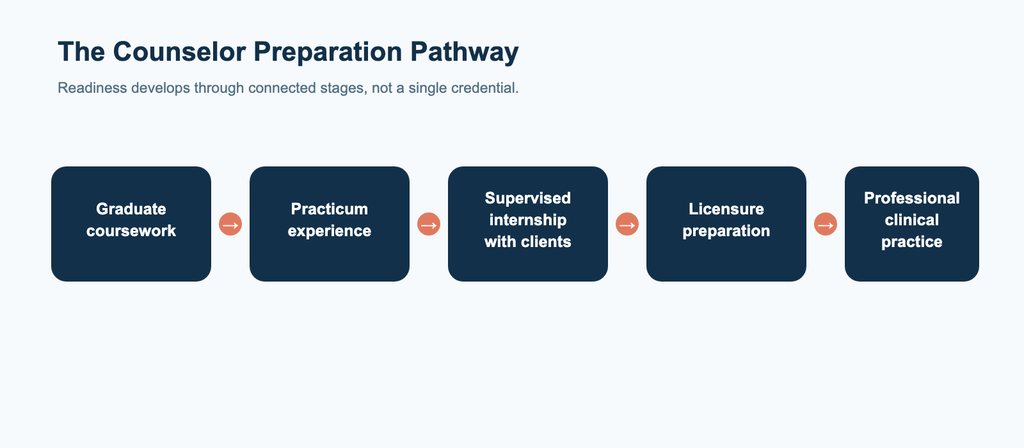
The stages of preparation for professional counseling practice.
Online Study Still Comes With a Clinical Commitment
Students complete a 100-hour practicum before moving into two internships of 300 hours each. The program also provides support during the practicum and internship placement approval process.
This clinical commitment gives students the opportunity to apply what they learn with real clients under supervision. It also requires careful planning. A student must be able to complete the required hours in an approved setting and meet the expectations of the placement and supervising counselor.
Academic coursework also requires consistent time and attention. During academic sessions, each class requires roughly 15 to 20 hours a week. An internship can require another 25 to 30 hours.
Those expectations give students a much clearer picture than the word “online” alone. Online delivery saves the commute, but preparation still demands a block of time and sustained attention every week.
Students need to plan for coursework, clinical responsibilities, supervision, documentation, and the emotional concentration required for counseling work. Understanding the workload before enrollment helps students make a realistic decision about whether the program fits their professional and personal responsibilities.
Supervised Practice Builds Clinical Judgment
Coursework can explain a counseling model. Supervised practice teaches a student what happens when a client does not respond according to the model.
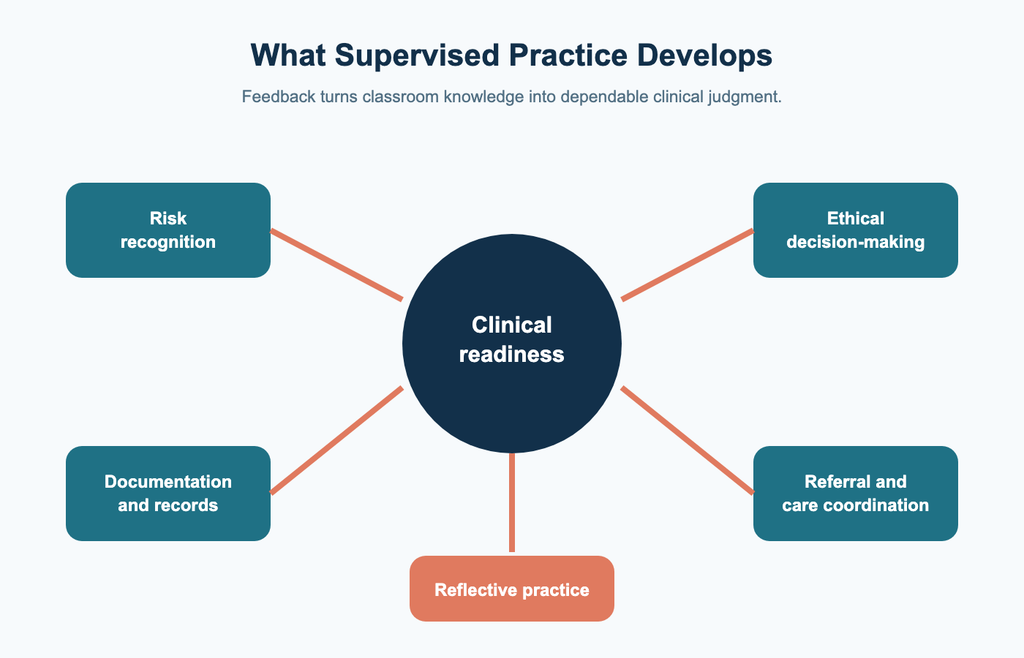
Supervised practice helps future counselors develop judgment, ethical awareness, and practical clinical skills.
A practicum is often the first opportunity for a student to begin applying academic knowledge with real clients under supervision. The student may observe experienced professionals, participate in client care, practice counseling skills, and receive feedback on their decisions.
Internship experience usually provides a longer and more developed clinical placement. Students may work in an agency, clinic, school, hospital, or community organization and gradually take on more responsibility within the limits of their training.
The Council for Accreditation of Counseling and Related Educational Programs requires professional practice experiences that apply theory and develop counseling skills under supervision. Under the 2024 CACREP guidance, students complete a supervised counseling internship of at least 600 hours after practicum, including at least 240 hours of direct service.
These hours are not simply a box to check before graduation. They provide repeated opportunities to develop judgment.
A client may reveal important information near the end of a session. A person who initially reports stress may later disclose suicidal thoughts, abuse, trauma, or substance-use concerns. A family member may provide information that changes the context of the case.
The student then has to consider:
- What information requires immediate attention?
- Does the client’s situation require a risk assessment?
- Should the student consult a supervisor?
- Is a referral necessary?
- How should the decision be documented?
- Is the student working within the limits of their training?
Supervision gives students a structured way to work through those decisions before they practice independently.
Supervision Helps Prevent Weak Habits
Early clinical habits can influence a counselor’s work for years. Without consistent feedback, a student may not recognize that they are asking leading questions, overlooking important details, documenting too little, or moving too quickly toward an intervention.
A supervisor can help the student examine both what happened in the session and why it happened.
Supervision may focus on:
- The student’s communication style.
- The client’s response to an intervention.
- Risk and safety concerns.
- Cultural or contextual factors.
- Ethical and confidentiality issues.
- Documentation quality.
- Referral and coordination decisions.
- The student’s emotional response to the client.
- The boundaries of the counselor’s role.
This process is valuable because counseling involves the professional judgment of the counselor as well as the needs of the client. A student must learn to notice personal reactions without allowing those reactions to direct care improperly.
Supervision also teaches counselors that asking for help is part of competent practice. A prepared counselor is not someone who believes they can handle every situation alone. A prepared counselor understands when consultation is necessary and knows how to use it responsibly.
Cultural Competence Is Part of Safe Care
A counselor cannot understand a client’s experience without taking the client’s background seriously.
Culture may influence how people describe distress, whether they seek professional help, how they understand treatment, and which forms of support they trust. Language, family relationships, religion, identity, income, disability, immigration experience, and previous interactions with healthcare may all affect the counseling process.
Cultural competence does not mean making assumptions about people based on their background. It means developing the discipline to ask respectful questions, listen carefully, and check interpretations before acting on them.
For a future counselor, this may involve learning how to:
- Recognize personal assumptions.
- Ask about the client’s cultural and social context.
- Adapt communication appropriately.
- Identify language and interpretation needs.
- Understand barriers related to cost, transportation, technology, or trust.
- Include relevant family or community factors.
- Avoid treating cultural difference as a clinical problem.
- Seek consultation when additional knowledge is needed.
A treatment plan may be clinically reasonable but still fail if it does not fit the client’s life. A client may be unable to attend frequent in-person appointments, may rely on family support, or may have concerns about privacy in a small community.
Good counseling requires curiosity backed by professional discipline. Students need to learn how to remain open to information that challenges their first interpretation of a client’s situation.
Ethical Preparation Matters in Everyday Decisions
Ethics is not limited to the most dramatic cases. Counselors encounter ethical questions in ordinary clinical work.
They may need to consider how to protect confidentiality when communicating with a family member, how to respond to a request outside their role, how to manage dual relationships, or how to document a difficult decision.
They may also need to understand when a client’s safety requires action within applicable legal and professional requirements.
Academic training introduces the relevant principles. Supervised practice helps students understand how those principles apply in real settings.
A student may know that confidentiality is important but still need guidance on how to explain its limits clearly. They may understand the concept of professional boundaries but need practice managing a client’s request to communicate outside approved channels.
These situations are part of becoming a responsible counselor. They should be discussed before the student is expected to manage them independently.
Graduation Is One Stage of the Licensure Path
A master’s degree is an important step toward professional counseling, but graduation does not automatically authorize independent practice.
Licensure requirements are established by individual states. Depending on the jurisdiction, graduates may need to complete a specific educational program, pass an examination, document supervised experience, complete background checks, or meet additional requirements.
Students should check the current rules in the state where they plan to practice before enrolling. They should also confirm that the program’s curriculum and clinical structure support that pathway.
Important questions include:
- Does the program meet the educational requirements in my state?
- Is the program currently accredited or approved?
- Which examination is relevant to my intended license?
- Can practicum and internship hours be completed in my state?
- How are clinical placements approved?
- What supervision is required during and after graduation?
- Are additional courses or postgraduate hours required?
- What happens if I move to another state?
Licensure rules can change. Students should verify information with the relevant state licensing board and the university rather than relying on an old article or general summary.
The Workload Should Be Clear Before Enrollment
Students considering an online program should understand the full-time commitment before they begin.
Academic coursework may involve weekly reading, written assignments, discussions, examinations, skills practice, and group work. Clinical placements may involve scheduled hours at an approved site, supervision, documentation, preparation, and travel.
The original program description refers to 60 credits, 20 courses, seven-week academic sessions, a 100-hour practicum, and two 300-hour internships. These details should be confirmed against the current program information before publication.
A transparent program should explain:
- The expected weekly academic workload.
- The schedule for practicum and internships.
- Whether students must attend live online sessions.
- How clinical placements are arranged.
- Whether students can complete placements near their home.
- What support is available during placement approval.
- How supervision is delivered.
- What happens if a placement changes or becomes unavailable.
Understanding these expectations helps applicants decide whether they can manage the program successfully. It also reflects the seriousness of the profession.
Becoming Ready for the First Caseload
A graduate does not need to know everything on the first day of professional practice. They do need to know how to work within their training, recognize uncertainty, seek consultation, and continue developing.
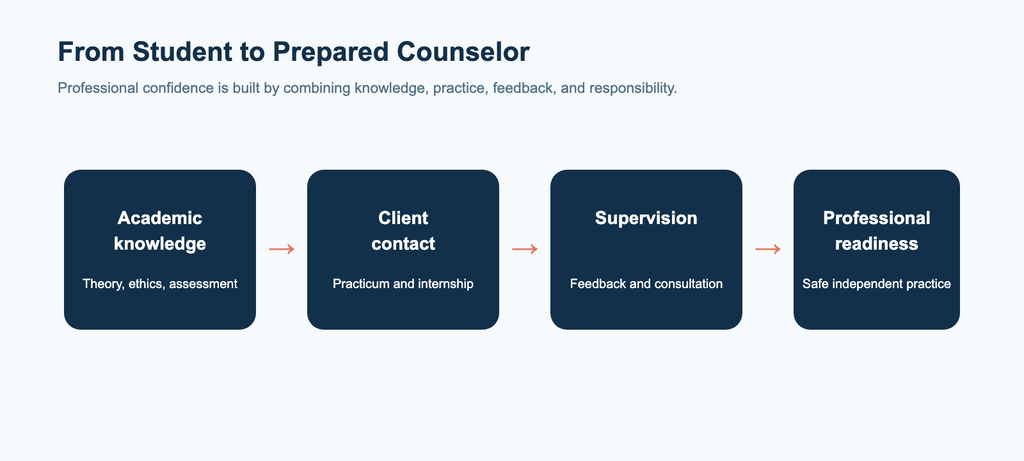
Professional readiness develops through the combination of knowledge, client contact, supervision, and responsibility.
A strong counseling program should help students build a foundation in:
- Clinical interviewing.
- Assessment and treatment planning.
- Crisis and risk response.
- Documentation.
- Ethics and professional boundaries.
- Cultural responsiveness.
- Referral and care coordination.
- Communication with supervisors and other providers.
- Reflective practice.
- Lifelong professional development.
These skills prepare students for the reality that counseling is both relational and operational. The counselor must build trust with the client while also following procedures, documenting work, coordinating care, and meeting professional responsibilities.
That balance is essential in every setting, from a community clinic to a hospital, school, private practice, or integrated healthcare organization.
Conclusion
America needs more mental health counselors, but the profession cannot meet that need through numbers alone. Future counselors need preparation that reflects the responsibility they will carry when a client asks for help.
Academic coursework provides the foundation. Supervised practicum and internship experience allow students to test their decisions with real clients. Feedback helps them develop clinical judgment. Cultural and ethical training helps them provide care responsibly. Licensure preparation connects their education to the requirements of professional practice.
An online master’s degree can offer a flexible path into the field, but the standard of preparation should remain high. Students should look for a program that combines accessible delivery with meaningful clinical experience, qualified supervision, clear expectations, and support throughout the transition into professional work.
Somebody has to be ready when a client sits down and waits for an answer they can trust. The preparation for that moment begins long before graduation day.
Frequently Asked Questions
Why is supervised practice important for mental health counseling students?
Supervised practice allows students to apply academic knowledge with real clients, receive feedback, develop clinical judgment, and learn how to manage ethical and professional responsibilities.
What skills should mental health counseling students develop before graduation?
Students should develop skills in communication, assessment, treatment planning, crisis response, documentation, cultural competence, ethical decision-making, and referral or care coordination.
How does supervision help a new counselor?
Supervision helps students recognize risk, question their assumptions, improve their clinical decisions, maintain professional boundaries, and understand when consultation or referral is necessary.
Why is cultural competence important in mental health counseling?
Cultural competence helps counselors understand how a client’s identity, language, family, background, and circumstances may affect communication, trust, treatment, and access to care.
How does clinical preparation support the growing counseling workforce?
Supervised education helps expand the workforce without lowering professional standards. More counselors are needed, but they must also be prepared to provide safe, ethical, and responsible care.