By
By 
The U.S. mental health sector is in a strange position.
More people are talking about therapy, psychiatric care, substance use treatment and emotional health than they did a generation ago. That visibility matters. It means more people can name what they need, and more families, employers and health systems understand that mental health is not separate from health.
But naming the need is not the same as getting care.
For many patients, the hard part still begins after they decide to ask for help. The appointment is too far away. The clinician does not take their insurance. The rural clinic is short-staffed. The psychiatrist is booked, or the therapist has no openings. The emergency department becomes the backstop for problems that should have been treated earlier, somewhere less frantic.
That is the real story inside America’s mental health workforce crisis. Demand is visible, access is uneven, and the workforce is tired. And yet the sector is not standing still.
New training pathways, expanded nurse practitioner roles, online graduate programs, residency models and policy attention are all moving at once. The question is whether that movement can outpace the gap.
- TL;DR
- The Root Problem Is a Nationwide Provider Shortage
- Demand Is Not Going Away
- Nurse Practitioners Are Stepping Into Part of the Gap
- Online Education Opens New Pathways, but the Clinical Bar Still Matters
- Burnout Is Undermining the Gains
- Reimbursement Is Part of the Workforce Story
- Residency Models Are One Sign of a More Serious Pipeline
- Momentum Is Real, but the Gap Is Still Widening in Places
- Frequently Asked Questions
TL;DR
- America’s mental health workforce crisis is not only a provider-count problem. It is an access, reimbursement, burnout, training, and distribution problem.
- As of December 31, 2025, more than 137.1 million people lived in mental health care Health Professional Shortage Areas, according to KFF’s analysis of HRSA data.
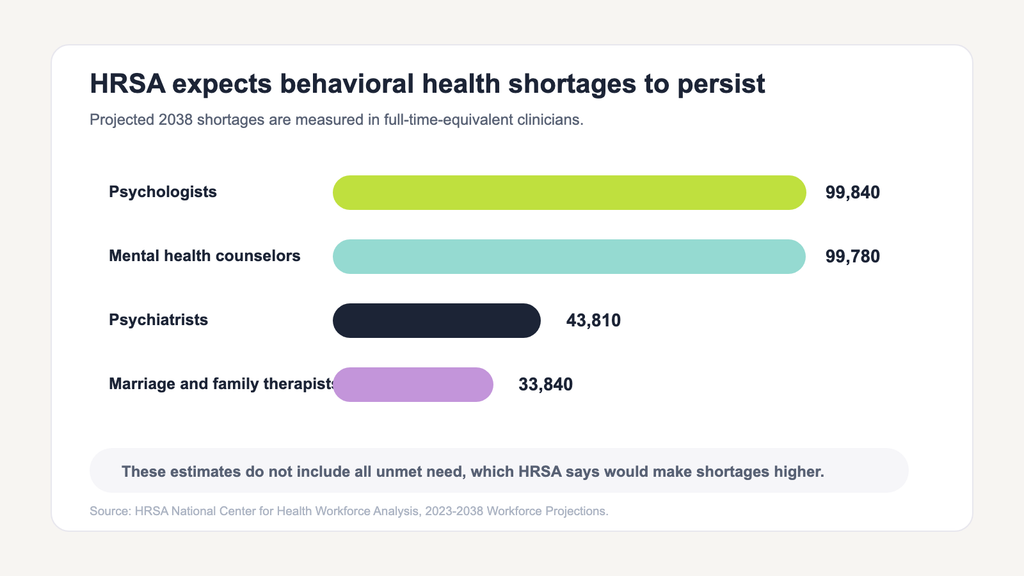
- HRSA’s 2023-2038 workforce projections point to large future shortages across behavioral health roles, including 99,780 mental health counselors, 99,840 psychologists and 43,810 psychiatrists.
- Psychiatric mental health nurse practitioners are one part of the response. BLS projects nurse practitioner employment to grow 41% from 2025 to 2035, adding about 137,800 NP jobs.
- But pipeline growth will not be enough if burnout and reimbursement keep pushing clinicians out. The National Council for Mental Wellbeing found that 93% of behavioral health workers reported burnout, with 62% reporting moderate or severe burnout.
The Root Problem Is a Nationwide Provider Shortage
The shortage is not theoretical anymore.
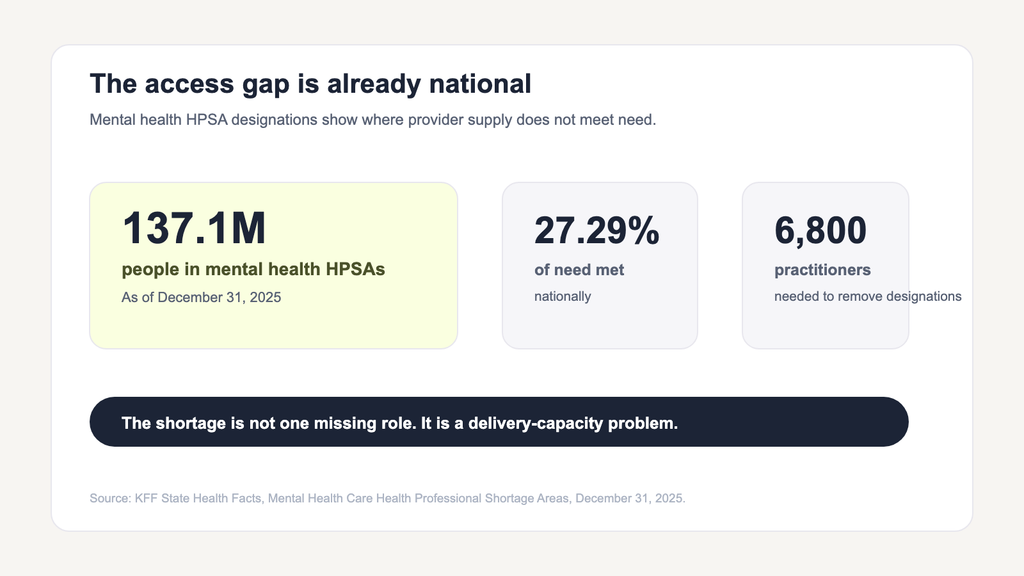
As of December 31, 2025, the United States had 6,807 mental health care Health Professional Shortage Area designations. Those shortage areas covered 137,133,953 people. KFF’s table also shows that only 27.29% of need was met nationally, with 6,800 practitioners needed to remove the shortage designations.
That is not just a rural problem, although rural access is a major part of it. It is also a payer problem, a training problem, a retention problem, and a system design problem.
This is where mental health becomes a signal for the rest of healthcare. The sector is dealing with several pressures at the same time: rising demand, constrained supply, burnout, uneven distribution, reimbursement friction and a workforce pipeline that cannot be rebuilt overnight.
HRSA’s longer-range view does not make the picture easier. Its 2023-2038 projections show expected shortages of 99,780 mental health counselors, 99,840 psychologists, 43,810 psychiatrists, 33,840 marriage and family therapists and 77,050 addiction counselors by 2038. HRSA also notes that these estimates are based on current use of behavioral health services and do not fully capture unmet need, which means the practical shortage may be even larger.
That distinction matters. A projection based on current use can understate the problem when current access is already limited.
Demand Is Not Going Away
Mental health need is not a temporary spike that health systems can wait out.
SAMHSA’s 2025 National Survey on Drug Use and Health found that 20.6% of adults, or 54.6 million people, had any mental illness in the past year. The same survey found that 6.9% of adults, or 18.2 million people, had a serious mental illness.
For adolescents, the picture is also heavy. In 2025, SAMHSA reported that 18.0% of adolescents aged 12 to 17, or 4.6 million adolescents, had moderate or severe anxiety symptoms in the past two weeks. Another 15.1%, or 3.7 million adolescents, had a past-year major depressive episode.
These numbers help explain why the workforce issue feels so persistent. Even when certain indicators stabilize or improve, the absolute number of people needing care remains large. In operations terms, this is not a demand blip. It is a capacity environment.
At MedicalFlow, we would frame the problem this way: mental health access is no longer a separate service-line concern. It now affects primary care, emergency departments, employer health strategy, payer networks, care coordination, patient experience, and workforce planning.
The system needs more clinicians, yes. But it also needs better pathways into the field and better reasons for trained people to stay.
Nurse Practitioners Are Stepping Into Part of the Gap
Psychiatric mental health nurse practitioners are not a complete answer to America’s mental health access problem. No single role is.
But they are an important part of the workforce response.
BLS reports that the broader group of nurse anesthetists, nurse midwives, and nurse practitioners held 399,000 jobs in 2025 and is projected to grow 36% from 2025 to 2035. Looking at nurse practitioners specifically, BLS projects employment to rise from 336,300 jobs in 2025 to 474,100 jobs in 2035, a 41% increase.
That growth is not specific to psychiatric care, so it should not be overstated. Still, it shows why nurse practitioner pathways are getting more attention in healthcare workforce planning.
PMHNPs can assess, diagnose, and treat mental health conditions, and their prescribing authority depends on state scope of practice rules. In many settings, they support medication management, psychiatric assessment, patient education, therapy-informed care and collaboration with physicians, counselors, social workers and care teams.
This is where the role becomes operationally useful. Mental health systems do not only need more appointment slots. They need clinicians who can work across outpatient clinics, community mental health centers, integrated primary care, telehealth, addiction treatment settings, crisis programs, and rural care models.
A PMHNP cannot erase the psychiatrist shortage. But in a well-designed team, the role can extend capacity where the system is otherwise thin.
Online Education Opens New Pathways, but the Clinical Bar Still Matters
Education is adapting because it has to.
Many nurses who might move into psychiatric advanced practice are already working. They cannot always relocate, pause income or build their lives around a campus schedule. That is where online graduate education can widen the pipeline.
But this is the important caveat: online delivery is only useful if the clinical preparation is serious.
A program can be flexible and still demanding. It can reduce commuting friction without reducing expectations. It can let a nurse study from where they live while still requiring supervised clinical practice, structured coursework and real accountability.
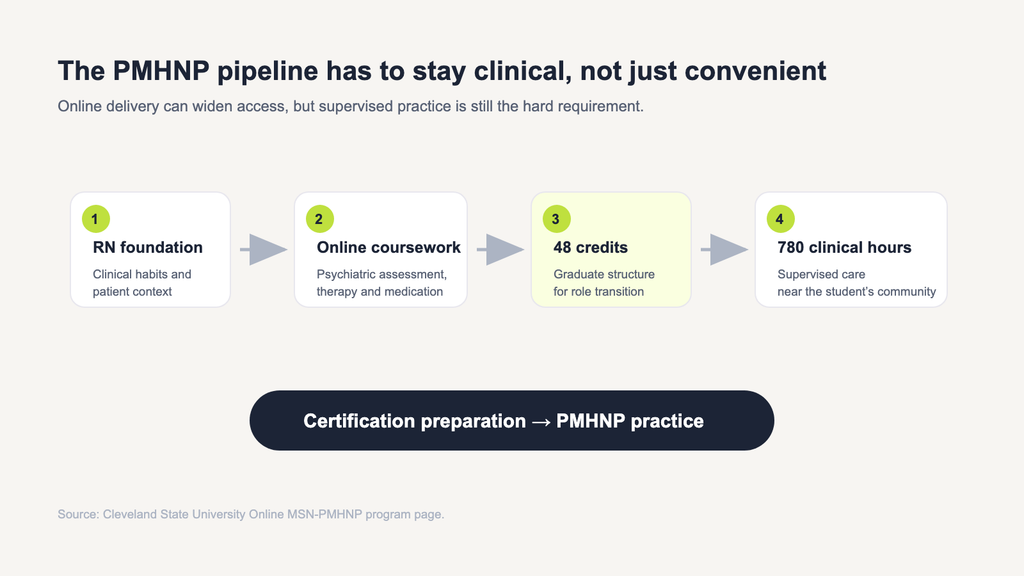
More registered nurses are enrolling in PMHNP schooling online, letting them specialize in mental health without having to quit their jobs or uproot their lives. Cleveland State University’s online psychiatric-mental health nurse practitioner program is a good example. The two-year, 48-credit master’s runs entirely online aside from 780 required clinical hours, which students can do near home.
The curriculum covers everything from psychiatric assessment and neuropsychopharmacology to family-focused treatments, with built-in support to help students find clinical placements. Programs like this are popping up because they let working nurses switch to psychiatric care without upending everything.
Those details matter because “online” can sound lighter than it is. In psychiatric care, the issue is not whether students can stream lectures from home. The issue is whether they are being prepared to make clinical decisions with real consequences.
The best PMHNP pathways should help nurses build skill in assessment, medication knowledge, therapeutic communication, diagnostic thinking, patient safety, crisis awareness, and team-based care. The schedule can be flexible. The standards cannot be loose.
Burnout Is Undermining the Gains
Training more clinicians helps. Losing experienced clinicians hurts faster.
That is the tension running through the behavioral health workforce. The field needs more people entering it, but many of the people already inside it are exhausted.
The National Council for Mental Wellbeing found that 93% of behavioral health workers reported experiencing burnout, while 62% reported moderate or severe burnout. Its survey also found that 65% reported increased client caseloads and 72% reported increased client severity since the COVID-19 pandemic. Nearly 48% said workforce shortages had caused them to consider other employment options.
That is not a soft HR issue. It is a capacity issue.
When behavioral health workers burn out, patients wait longer, teams rely more heavily on the people who remain, new hires get less support and organizations spend more time backfilling roles they can barely afford to lose.
Administrative burden makes the problem worse. The National Council found that 68% of workers who provide care said administrative tasks took time away from directly supporting clients. That is the kind of number executives should sit with for a minute. If clinicians are scarce, every hour pushed into avoidable admin work is not just inefficient. It is lost access.
Reimbursement Is Part of the Workforce Story
The mental health workforce crisis is often discussed as if the system simply needs more graduates.
It does. But the economics also matter.
The American Psychological Association’s 2025 Practitioner Pulse Survey found that 38% of psychologists did not accept any form of health insurance. The same report found that only 33% accepted traditional fee-for-service Medicare and 20% accepted traditional fee-for-service Medicaid.
That has direct access implications. A clinician may technically exist in a market, but if patients cannot use their insurance, the practical network is smaller than the directory suggests.
APA’s 2024 survey also explains why some clinicians leave networks. Among psychologists who had never accepted insurance, no longer accepted insurance or recently stopped taking some form of insurance, 82% cited insufficient reimbursement rates, 62% cited administrative issues, and 52% cited payment reliability concerns.
This is one reason the workforce crisis cannot be solved only by expanding school capacity. If reimbursement, prior authorization, documentation burden, and payment reliability make practice unsustainable, the pipeline leaks.
And a leaky pipeline is not a pipeline. It is a churn machine with better branding.
Residency Models Are One Sign of a More Serious Pipeline
Graduate education is one part of preparation. Transition-to-practice support is another.
That is why PMHNP residency models are worth watching. The Department of Veterans Affairs lists Mental Health Nurse Practitioner Residency Programs across multiple VA locations, including programs in states such as Alabama, Arizona, California, Ohio, Texas and Wisconsin through its Office of Academic Affiliations directory.
The Durham VA Health Care System’s Mental Health Nurse Practitioner Residency Program, for example, accepted applications for the Psychiatric Mental Health Nurse Practitioner Residency Program from October 31, 2025 through March 1, 2026.
The program describes its goal as enhancing novice nurse practitioners’ knowledge and skills so they can provide mental health treatment for veterans, including comprehensive mental health evaluation, diagnostic assessment, treatment planning and psychopharmacology management.
That kind of model matters because the first year after graduation is not a footnote. It is where confidence, supervision, team norms and clinical habits either strengthen or wobble.
Healthcare organizations that care about mental health access should pay attention to these transition models. Hiring a new PMHNP is one thing. Building a practice environment where that clinician can grow safely is another.
Momentum Is Real, but the Gap Is Still Widening in Places
So where does this leave the sector?
The mental health workforce is under pressure from several directions at once. Millions of people live in shortage areas. Demand remains high. Behavioral health workers are burning out. Reimbursement barriers push some clinicians away from insurance networks. HRSA expects sizable shortages across major behavioral health professions through 2038.
And still, the sector is moving.
Nurse practitioner employment is growing. PMHNP pathways are expanding. Online programs are making graduate education more reachable for working nurses. Residency models are trying to make the transition into practice less abrupt. Policymakers are paying more attention to workforce, access, and rural behavioral health.
The risk is pretending that movement equals resolution.
It does not.
A better reading is that the sector is in transition. The old workforce model is not producing enough access, but the newer model is still being built. That newer model will likely include more psychiatric nurse practitioners, more team-based care, more telehealth, more integrated behavioral health, and more pressure on reimbursement systems to stop quietly shrinking the usable network.
For healthcare leaders, the takeaway is practical: mental health workforce strategy cannot live only in recruiting. It has to include training partnerships, retention, scope-of-practice awareness, administrative simplification, payer strategy, clinical supervision, and smarter deployment of advanced practice roles.
The organizations that understand this first will have an advantage. Not because they solved the national shortage by themselves. They will not. But because they will be better prepared to deliver care inside the shortage instead of merely describing it.
Frequently Asked Questions
Why is there a mental health workforce crisis in the U.S.?
The crisis is driven by a mix of provider shortages, rising demand, uneven geographic distribution, burnout, reimbursement barriers, and administrative burden. As of December 31, 2025, more than 137.1 million people lived in mental health care HPSAs.
Are psychiatric mental health nurse practitioners part of the solution?
Yes, but they are not the whole solution. PMHNPs can expand access to psychiatric assessment, treatment, and medication management, depending on state scope of practice rules. They work best as part of a broader team-based behavioral health strategy.
Is online PMHNP education enough for clinical readiness?
It can be, if the program includes rigorous coursework, supervised clinical hours, placement support and preparation for certification. Online delivery should make education more accessible, not less clinically serious.
Why does burnout matter so much in behavioral health?
Burnout affects retention, patient access, supervision, appointment availability and team stability. The National Council for Mental Wellbeing found that 93% of behavioral health workers reported burnout, which makes retention a core workforce issue.
What should healthcare organizations do beyond hiring more clinicians?
They should reduce avoidable administrative load, improve clinical supervision, support transition-to-practice models, review payer participation strategy, build interdisciplinary teams, and create sustainable roles for clinicians already in the field.