By
By 
Family nurse practitioners sit in one of the most practical corners of healthcare.
They work with patients across ages, symptoms, concerns, family histories, chronic conditions and everyday barriers to care. That range asks for more than clinical knowledge. It asks for judgment, patience, pattern recognition and the ability to explain a care plan in language a patient can actually use.
That is why FNP education has become such an important workforce issue. Registered nurses who move into advanced practice are not simply adding another credential. They are preparing for a different level of responsibility: assessing patients, recognizing risk, shaping treatment plans, supporting prevention and helping people manage care over time.
The timing matters. The American Association of Nurse Practitioners reported that the U.S. had more than 461,000 licensed nurse practitioners in 2025.
Meanwhile, the U.S. Bureau of Labor Statistics projects nurse practitioner employment to grow from 336,300 jobs in 2025 to 474,100 jobs in 2035, an increase of 41% and about 137,800 additional jobs, according to the latest BLS occupational projections.
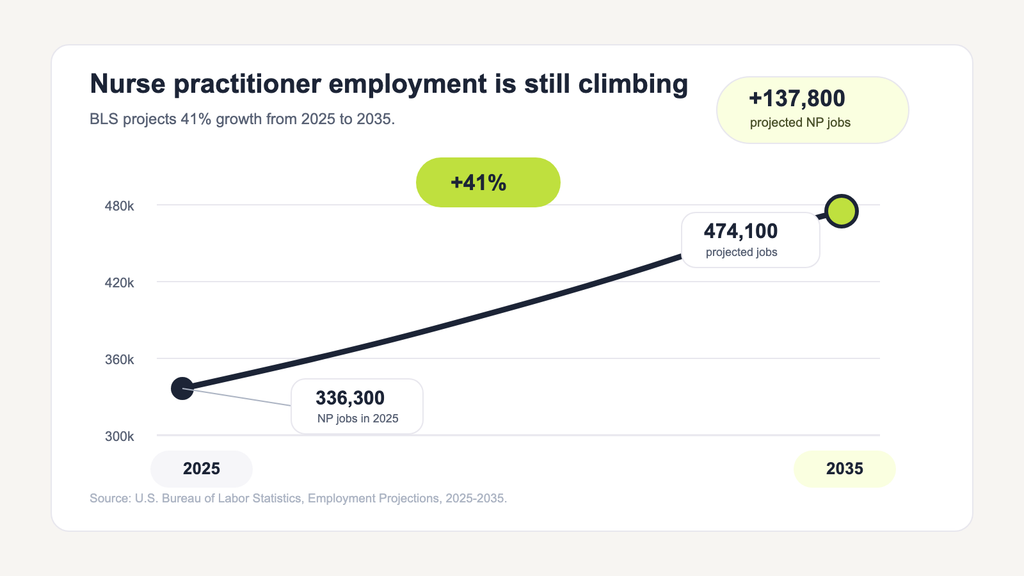
That kind of growth is not cosmetic. It reflects real pressure inside American healthcare: access gaps, an aging population, chronic disease burden, primary care demand and health systems trying to extend care without losing quality.
For nurses, this makes family nurse practitioner education more than a personal career move. It is one of the ways the workforce is adapting.
- TL;DR
- The FNP Role Is Built for Breadth
- Why RN-to-FNP Education Feels Different From Earlier Nursing Education
- Online Learning Can Fit Working Nurses’ Schedules
- Workforce Demand Gives the Pathway More Weight
- Clinical Preparation Should Be the Deciding Factor
- What Working Nurses Should Look For in an FNP Program
- FNP Education Is Becoming Part of the Workforce Response
- Frequently Asked Questions
TL;DR
- Family nurse practitioner education is becoming more important because healthcare needs clinicians who can work across age groups, manage chronic and preventive care, and support access in stretched primary care environments.
- The FNP role requires broad clinical preparation, including advanced assessment, pharmacology, diagnosis, patient education, and care across the lifespan.
- Online pathways can help working nurses continue their education without leaving practice entirely, but flexibility does not remove the need for serious coursework, clinical hours, and strong time management.
- A strong online BSN to MSN FNP program should be judged by its curriculum, clinical preparation, accreditation, placement support and alignment with certification and licensure goals.
The FNP Role Is Built for Breadth
Family care rarely arrives in neat categories.
A patient may come in for a cough, but the visit may also uncover uncontrolled blood pressure, medication confusion, poor sleep, anxiety or trouble getting follow-up care. A diabetes appointment may turn into a conversation about food access, family responsibilities, transportation, work schedules and whether the patient can afford the next prescription.
This is where the FNP role has real weight. Family nurse practitioners are trained to care for patients across the lifespan, from children to older adults. That broad scope is one reason FNP education places so much emphasis on advanced health assessment, pathophysiology, pharmacology, clinical reasoning, prevention and patient communication.
The primary care connection is especially important. According to the AANP’s primary care position statement, about 87% of nurse practitioners are educated and prepared in primary-care-focused programs, and family nurse practitioners represent the largest certification group among new NP certifications, at 51.3% in 2023-2024 testing data from AANP-cited certification bodies.
That distinction matters. Healthcare does not only need more people with advanced credentials. It needs clinicians who can handle the ordinary complexity of front-line care without treating it as ordinary.
Why RN-to-FNP Education Feels Different From Earlier Nursing Education
For registered nurses, the shift into FNP preparation can feel both natural and uncomfortable.
Natural, because nursing already builds habits that matter in advanced practice: listening closely, noticing changes, educating patients, coordinating with teams, and understanding how care actually works once it leaves the exam room.
Uncomfortable, because the expectations change.
An RN may already have years of bedside or clinical experience, but FNP education asks that nurse to move further into diagnostic thinking, treatment planning, and independent clinical judgment.
The questions become bigger. What else could this symptom mean? What risk factors are being missed? What medication choice makes sense for this patient’s history? When does this situation need referral or escalation?
That shift is the point of the education.
A good FNP pathway should help nurses keep the strengths of nursing practice while building the advanced clinical structure required for provider-level work. It should not flatten the role into “more autonomy” as a slogan. Autonomy without preparation is not a workforce solution. It is a risk.
At MedicalFlow, we tend to look at this through an operational lens too. A clinician’s education does not stay inside the classroom. It eventually shows up in appointment quality, patient trust, care continuity, documentation, referral patterns, and how confidently teams can distribute responsibility.
Online Learning Can Fit Working Nurses’ Schedules
Many nurses considering graduate education are already working long shifts, managing family life and trying to avoid turning every spare evening into a scheduling crime scene.
Online learning can make that path more workable. It gives working nurses more control over when they complete coursework and reduces the friction of commuting to campus several times a week. For nurses who cannot simply pause employment for graduate school, that flexibility can be the difference between considering advanced practice and ruling it out.
But online does not mean light.
Graduate nursing education still requires reading, assignments, exams, discussion, skill development, clinical preparation, and supervised patient care. The flexibility is real, but so is the workload.
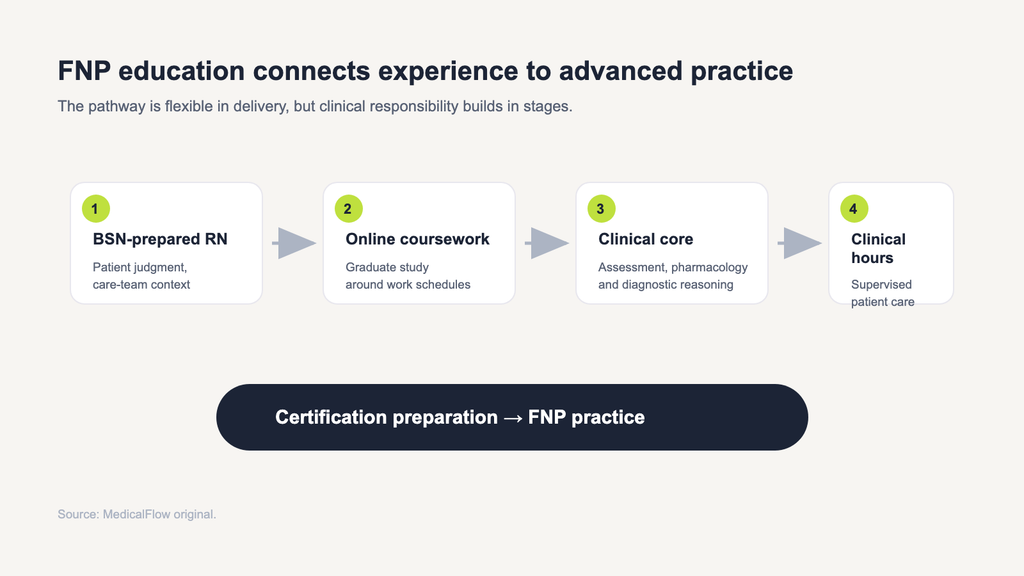
That is why program structure matters. For example, the Spring Arbor University online BSN to MSN FNP program is described as a 52-credit pathway with 625 clinical hours, six starts per year, a part-time format that can be completed in as few as 2 years and 5 months, and a 7-1-7 model where students take one seven-week course at a time. It also includes one four-day campus residency in year two, according to the program page.
Those details are useful because they make the commitment concrete. “Online” tells you the delivery format. It does not tell you whether a program is serious, clinically grounded, or realistic for a working nurse. Credits, clinical hours, course rhythm, residency requirements and placement support tell a much fuller story.
Workforce Demand Gives the Pathway More Weight
The demand for nurse practitioners is not a vague healthcare talking point.
BLS projects nurse practitioner jobs to grow 41% from 2025 to 2035, adding about 137,800 jobs over the decade, with about 29,400 openings projected each year on average, according to the BLS occupational projections.
That pressure connects directly to how care is changing. More patients are living with chronic conditions. More care is moving into outpatient, community and preventive settings. More health systems are trying to build team-based models where physicians, nurse practitioners, physician assistants, nurses, care managers and other professionals work together around patient need.
Primary care access is part of the picture too. KFF’s tracker of primary care Health Professional Shortage Areas reported that more than 92 million people lived in primary care HPSAs as of December 31, 2025, based on HRSA data. That does not mean nurse practitioners alone can solve access. They cannot. But it does explain why the FNP pathway has become more strategically important.
Healthcare systems need clinicians who can support prevention, chronic condition management, patient education, and follow-up across a wide patient population. FNPs are often part of that answer because their training is broad by design.
For nurses, workforce demand can make the pathway feel more practical. It does not mean every program is right, every market is identical or every advanced practice role will look the same. It does mean the decision deserves serious consideration, especially for nurses who want to stay close to patient care while moving into a larger clinical role.
Clinical Preparation Should Be the Deciding Factor
When comparing FNP programs, clinical preparation should sit near the top of the checklist.
Online coursework can teach theory, but advanced practice nursing depends on supervised patient care, feedback, and skill development. The classroom may explain the framework. Clinical training is where students learn how that framework holds up when the patient is complicated, anxious, rushed, medically layered, or unsure how to describe what is wrong.
A strong FNP pathway should help students build confidence in:
- Advanced health assessment
- Pathophysiology and pharmacology
- Differential diagnosis
- Evidence-based treatment planning
- Care across the lifespan
- Chronic disease management
- Preventive care and patient education
- Referral judgment and escalation
- Communication with patients and care teams
The clinical setting matters too. Family practice, primary care, community health, outpatient clinics and related environments can all help students build the patient range FNPs need.
Support also matters. Placement guidance, faculty access, advising, technical help and clear timelines can make the difference between feeling guided and feeling like you are floating alone in graduate school soup.
That last point sounds small until a nurse is trying to manage work, coursework, clinical hours and life in the same week. Then support is no longer a nice extra. It is infrastructure.
What Working Nurses Should Look For in an FNP Program
Choosing an FNP pathway is a career decision, not only an academic one.
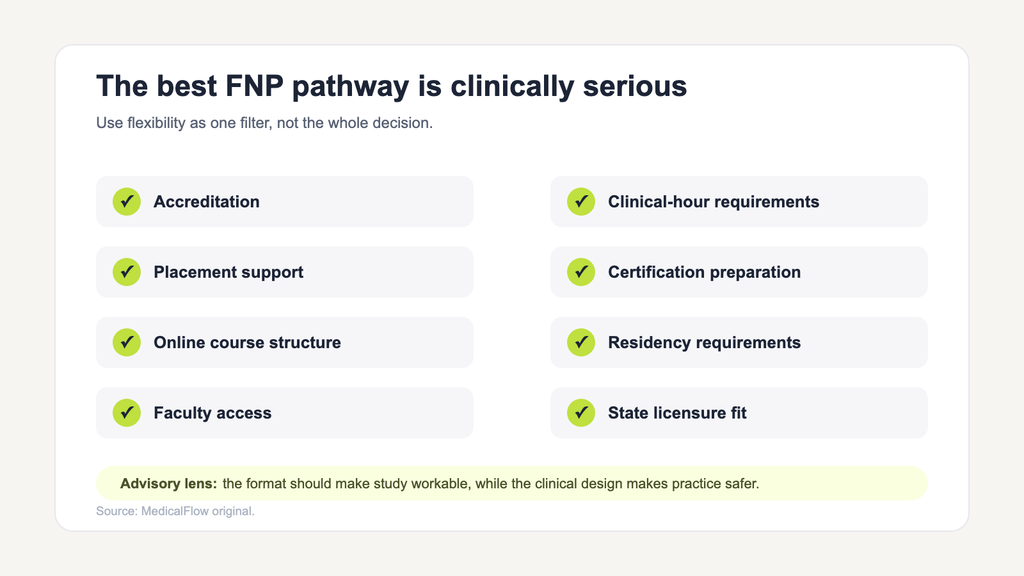
The right program should match the nurse’s goals, schedule, state licensure needs, and the kind of care they want to provide. A convenient format helps, but convenience should never be the only filter.
Before enrolling, nurses should look closely at these details:
- Program accreditation. Accreditation affects credibility, certification preparation, and, in many cases, whether the program fits future licensing expectations.
- Clinical-hour requirements. The number of required hours matters, but so does how those hours are structured and supported.
- Placement support. Students should understand whether they are fully responsible for finding sites or whether the program helps guide the process.
- Certification preparation. The curriculum should prepare students for the relevant FNP certification exam and the realities of advanced practice.
- State licensure alignment. Nurse practitioner scope and licensing rules vary by state, so students need to confirm that a program fits the state where they intend to practice.
- Course rhythm. Seven-week courses, part-time pacing, asynchronous learning, and residency requirements all affect whether the program is realistic.
- Faculty access. Graduate nursing students need feedback, not just content.
This is where the conversation should become very practical. A nurse may love the idea of becoming an FNP, but the program still has to work around employment, family responsibilities, clinical placement logistics, and financial planning.
The best decision is not the most ambitious one on paper. It is the one that a nurse can actually complete while building the competence the role requires.
FNP Education Is Becoming Part of the Workforce Response
The future of nursing is not moving in one direction.
Some nurses are leaving because the work has become too exhausting. Some are moving into leadership, informatics, education, or care coordination. Some are choosing advanced practice because they want to stay connected to patients while expanding their clinical scope.
FNP education sits inside that larger transition.
It gives experienced nurses a pathway into a role healthcare systems increasingly need, especially in primary and family care. It also gives organizations another way to build capacity without pretending that workforce pressure can be solved by hiring alone.
That is the larger point. FNP education matters because care is becoming more complex, access pressure is real, and the workforce needs pathways that turn experienced nurses into well-prepared advanced practice clinicians.
Not every nurse needs to become an FNP. But for nurses who want that next clinical step, the quality of the educational pathway matters enormously.
The credential is only the visible part. The real value is the preparation behind it.
Frequently Asked Questions
Why is FNP education becoming more important?
FNP education is becoming more important because healthcare systems need clinicians who can support primary care, chronic disease management, prevention, patient education, and care across the lifespan. BLS projects nurse practitioner employment to grow 41% from 2025 to 2035, according to the BLS occupational projections.
Can an online BSN to MSN FNP program prepare nurses for advanced practice?
Yes, if the program includes rigorous graduate coursework, supervised clinical experience, certification preparation, and appropriate licensure alignment. Online delivery can make coursework more flexible, but students still need serious clinical preparation and enough time for reading, assignments and patient-facing training.
What should nurses check before choosing an FNP program?
Nurses should review accreditation, clinical hours, placement support, course format, residency requirements, faculty access, certification preparation and whether the program fits the licensing rules in the state where they intend to practice.
Why are family nurse practitioners important in primary care?
Family nurse practitioners are trained to work with patients across age groups and care needs. According to AANP’s primary care position statement, about 87% of NPs are educated and prepared in primary-care-focused programs, which helps explain why the FNP role is so relevant to access, prevention and chronic condition management.
Is FNP demand the same in every state?
No. Demand, scope of practice, licensing requirements, and job opportunities vary by state and local market. Nurses considering FNP education should review state licensure rules and local workforce conditions before choosing a program.