By
By 
“Shortage” is the word most people use to describe American nursing.
It is accurate. It is also incomplete.
Hospitals are struggling to fill shifts, but the country is not simply running out of licensed nurses. Many nurses are leaving the workforce, stepping away from bedside care, cutting their hours, or moving into other roles. Burnout, workload, pay, workplace violence, retirement, and limited career mobility are changing the profession from the inside.
Advanced practice nursing is growing at the same time. Nurse practitioners are becoming a larger part of primary care, state laws are changing, and experienced nurses are looking for ways to take on broader clinical responsibilities.
From a healthcare workforce planning perspective, the pattern is clear: the United States needs more nurses, but it also needs to keep experienced nurses in the profession and make advancement possible for those who want a different role.
- The Nursing Shortage Is Also a Retention and Distribution Problem
- Nursing Education Is Limiting How Fast the Workforce Can Grow
- An Aging Workforce Adds to the Pressure
- Advanced Practice Nursing Is Reshaping the Profession
- Full Practice Authority Is Changing the Policy Environment
- A Post-Master’s FNP Certificate Can Create a Focused Path Forward
- Clinical Preparation Matters as Much as Career Mobility
- Rural Communities Need More Flexible Workforce Strategies
- Recruitment Incentives Are Not a Long-Term Workforce Plan
- What the Future of American Nursing May Look Like
- Conclusion
- Frequently Asked Questions
The Nursing Shortage Is Also a Retention and Distribution Problem
The United States has more licensed nurses than it can consistently keep in active nursing roles. That distinction matters because a license does not necessarily mean that a nurse is currently working in patient care.
The National Council of State Boards of Nursing’s 2024 National Nursing Workforce Study found that more than 138,000 nurses had left the workforce since 2022. The study also found that 39.9% of registered nurses reported an intent to leave the workforce by 2029.
The figure is a warning signal rather than a guarantee that every nurse will leave. Even so, it shows why workforce planning cannot focus only on recruitment.
NCSBN’s study included responses from 744,714 RNs and 137,902 LPNs/LVNs. The report found that 40% of RNs and 41% of LPNs/LVNs reported plans to leave the profession within five years.
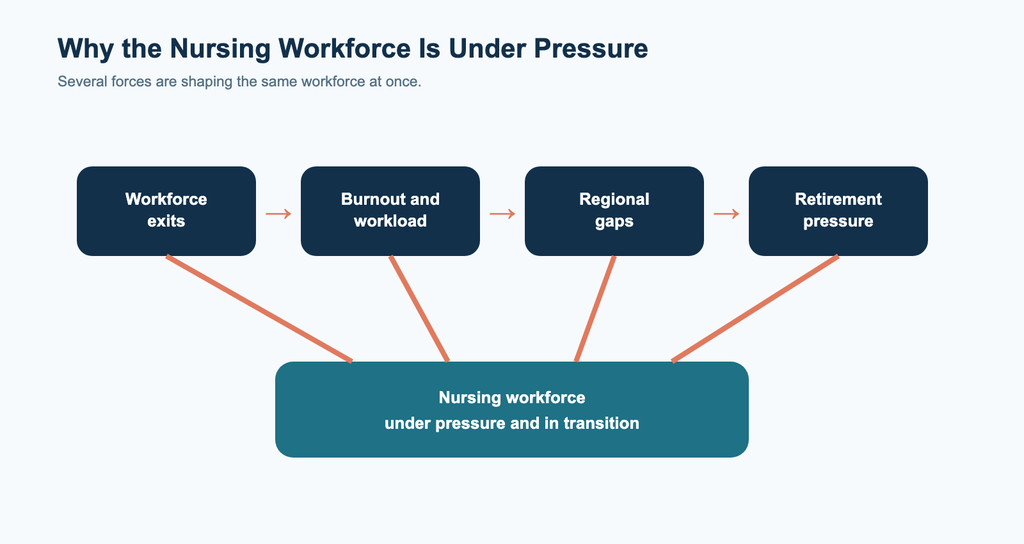
The leading reasons reported by nurses included:
- Stress and burnout.
- Workload.
- Understaffing.
- Inadequate salary.
- Workplace violence.
- Retirement.
These pressures can create a cycle:
- Staffing gaps increase workload for the nurses who remain.
- Higher workload contributes to stress and burnout.
- Burnout increases the likelihood that nurses will leave or change roles.
- Further departures create additional pressure on the remaining workforce.
The distribution of nurses is also uneven. HRSA projects a shortage of 108,960 full-time-equivalent registered nurses by 2038. The projected shortage is expected to be more severe in nonmetropolitan areas, where HRSA estimates an 11% RN shortage in 2038 compared with 2% in metropolitan areas.
Recruitment is necessary, but it cannot be the only response. Retention, career development, workplace safety, scheduling, compensation, and leadership support must be part of the same workforce strategy.
Nursing Education Is Limiting How Fast the Workforce Can Grow
Even when prospective students are interested in nursing, education systems may not have enough capacity to prepare them.
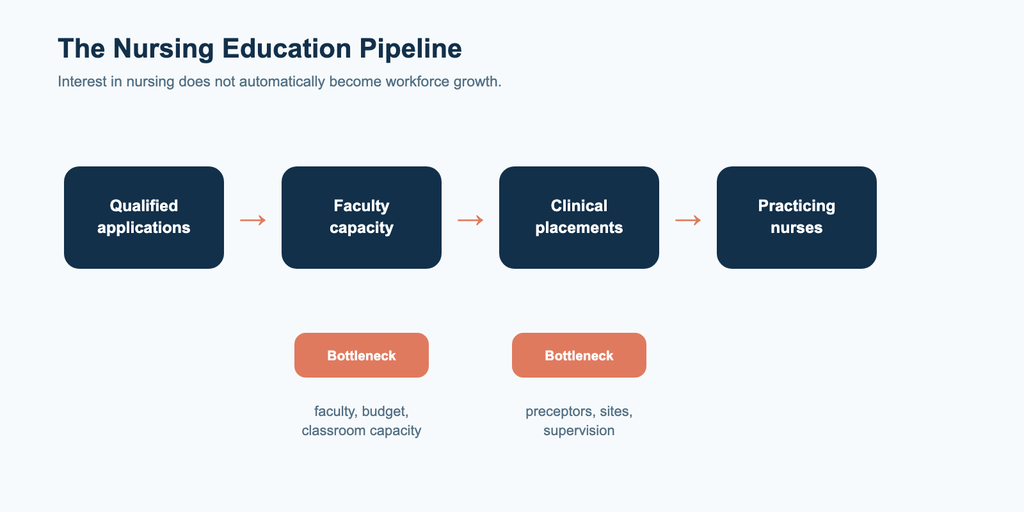
The American Association of Colleges of Nursing reported that U.S. nursing schools turned away 80,162 qualified applications in 2024. These were applications rather than individual applicants, and some applicants may have been accepted by another school.
The reasons included insufficient:
- Faculty.
- Clinical sites.
- Classroom space.
- Clinical preceptors.
- Program budgets.
The problem affects graduate education as well as entry-level nursing. Of the applications turned away, 7,603 came from master’s programs, 5,366 from DNP programs, and 265 from research-focused doctoral programs.
At the same time, interest in advanced nursing education is growing. AACN reported that applications increased by 4.5% for master’s programs and 18.5% for DNP programs.
This creates an important distinction between demand for nurses and the capacity to educate them. A qualified nurse may want to advance but still face a long or uncertain path because the available programs do not have enough instructors, preceptors, or clinical placements.
Faculty shortages are particularly significant because nursing education depends on instructors with advanced clinical and academic expertise. Nursing schools also compete with healthcare employers that may offer higher salaries to experienced nurses than academic institutions can provide.
Clinical placements create another bottleneck. Students need supervised opportunities to apply what they learn, but hospitals and other healthcare organizations have limited capacity to host trainees. Preceptors also need time and institutional support to supervise students effectively.
Expanding the nursing workforce therefore requires investment in the entire education pipeline:
- Nursing faculty.
- Clinical instructors.
- Preceptors.
- Classroom and simulation capacity.
- Community and rural clinical placements.
- Graduate education.
- Financial support for advanced nursing students.
Without that infrastructure, increasing applications does not necessarily produce more practicing nurses.
An Aging Workforce Adds to the Pressure
Retirement is another force reshaping American nursing.
Experienced nurses carry clinical knowledge that is difficult to replace quickly. They understand how to recognize subtle changes in a patient’s condition, coordinate with physicians and other professionals, manage complex workflows, and support less experienced colleagues.
When those nurses retire or leave the profession, the loss affects more than the number of available staff. Organizations may also lose mentorship, institutional knowledge, and clinical leadership.
The NCSBN workforce study found that retirement, stress, burnout, insufficient staffing, and high workloads remain important factors in nurses’ decisions to leave. NCSBN workforce findings
The study also found that 73% of RNs held a baccalaureate degree or higher, the highest educational level documented in the NCSBN workforce data. That rising level of education creates opportunities for advanced roles, but it also makes retention and career progression more important.
Healthcare employers face two connected challenges:
- Preparing new nurses to enter practice.
- Retaining experienced nurses long enough to transfer knowledge and support the next generation.
Short-term incentives may help fill urgent vacancies, but they do not replace sustainable workforce planning. If the conditions that caused nurses to leave remain unchanged, recruitment campaigns may provide only temporary relief.
Retention strategies need to address the work itself. Scheduling, staffing, leadership behavior, professional autonomy, safety, advancement opportunities, and access to support all influence whether nurses see a long-term future in an organization.
Advanced Practice Nursing Is Reshaping the Profession
While traditional nursing roles are under pressure, advanced practice nursing continues to expand.
The Bureau of Labor Statistics projects 40% employment growth for nurse practitioners between 2024 and 2034, much faster than the average for all occupations. BLS projects nurse practitioner employment to grow from 336,300 jobs in 2024 to 474,100 jobs in 2034.
The median annual wage for nurse practitioners was $129,210 in May 2024.
The number of nurse practitioners is growing as well. The American Association of Nurse Practitioners reported more than 461,000 licensed nurse practitioners in the United States in 2025. AANP previously reported 431,410 licensed NPs in 2024, compared with 385,358 in 2023.
This growth reflects several factors:
- Increasing demand for primary care.
- Shortages of physicians and other healthcare professionals.
- Greater use of team-based care.
- Expansion of outpatient services.
- Career advancement opportunities for experienced nurses.
- State-level changes affecting nurse practitioner practice.
Family nurse practitioners are especially relevant to workforce planning because they can care for patients across the lifespan in many primary care settings. Depending on state law and organizational structure, FNPs may conduct assessments, diagnose conditions, order tests, prescribe medications, manage chronic conditions, provide preventive care, and educate patients.
The growth of advanced practice nursing does not eliminate the need for registered nurses. It adds another layer to the workforce and creates opportunities for experienced nurses to move into roles with broader clinical responsibilities.
Full Practice Authority Is Changing the Policy Environment
The role of a nurse practitioner also depends on state law.
Some states grant full practice authority, allowing nurse practitioners to evaluate patients, diagnose conditions, order and interpret tests, prescribe medications, and manage treatment without a formal requirement for physician supervision or collaboration. Other states maintain different levels of restrictions.
The American Association of Nurse Practitioners tracks these differences through its State Practice Environment resources.
These variations affect workforce planning. A nurse practitioner may have greater autonomy in one state than another. State rules can also influence where advanced practice nurses choose to work, how healthcare organizations design care teams, and whether NPs can open or lead practices.
Policy changes should not be treated as a universal solution to the nursing workforce challenge. Scope-of-practice laws are one part of a larger system that includes education, certification, reimbursement, employer policies, and patient access.
However, the policy environment does influence the professional opportunities available to NPs. It can determine whether a nurse practitioner is able to practice at the full level of education and training.
A Post-Master’s FNP Certificate Can Create a Focused Path Forward
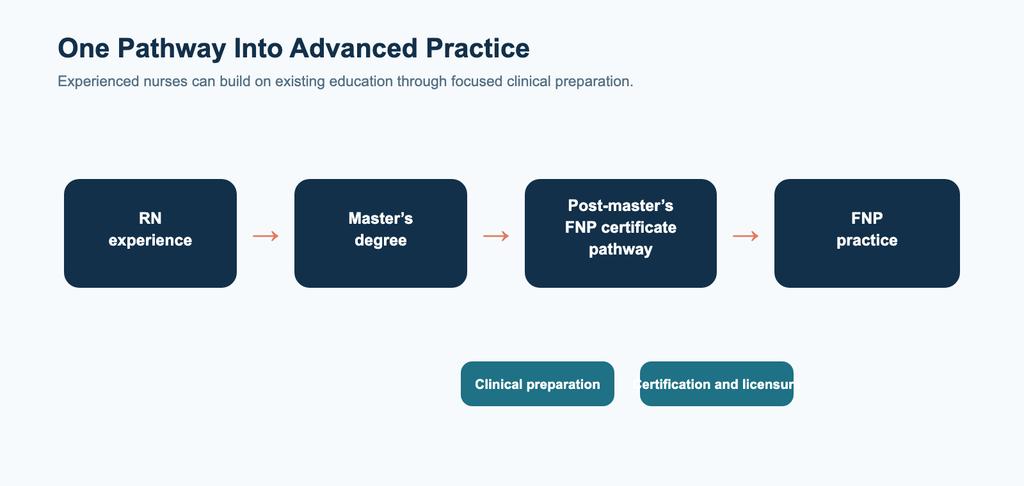
Nurses who already hold a master’s degree may not want to begin an entirely new graduate program to move into family nurse practitioner practice.
A post masters FNP certificate can provide a focused pathway for nurses who already have graduate-level nursing education and want to build the additional knowledge and clinical preparation required for FNP practice. Schools like Carson-Newman University are opening up more seats because demand for family nurse practitioners keeps rising, especially as more states let NPs operate independently, without a doctor looking over their shoulder.
This type of pathway matters because career advancement can support retention. A nurse who sees a realistic opportunity to develop new skills, increase professional responsibility, and move into a role that fits long-term goals may be more likely to remain connected to nursing.
A post-master’s certificate is not a shortcut around clinical preparation. FNP practice requires advanced knowledge in assessment, pharmacology, pathophysiology, diagnosis, treatment, and primary care. Students also need supervised clinical experience and preparation for national certification and state licensure.
The value of a focused certificate is that it builds on education the nurse already has. Instead of repeating an entire master’s degree, the student can concentrate on the additional competencies needed for the new role.
Clinical Preparation Matters as Much as Career Mobility
Advanced practice nursing creates opportunities, but the transition requires meaningful preparation.
A family nurse practitioner may serve patients of different ages and manage a broad range of primary care needs. The role can include preventive services, acute care, chronic disease management, women’s health, health assessment, diagnostic testing, medication management, and patient education.
That scope requires more than professional ambition. It requires advanced coursework and supervised clinical practice.
A post-master’s FNP pathway may include advanced study in areas such as:
- Advanced pathophysiology.
- Advanced pharmacology.
- Health assessment.
- Women’s health.
- Adult and older-adult primary care.
- Family-centered care.
- Diagnostic reasoning.
- Preventive care.
- Chronic disease management.
Students also need opportunities to practice those decisions under the guidance of experienced preceptors.
Clinical education can help students develop:
- Advanced assessment skills.
- Diagnostic reasoning.
- Safe prescribing practices.
- Chronic disease management.
- Preventive care planning.
- Patient education.
- Communication with families and care teams.
- Documentation and care coordination.
- Professional confidence within an appropriate scope.
Clinical placements expose students to the realities of different care settings. A student may learn how access, staffing, reimbursement, transportation, and patient trust affect the delivery of primary care.
For nurses moving from a traditional RN role into advanced practice, this experience is especially important. The responsibilities are broader, and the decisions may carry different clinical and legal implications.
Rural Communities Need More Flexible Workforce Strategies
Rural hospitals and clinics often experience the workforce challenge more intensely than large urban systems.
HRSA projects that nonmetropolitan areas will experience an 11% RN shortage in 2038, compared with a 2% shortage in metropolitan areas.
A rural community may have fewer healthcare employers, fewer training sites, limited housing, longer travel distances, and fewer opportunities for specialized professional development. Patients may also have to travel significant distances for primary or specialty care.
Family nurse practitioners can play an important role in rural and underserved communities because their training is centered on broad primary care. They may provide care across age groups and address a wide range of common health needs.
However, preparing more FNPs does not automatically guarantee that they will work in rural communities. Retention also depends on compensation, professional support, manageable workload, access to continuing education, infrastructure, and community conditions.
Workforce planning should therefore connect education to place. Clinical training opportunities in rural and underserved settings can help students understand local care needs and build relationships with potential employers. Organizations also need to create working environments that make long-term practice possible.
Recruitment Incentives Are Not a Long-Term Workforce Plan
Hospitals facing immediate staffing shortages may use sign-on bonuses, relocation assistance, flexible schedules, higher hourly rates, or travel contracts to attract nurses.
These tools can be useful in urgent situations, but they do not resolve the underlying causes of workforce instability. An organization may fill a vacancy and still struggle with turnover if nurses face excessive workloads, inadequate staffing, poor leadership, safety concerns, or limited advancement opportunities.
Long-term workforce planning should combine recruitment with:
- Retention programs.
- Career development.
- Leadership training.
- Mentorship.
- Support for advanced education.
- Flexible scheduling.
- Workplace safety initiatives.
- Appropriate staffing models.
- Stronger faculty and preceptor partnerships.
- Clear pathways into advanced practice.
The goal is to make nursing a sustainable career across different stages of professional life.
A new graduate may need structured support and mentorship. An experienced bedside nurse may want leadership or advanced practice opportunities. A nurse returning after a career break may need a gradual re-entry pathway. A rural nurse may need access to online education and clinical support without relocating.
Different workforce problems require different solutions.
What the Future of American Nursing May Look Like
The future nursing workforce will likely be more varied in role, education, setting, and career path.
Registered nurses will remain essential to hospitals, clinics, long-term care, public health, schools, and community organizations. At the same time, more nurses may move into advanced practice, care coordination, education, leadership, informatics, quality improvement, and population health.
That transition can benefit the profession, but only if the system continues to support bedside care and invests in education.
The most effective workforce strategy will not treat nurses as interchangeable units. It will recognize that nurses have different goals, responsibilities, experience levels, and reasons for entering or leaving particular roles.
A sustainable system needs:
- Enough nurses to provide safe care.
- Enough faculty to educate future nurses.
- Enough preceptors and clinical sites to support training.
- Enough advancement opportunities to retain experienced professionals.
- Enough policy flexibility to support access.
- Enough organizational support to make demanding work sustainable.
The United States does not face one nursing workforce problem. It faces several connected problems that require coordinated action.
Conclusion
American nursing is not defined by shortage alone. It is a workforce under pressure and in transition.
More than 138,000 nurses have left the workforce since 2022, and 39.9% of RNs reported an intent to leave by 2029. Nursing schools turned away 80,162 qualified applications in 2024 because of constraints involving faculty, clinical sites, classroom space, preceptors, and budgets.
At the same time, nurse practitioner employment is projected to grow by 40% between 2024 and 2034, and the United States had more than 461,000 licensed NPs in 2025.
These figures point to a workforce that needs both stabilization and evolution.
Retention, education capacity, rural access, workplace conditions, and advanced practice pathways all matter. Nurses need realistic opportunities to build on their experience and move into roles that support their professional goals and the needs of the communities they serve.
The future of American nursing will depend not only on how many nurses the country trains, but also on whether the profession gives them a sustainable reason to stay.
Frequently Asked Questions
Is the U.S. nursing workforce facing a shortage?
Yes, but the challenge is broader than the number of licensed nurses. Workforce pressure is also driven by nurses leaving the profession, burnout, aging, uneven geographic distribution, and limited educational capacity.
Why are nurses leaving the workforce?
NCSBN identifies stress and burnout, workload, understaffing, inadequate salary, workplace violence, and retirement among the factors affecting nurses’ decisions to leave.
Why are nurse practitioner roles growing?
Demand for primary care, workforce shortages, team-based care, and changing state practice laws are contributing to the growth of nurse practitioner roles.
What is a post-master’s FNP certificate?
A post-master’s FNP certificate is a focused educational pathway for nurses who already hold a master’s degree and want additional preparation for Family Nurse Practitioner practice without completing another full master’s degree.
Does a post-master’s certificate automatically lead to FNP licensure?
No. Certification and licensure requirements vary by state. Students must complete the required education, clinical preparation, national certification examination, and state-specific licensing steps.