By
By 
Growth in clinics and healthtech firms rarely starts with software alone.
That version belongs more in pitch decks than in operating plans. Real expansion begins with people who can diagnose, prescribe, reassure, document, make judgment calls, and take legal responsibility when care gets complicated. Physicians sit at the center of that pressure.
A company can build scheduling tools, remote monitoring platforms, AI triage systems, virtual care workflows, or specialty care networks. None of it scales cleanly if the physician pipeline stays thin, unstable, or poorly matched to the model.
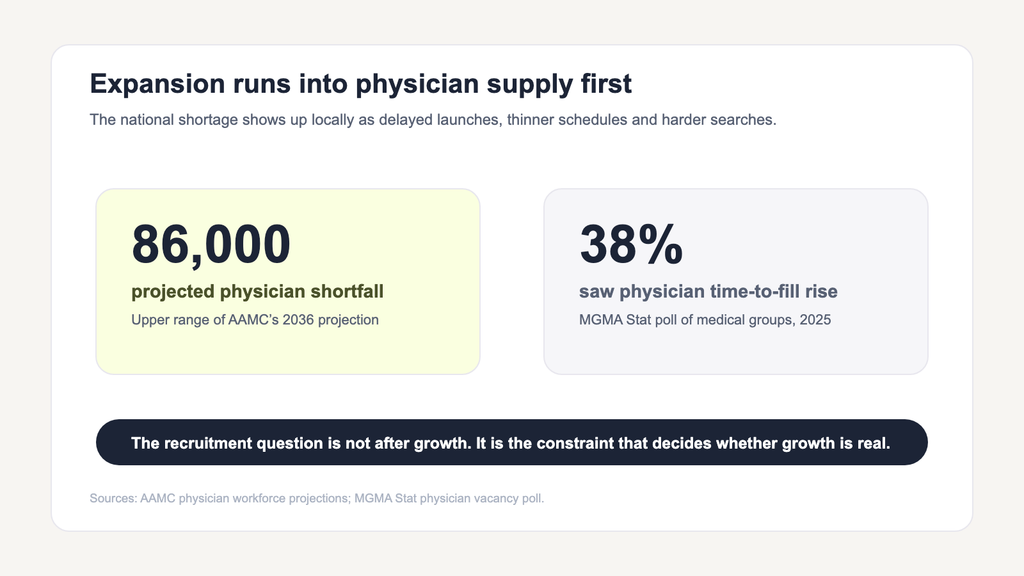
The national backdrop makes that harder to ignore. AAMC projects a U.S. physician shortage of up to 86,000 physicians by 2036, while an MGMA Stat poll found that 38% of medical groups said time to fill physician vacancies increased in the prior year.
Hiring doctors is not a support function. It is a growth engine.
Clinics already know this, even when strategy decks pretend otherwise. Healthtech companies learn it the hard way, usually after the platform is built and the clinical layer proves thinner than expected.
TL;DR
- Strategic physician recruitment can drive clinic and healthtech expansion because physician capacity determines whether new sites, service lines, and digital care models can operate safely and credibly.
- AAMC projects a U.S. physician shortage of up to 86,000 physicians by 2036, which means expansion plans have to account for supply constraints early.
- Recruitment should happen before the launch plan hardens, not after a clinic signs a lease or a healthtech firm sells a model it cannot staff.
- For healthtech firms, physician involvement is not decorative. Doctors validate workflows, manage clinical risk, build trust, and expose operational fantasy before it becomes expensive.
- The strongest growth plans treat physician recruitment as operational design: specialty fit, state licensing, credentialing, payer mix, workflow, culture, and long-term retention all get mapped before expansion.
Doctors First
Every serious clinic operator learns the same lesson. Geography matters, payer mix matters, and technology matters, yet physician supply decides whether an expansion plan lives or dies. A new site without the right medical staff is not a clinic. It is a lease with furniture.
That is why physician recruitment at MASC Medical belongs in the strategy conversation, not the back-office pile. Smart recruitment identifies specialty gaps, local demand, licensing hurdles, compensation realities, and cultural fit before leadership burns cash on an expansion plan that cannot hold.
This is where many organizations get the order wrong. They choose a market, model the revenue, hire the real estate team, announce the service line, and then discover that the physician search is harder than expected. By then, the timeline is public, the cost base is real, and the organization has started negotiating with scarcity from a weak position.
A better sequence starts with medical capacity. Which physician specialties are needed? How competitive is the market? Which payers shape the economics? What credentialing timeline is realistic? Which physicians will actually want the workload, culture, and care model being offered?
That is less glamorous than the launch plan. It is also the part that keeps the launch plan alive.
Scale Has a Human Limit
Executives love the word “scale” because it sounds clean.
Medicine is not clean. Medicine has calendars, call schedules, credentialing delays, state rules, malpractice concerns, documentation burden, referral relationships, panel management, and the old fact that patients want a competent human being, not just an app.
Expansion fails when leaders treat physicians like interchangeable parts. They are not. A strong hire can anchor a service line, attract support staff, reassure patients, and give a clinic credibility in a new market. A poor fit can damage culture quickly. That is true in brick-and-mortar clinics, and it is even more obvious in hybrid or virtual care models where trust is already fragile.
Physician burnout makes the issue sharper.
AMA reported that 41.9% of physicians experienced at least one symptom of burnout in 2025. That number was lower than prior years, which is good news, but it is still high enough to matter in every recruitment conversation.
A candidate is not just evaluating compensation. They are evaluating workload, autonomy, administrative friction, clinical support, technology burden, leadership maturity, and whether the organization understands what medical practice actually feels like.
Clinics that grow wisely map physician capacity before launch. Healthtech firms should shape products around clinical behavior, not boardroom fantasy.
Tech Needs Clinical Gravity
Healthtech often behaves like aviation in its rough early years.
Plenty of daring. Plenty of noise. Not enough respect for gravity.
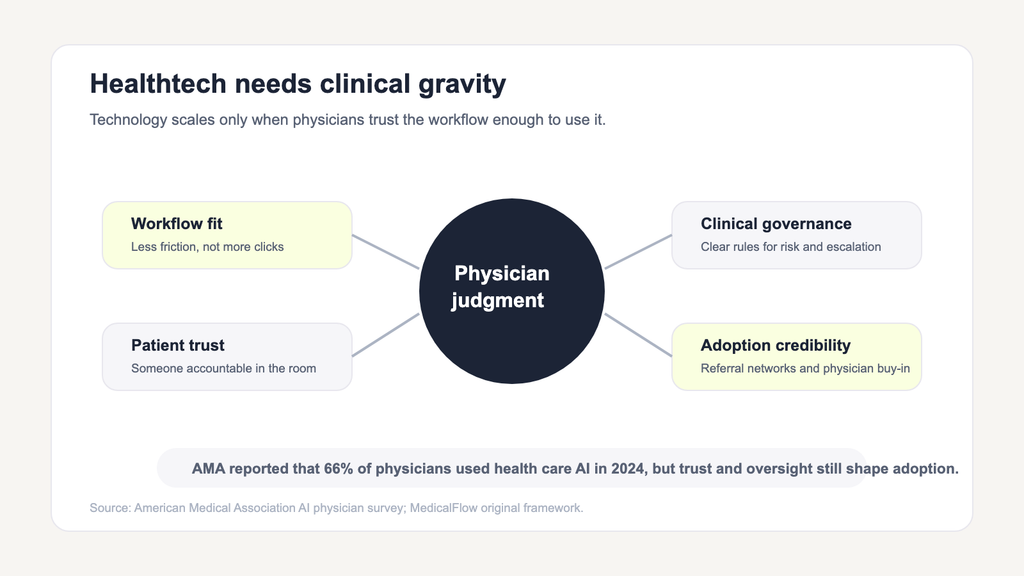
Here, gravity means licensed clinicians with judgment, reputation, and patient trust. A platform may promise faster access, smoother coordination, better triage, or cleaner documentation. The physician layer determines whether those promises survive contact with reality.
IBM describes healthcare technology as the use of tools and systems to improve medical care, including areas such as AI, data sharing, remote monitoring, and digital workflows. That definition is broad, and it should be. But in practical care delivery, technology does not replace the need for clinical accountability. It changes where that accountability shows up.
Doctors validate workflows. Doctors catch dangerous edge cases. Doctors know when a digital intake flow is missing the real question. Doctors also reject systems that waste time.
That rejection carries consequences. Product adoption stalls. Referral networks cool. Clinical champions disappear. The product team calls it resistance. Sometimes it is. More often, it is a clinical signal the company should have heard earlier.
The market is not anti-technology. AMA reported that 66% of physicians used health care AI in 2024. That should end the lazy story that doctors simply refuse new tools. Physicians will adopt technology when it improves care, reduces friction, supports judgment, and respects the reality of clinical work.
Strategic recruitment helps because it brings physicians into the model early. Not as mascots. As operators.
Expansion Without Chaos
The strongest growth plans treat recruitment as operational design, not rescue work.
Reactive hiring usually follows a crisis. A physician leaves. A panel is uncovered. A clinic opens before staffing stabilizes. A digital care company sells into a market before it understands state licensing. Leaders scramble, overpay, loosen standards, and lose the advantage they thought speed would give them.
Strategic recruitment flips the sequence. Leadership defines the service mix, patient volume, care model, compliance requirements, supervision structure, documentation expectations, payer environment, and clinician experience first. Recruitment then targets physicians who match those facts instead of forcing mismatched clinicians into a shiny plan.
The difference shows up quickly. A clinic expanding into a new market needs physicians who fit local demand and payer economics. A multi-site group needs physicians who can maintain consistency without flattening clinical judgment. A healthtech company needs physicians who can work inside digital workflows without becoming unpaid product testers. A specialty platform needs physicians whose reputations can create trust with patients and referral partners.
This is why physician recruitment cannot be reduced to sourcing resumes. The real work is fit.
Fit means specialty fit, market fit, workflow fit, compensation fit, regulatory fit, and cultural fit. Miss any of those, and the hire may still look good on paper while weakening the business in practice.
What Strategic Physician Recruitment Should Actually Solve
Strategic physician recruitment should solve the problems that appear before the job posting goes live.
It should clarify where the business is going, what kind of physician can support that direction, and what the organization must change to attract that physician. The best recruiters and leadership teams are not merely asking, “Who is available?” They are asking, “What does this growth model require from a clinician, and why would the right person say yes?”
That question changes the work.
Compensation has to reflect the market, but compensation alone will not save a poor role. Credentialing and licensing timelines have to be realistic. Workload has to make sense. Technology has to support the physician rather than quietly adding another administrative layer. Leadership has to understand that clinical trust is earned in the design of the job, not promised in the offer letter.
For clinics, this means recruitment belongs in expansion planning from the first serious market conversation. For healthtech firms, it means physicians should be involved before workflows harden, pricing assumptions settle, and go-to-market teams start selling clinical capabilities the company cannot yet deliver.
Many ambitious healthcare companies stumble by chasing reach before securing medical depth. The firms that win reverse that order.
They recruit and expand on foundations sturdy enough to survive pressure.
Physician Recruitment Gives Growth a Spine
Strategic physician hiring can drive expansion, though not in the simplistic way corporate slogans suggest.
It will not rescue weak operations. It will not save subpar products from deserved failure. It will not make an unrealistic market suddenly attractive to doctors who know better.
It does something more valuable. It gives growth the clinical depth it needs to hold up under pressure.
Clinics gain the medical leadership needed to enter new markets with credibility and continuity. Healthtech firms gain the clinical trust needed to turn software into care delivery, not digital decoration. Patients gain access to organizations that have planned for actual care, not only acquisition funnels.
This is the quiet advantage of strategic recruitment. It makes expansion less theatrical and more durable.
The companies that understand that will not treat physician hiring as the final step before launch. They will treat it as one of the first tests of whether the launch deserves to happen.
Frequently Asked Questions
Why is physician recruitment important for clinic expansion?
Physician recruitment determines whether a clinic can actually deliver the services it plans to offer. Without the right doctors, a new location may have the brand, lease, equipment, and scheduling tools, but not the clinical capacity to operate credibly.
How does physician recruitment affect healthtech growth?
Healthtech firms need physicians to validate workflows, manage clinical risk, build trust, and support adoption. Technology may create access and efficiency, but physicians often determine whether the model works in real patient care.
Is physician burnout relevant to recruitment strategy?
Yes. Burnout affects retention, job selection, workload expectations, and candidate willingness to join high-pressure models. AMA reported that 41.9% of physicians experienced at least one burnout symptom in 2025, so recruitment strategies need to address role design, not only pay.
What makes physician recruitment strategic instead of reactive?
Strategic recruitment begins before a vacancy becomes urgent. It maps market demand, specialty needs, licensing timelines, credentialing, compensation, workflow, culture, and retention risk before expansion commitments are made.
Can technology reduce the need for physician recruitment?
Technology can improve access and efficiency, but it does not remove the need for physician judgment, accountability, and trust. In many models, better technology increases the need for well-matched physicians because the care model becomes more distributed, specialized, or complex.