
Healthcare organizations are dealing with a very different hiring environment than they were just a few years ago. Open roles are harder to fill, experienced professionals are leaving, and patient demand keeps growing.
Hiring still matters, of course. The problem is that recruitment alone won’t fix everything happening behind the scenes.
Take nursing as an example. Since 2022, more than 138,000 nurses have left the workforce, and nearly 40% say they expect to leave by 2029. On the physician side, HRSA projects a shortage of more than 187,000 full-time equivalent physicians by 2037.
Looking at hiring alone makes those challenges even harder to solve.
More healthcare organizations are stepping back and asking a different question: How do we build a workforce people want to join and stay in?
Well, the answer starts with taking a broader view of healthcare workforce solutions.
Next, we’ll look at what they include, how they compare to traditional staffing, and why more healthcare organizations are making them part of their hiring and retention strategy.
Let’s get into it.
- TL;DR
- What Do Healthcare Workforce Solutions Mean?
- What Healthcare Workforce Solutions Actually Include
- How Workforce Solutions Help You Recruit and Retain Top Talent
- What Healthcare Organizations Gain From Workforce Solutions
- How to Choose a Healthcare Workforce Solutions Partner
- Ready to Build a Stronger Healthcare Workforce Beyond Hiring?
- FAQs
TL;DR
If you’re looking for the short version, here are the key ideas to keep in mind:
- Healthcare workforce solutions go beyond recruiting. They help organizations plan, hire, support, and retain their workforce over time.
- Traditional staffing focuses on filling vacancies. A workforce solutions approach looks at the factors that influence hiring success before and after someone joins your team.
- Workforce planning, onboarding, scheduling, employee engagement, and retention all play a role in building a more stable workforce.
- Better planning leads to better hiring decisions, while a stronger employee experience can help reduce turnover.
- Connected workforce data gives leaders better visibility into staffing trends, operational challenges, and future needs.
- The right partner should support your organization beyond recruitment and adapt as workforce needs change.
What Do Healthcare Workforce Solutions Mean?
The term healthcare workforce solutions covers the services, strategies, and technologies organizations use to build and support their workforce.
Recruitment is part of the picture, but it isn’t the whole picture.
Workforce planning, onboarding, scheduling, employee engagement, and retention all influence how effectively an organization can build and maintain a reliable team.
Looking at those areas together gives leaders a clearer picture of what is really happening.
How workforce solutions differ from traditional staffing
Traditional staffing solves a very specific problem: you have an open role, and you need someone to fill it.
But here’s the question: What happens when the same staffing problems keep coming back?
A workforce solutions approach looks beyond the open position itself. It considers the factors that influence hiring, employee experience, and retention over time.
That means looking at areas like:
- Workforce planning that helps you prepare for future staffing needs instead of reacting to shortages.
- Onboarding processes that help new employees feel prepared and supported from the start.
- Scheduling strategies that reduce unnecessary pressure on teams.
- Employee engagement efforts that help professionals stay committed to your organization.
The difference is simple.
Traditional staffing helps you solve the immediate gap.
Meanwhile, a workforce solutions approach helps you understand why that gap exists and what you can do to prevent it from happening again.
The goals these solutions help healthcare organizations achieve
No two healthcare organizations are dealing with the same workforce challenges:
- A growing clinic may need help expanding its team.
- A hospital network may be trying to coordinate staffing across multiple locations.
- Another organization may have access to candidates but struggles to keep experienced professionals long-term.
The priorities change, but the main goals usually come back to a few key areas:
- Finding qualified professionals without lowering hiring standards.
- Creating a better experience for employees after they join the organization.
- Identifying staffing needs before they become urgent problems.
- Reducing turnover and keeping valuable professionals on the team.
The answer isn’t always hiring more people. Sometimes the problem is the process around hiring.
A stronger workforce strategy helps organizations identify those gaps and create the conditions where employees can succeed and choose to stay.
Why healthcare organizations need a more connected workforce approach
Healthcare doesn’t operate in separate pieces. A change in one area usually affects everything around it.
Trying to solve each issue separately can create more work than progress.
For example:
- Hiring more people won’t fix schedules that continue creating burnout.
- Better scheduling won’t solve an onboarding process that leaves new employees struggling.
- More applicants won’t help if experienced professionals keep leaving.
The bigger picture matters. Organizations need to understand how recruitment, scheduling, employee support, and retention influence each other.
Once those pieces work together, leaders can move from constantly reacting to staffing problems to making decisions with a clearer view of what their workforce actually needs.
What Healthcare Workforce Solutions Actually Include
Hiring is important. It just isn’t the whole story.
The organizations that build stronger teams don’t look only at recruitment. They also pay attention to everything that happens before and after someone is hired.
Here’s what that usually looks like:
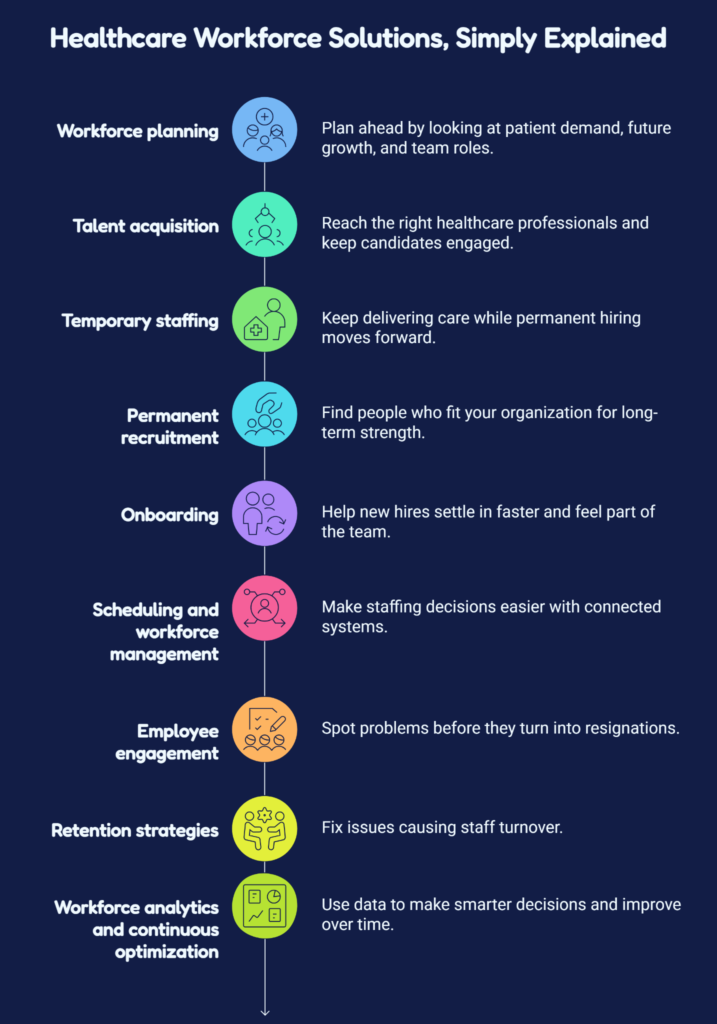
Workforce planning
It’s easy to think workforce planning starts when a department needs more people.
By then, you’re already reacting.
The work starts much earlier. Patient demand changes. New services are added. Some teams grow faster than others. Those changes all affect the number and type of professionals you’ll need.
Looking ahead gives leaders time to prepare instead of trying to solve staffing gaps at the last minute.
Talent acquisition
Posting a job is easy. Getting the right healthcare professionals interested in your organization is the hard part.
A registered nurse or physician may be reviewing several opportunities at once. If your hiring process feels slow, confusing, or disconnected, they may never make it to the final interview.
Talent acquisition looks at that entire experience:
- How are candidates finding your organization?
- Are you communicating clearly?
- Are you moving quickly enough?
Small improvements in those areas can have a big impact on hiring outcomes.
Pro Tip: Every successful hire starts long before the interview. If you want to attract better candidates and keep your pipeline full, don’t miss our guide on how to build a healthcare talent acquisition strategy.
Temporary staffing
Some staffing gaps can’t wait. A nurse goes on leave, patient volumes spike, and a department suddenly needs extra coverage.
Those situations are part of healthcare.
Temporary staffing helps teams keep moving while longer-term decisions are being made. That may mean bringing in contract staff or a locum tenens physician until permanent coverage is in place.
Permanent recruitment
Covering next week’s schedule solves one problem, but building a team that stays with you solves another.
Permanent recruitment is about finding people who fit the role and the organization behind it. Skills matter, of course. So do leadership, career opportunities, workload, and the experience employees have once they join.
The strongest hires usually happen when those pieces line up.
Onboarding
A signed offer is not the finish line. Actually, that’s the starting point.
Think about someone’s first week on the job. They’re learning new systems, meeting a new team, and figuring out how your organization works.
A good onboarding process makes that transition smoother. People know what’s expected, where to find support, and how their role fits into the bigger picture.
Those first weeks matter more than many organizations realize.
Scheduling and workforce management
In healthcare, schedules affect far more than calendars.
One uncovered shift can increase pressure on the rest of the team. Repeat that often enough, and burnout becomes much harder to avoid.
Managing schedules also becomes more difficult when teams are working across disconnected systems. When leaders can see the full picture, staffing decisions become much easier to make.
Key Stat: According to QGenda, 63% of healthcare IT leaders say disconnected workforce technology makes planning harder, while 93% believe consistent systems are essential for better workforce decisions.
Employee engagement
People rarely wake up one morning and decide to leave.
Most of the time, smaller frustrations have been building for a while.
In healthcare, employee engagement means staying close to your teams before those frustrations turn into resignations.
Regular check-ins, honest conversations, and ongoing feedback help leaders understand what’s making the job harder and where more support is needed.
That’s a much better conversation to have than an exit interview.
Retention strategies
Replacing great people gets expensive very quickly.
For instance, replacing one bedside registered nurse costs an average of $60,090, as reported by NSI. Per the same source, RN turnover costs the average hospital between $4.2 million and $6.2 million every year.
The better question isn’t, “How do we replace this employee?”
It’s, “What keeps putting us back in this position?”
Answering that question usually leads to improvements in workload, scheduling, leadership support, career growth, and the overall employee experience.
Workforce analytics and continuous optimization
Every healthcare organization has workforce data. The question is if it’s helping you make better decisions.
Maybe:
- One department keeps losing people faster than the others.
- Some roles always take longer to fill.
- Overtime keeps increasing, but nobody knows exactly why.
Looking at those patterns together makes the next decision much easier.
Instead of reacting to the same staffing issues over and over, leaders can spot trends earlier, make adjustments, and keep improving as their workforce evolves.
How Workforce Solutions Help You Recruit and Retain Top Talent
Healthcare organizations spend a lot of time thinking about hiring.
The problem is that recruitment and retention are connected. If one part isn’t working, the other usually isn’t either.
Here’s where a broader workforce approach starts paying off:
- Better planning leads to better hiring. It’s hard to make a good hire when you’re rushing to replace the last nurse or physician who left. Looking ahead gives your team more time, more options, and a much better chance of finding someone who truly fits the role.
- A smoother employee experience supports long-term retention. The offer letter is only the beginning. Clear onboarding, manageable workloads, realistic schedules, and supportive managers help healthcare professionals settle into their new role.
- Workforce insights help teams improve over time. Maybe one department always struggles to recruit, or another keeps losing experienced staff. Looking at those patterns helps leaders fix the real issue instead of filling the same position every few months.
Recruitment brings people through the door.
Everything that follows gives them a reason to stay.

What Healthcare Organizations Gain From Workforce Solutions
Every healthcare organization wants to hire faster.
But if hiring is the only thing that gets better, you’ll probably find yourself trying to fill the same positions again a few months later.
A stronger workforce approach helps you break that cycle. Here’s what organizations usually gain:
- Faster access to qualified talent. Nobody wants to restart the hiring process every time someone leaves. Better planning and a stronger recruitment process make it much easier to move quickly when the right role opens.
- Lower turnover and stronger workforce stability. Keeping experienced professionals is almost always a better investment than replacing them.
- Greater flexibility when staffing needs change. Having access to permanent hiring, temporary staff, and locum tenens professionals gives your team more ways to respond without putting extra pressure on everyone else.
- More efficient workforce management. It’s much easier to make good staffing decisions when you can see the whole picture. Better data helps leaders spend less time reacting and more time planning.
- Better patient care through consistent staffing. Stable teams create better experiences for everyone. Patients see familiar faces. Healthcare professionals have the support they need. And managers spend less time putting out fires and more time helping their teams succeed.
At the end of the day, the point is building a team that can keep up with patient demand without burning itself out along the way.
How to Choose a Healthcare Workforce Solutions Partner
Anyone can find a workforce partner in the healthcare industry. The real challenge is finding one that’s still helping you a year from now.
Here are a few things worth paying attention to:
- Healthcare expertise that matches your needs. Staffing a private practice isn’t the same as supporting a hospital or a multi-location health system. Look for a partner that understands your environment without needing a crash course in how healthcare works.
- Support across the entire workforce lifecycle. Filling today’s vacancy matters, but the work shouldn’t stop there. Ask how the partner approaches workforce planning, onboarding, scheduling, and retention once someone joins your team.
- Flexible solutions that grow with your organization. Your staffing needs may look completely different next year. New services, changing patient demand, or another location can quickly change what kind of support you need.
- Technology and data that support better decisions. Hiring numbers only tell part of the story. Good workforce data should help you see which roles are harder to fill, where turnover keeps happening, and which areas need more attention.
- A partnership built for long-term success. The strongest partners stay involved after the role is filled. They keep asking questions, sharing ideas, and helping you avoid the same staffing problems a few months later.
Nobody can promise you’ll solve every workforce challenge overnight.
But if you’re still dealing with the exact same hiring problems a year from now, it may be time to question the partnership.

Ready to Build a Stronger Healthcare Workforce Beyond Hiring?
Hiring will always be part of healthcare, but it won’t fix every workforce challenge. That is why building a stronger workforce requires looking beyond the next vacancy.
Workforce planning, recruitment, onboarding, scheduling, engagement, and retention all play a role in creating teams that can support both healthcare professionals and patients.
The organizations that succeed long-term are the ones that stop treating every staffing issue as a separate problem. They look at the bigger picture.
At Medical Flow, we help build that kind of approach. If your organization keeps running into the same staffing challenges, it’s worth taking a closer look at what’s behind them.
Let’s talk and find the best way forward.
FAQs
What are healthcare workforce solutions, and why are they important?
Healthcare workforce solutions bring together the different strategies organizations use to build and support their teams, from workforce planning and hiring to onboarding and retention.
The idea is simple: don’t just fill today’s vacancy. Build a workforce that’s ready for whatever comes next.
What challenges do healthcare workforce solutions aim to solve?
Open positions are only part of the problem. These solutions also help organizations tackle turnover, scheduling pressure, staffing gaps, and the day-to-day challenges that make hiring harder than it needs to be.
How do healthcare workforce solutions help address staffing shortages?
Staffing shortages don’t happen overnight, and they usually aren’t solved overnight either.
Planning ahead, improving recruitment, and giving healthcare professionals good reasons to stay can make a much bigger difference than simply posting another job opening.
How do healthcare workforce solutions improve employee retention?
People rarely leave because of one bad day.
More often, smaller issues build up over time. Better onboarding, manageable workloads, and stronger support help stop those issues before they become resignations.
Can healthcare workforce solutions help reduce labor costs?
Yes, and it usually starts with turnover. Hiring the same positions over and over gets expensive. Keeping experienced professionals on your team is almost always the better investment.