
Hiring in healthcare has become a lot less predictable. Some positions fill quickly, while others stay open for weeks, even months.
In the meantime, your team picks up the extra workload, and hiring managers keep squeezing interviews into already packed schedules. Also, great candidates disappear before you even make a decision.
If you’re tired of feeling like you’re always hiring under pressure, you’re not the only one.
The hiring process needs to keep up, and talent acquisition gives you a way to do exactly that.
Next, we’ll break down how to build a healthcare talent acquisition strategy that can help you attract, hire, and retain top talent.
Let’s begin, shall we?
- TL;DR
- Why Healthcare Talent Acquisition Requires a Different Hiring Strategy
- Meet the Building Blocks of a Successful Healthcare Talent Acquisition Strategy
- The Technology That Gives Recruiters an Advantage
- Small hiring improvements that make top candidates say yes
- When an External Healthcare Talent Acquisition Partner Makes Sense
- Ready to Build a Healthcare Talent Acquisition Strategy That Keeps Working?
- FAQs
TL;DR
Short on time? Here’s a quick breakdown:
- Healthcare hiring has become more competitive, so filling open roles takes more than posting a job.
- A strong healthcare talent acquisition strategy helps you attract qualified professionals before hiring becomes urgent.
- Employer branding, candidate experience, and proactive talent pipelines all play a major role in hiring success.
- Recruiters and hiring managers need to stay aligned to keep the hiring process moving.
- AI and recruitment technology can speed up hiring, but they work best alongside a clear strategy.
- Small improvements, like faster communication and smoother onboarding, can increase offer acceptance rates.
- A specialized healthcare talent acquisition partner can help when your internal team can’t keep up with hiring demand.
Why Healthcare Talent Acquisition Requires a Different Hiring Strategy
Many healthcare organizations think they have a recruiting problem.
But, most of the time, what they have is a strategy problem.
Posting a job every time someone resigns might help you fill today’s vacancy. It won’t make the next hire any easier.
A few months later, you’re back in the same position, competing for the same professionals under even more pressure.
That’s the biggest difference between recruitment and healthcare talent acquisition.
Recruitment focuses on filling an opening.
Talent acquisition looks at the bigger picture. It helps you build a hiring process that keeps bringing qualified people into your pipeline instead of starting from zero every time a role opens.
That shift matters more than ever because today’s hiring challenges go well beyond a talent shortage.
IPMI Fireside Chat | Navigating Healthcare Talent Acquisition & Recruitment
The workforce shortage is only part of the problem
It’s easy to blame every hiring challenge on the workforce shortage.
The numbers certainly show that demand is growing faster than the available workforce.
- Healthcare demand keeps growing. The U.S. Bureau of Labor Statistics continues to project around 1.9 million healthcare job openings each year through 2034, driven by industry growth and replacement needs.
- Physician shortages aren’t going away anytime soon. HRSA estimates the U.S. could face a shortage of more than 141,000 full-time equivalent physicians by 2038, with gaps expected across most specialties.
- Retention is adding even more pressure. A 2025 report by Press Ganey found that 18% of healthcare workers and 17% of nurses left their roles during the previous year. It also highlighted higher turnover among Gen Z registered nurses.
Those numbers explain why hiring feels harder. But they don’t show why some organizations continue attracting great candidates while others struggle to fill the same positions.
Competition extends beyond local employers
There was a time when your biggest competitors were the hospitals and clinics across town.
Well, not anymore.
Today, qualified healthcare professionals — including multilingual healthcare professionals — compare opportunities from regional health systems, national organizations, telehealth providers, staffing firms, and employers in other states. For multilingual professionals, the ability to communicate effectively with diverse patient populations can further expand the range of healthcare organizations and roles available to them. In many cases, they’re considering several offers at the same time.
That raises the bar for everyone.
A competitive salary still matters, but it rarely makes the decision on its own.
Candidates are also paying attention to flexibility, leadership, career growth, scheduling, workplace culture, and the overall hiring experience.
If another employer moves faster or communicates better, that can be enough to close the deal before your process reaches the final interview.
Candidate expectations continue to rise.
Healthcare professionals expect the hiring process to respect their time.
Long gaps without updates, multiple rounds of interviews with no clear purpose, or a vague job description create friction that didn’t need to exist in the first place.
On the other hand, quick communication, realistic timelines, and a well-organized process send a different message.
From a candidate’s perspective, those details can be the deciding factor between accepting your offer and moving on to the next one.
Meet the Building Blocks of a Successful Healthcare Talent Acquisition Strategy
Good hiring doesn’t happen by accident. It’s the result of doing a lot of small things well, over and over again.
The organizations that consistently attract great healthcare talent already have a plan. They know who they’re looking for, how they want to reach them, and what kind of experience they want every candidate to have.
That matters more than many teams realize.
Per benchmark reports, 7 out of 10 talent leaders see hiring as a business priority, not just an HR responsibility. It makes sense. Every unfilled role affects productivity, patient care, team morale, and long-term growth.
So, what does a strong healthcare talent acquisition strategy look like?
Let’s break it down.
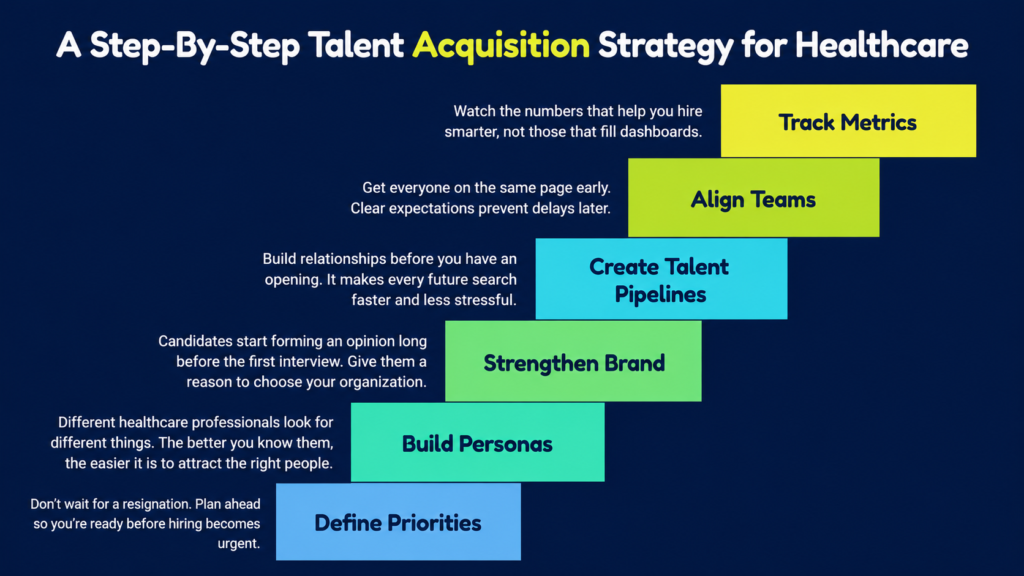
1. Define workforce priorities
Hiring shouldn’t start with an open position.
It should start with a simple question: Who will we need six months from now?
Maybe you’re opening a new location. Maybe patient demand keeps growing in one specialty. Or maybe you already know several retirements are coming this year.
Looking ahead gives you time to prepare instead of rushing to replace people after they’ve already left.
2. Build candidate personas
Not every healthcare professional is looking for the same thing:
- A new graduate may care most about mentorship and career growth.
- An experienced physician may value autonomy.
- And a nurse with young children might prioritize scheduling flexibility over almost everything else.
Understanding your ideal candidates changes the way you hire.
It helps you write stronger job descriptions, focus on the right sourcing channels, and connect with candidates in a way that feels relevant from the very first conversation.
3. Strengthen your employer brand
Candidates do their homework.
Before applying, many will visit your website, check employee reviews, browse your social media, or ask people in their network what it’s like to work with your organization.
That means your employer brand starts long before the first interview.
Show what it’s really like to work on your team. Share employee stories. Highlight professional development opportunities. Give people a reason to picture themselves working there.
A strong employer brand will help the right people decide you’re worth talking to.
4. Create proactive talent pipelines
Waiting until someone resigns is one of the most expensive hiring habits a healthcare organization can have.
The search starts under pressure. Everyone wants the position filled as quickly as possible. And suddenly every decision feels urgent.
A talent pipeline changes that.
Instead of starting from zero, you’re already building relationships with people who could be a great fit down the road. Some aren’t looking today. Others may become available in a few months.
Either way, you’re not introducing yourself for the first time when you need to hire.
5. Align recruiters and hiring managers
This sounds simple, but it isn’t.
Recruiters and hiring managers can have completely different ideas about what the ideal candidate looks like. One moves quickly, while the other wants more interviews. One cares about certifications, and the other focuses on experience.
That back-and-forth slows everything down.
Before the search begins, agree on the basics:
- What skills matter most?
- Which requirements are truly non-negotiable?
- How quickly should feedback happen after each interview?
A few conversations upfront can save weeks later.
6. Track the right hiring metrics
You can’t improve what you don’t measure. But that doesn’t mean tracking dozens of reports every month.
Start with the numbers that help you make better hiring decisions:
- Time-to-fill
- Time-to-hire
- Source of hire
- Offer acceptance rate
- Candidate satisfaction
- Employee retention after hiring
Those metrics tell a story.
If candidates keep dropping out halfway through the process, there’s probably friction somewhere. If one sourcing channel consistently produces stronger hires, it deserves more attention.
The Technology That Gives Recruiters an Advantage
Technology won’t fix a broken hiring process. But it can remove a lot of the friction that slows good hiring down.
Let’s meet the tools that can help your team:
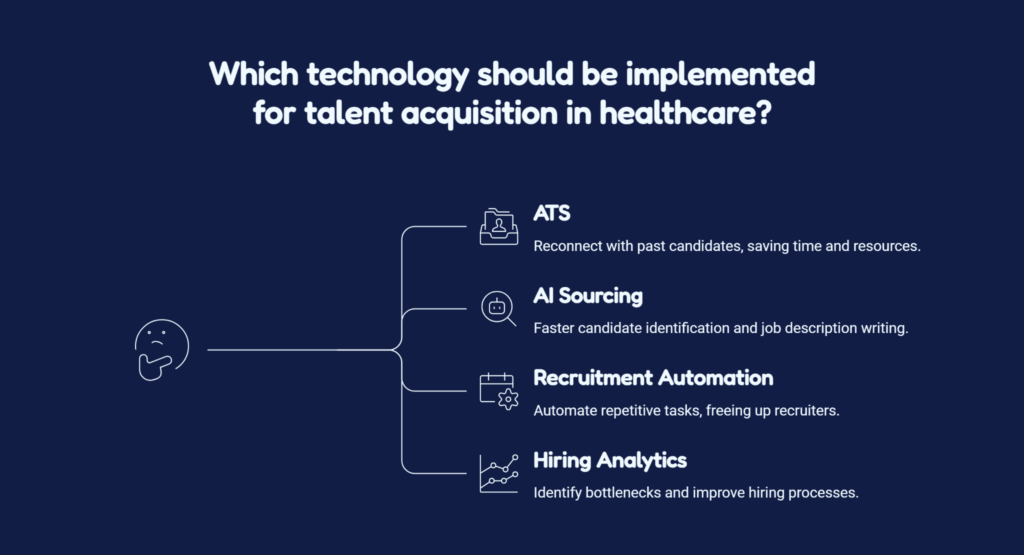
Applicant tracking systems (ATS)
Your next hire might already be sitting in your ATS. Seriously.
According to a symplr and RogueHire’s benchmark study in 2025, 43% of hires had created their ATS profile more than 1,000 days before they were hired.
That’s a reminder that your ATS shouldn’t be treated like a filing cabinet.
Used well, it becomes a searchable talent pool. You can reconnect with past applicants, revisit strong candidates who weren’t the right fit at the time, and fill roles faster without starting every search from scratch.
AI-assisted sourcing
AI has quickly become part of the recruiting toolkit because it helps to work faster.
Instead of spending hours searching for qualified candidates, recruiters can use AI to identify potential matches, surface overlooked profiles, write first drafts of job descriptions, and prioritize applicants based on specific criteria.
It’s no surprise adoption keeps growing. Korn Ferry reports that 84% of talent leaders expect to use AI during 2026 as part of their talent acquisition efforts.
At the same time, the report raises an important point.
Organizations that rely too heavily on automation for entry-level hiring could end up creating leadership gaps in the future.
After all, today’s entry-level hires are tomorrow’s managers and department leaders.
Recruitment automation
Recruiters shouldn’t spend their day sending interview reminders or updating spreadsheets.
Automation can take care of many of those repetitive tasks while keeping the hiring process moving.
For example, you can automate:
- Interview scheduling
- Candidate status updates
- Reminder emails
- Reference check requests
- Interview feedback collection
None of this replaces human interaction, but it creates more time for it.
That means recruiters can focus on conversations, relationship building, and evaluating candidates instead of getting buried in administrative work.
Hiring analytics
Every hiring process leaves behind useful data. The question is if you’re using it.
Hiring analytics can show:
- Where candidates are dropping out.
- How long can each stage take.
- Which sourcing channels can produce the strongest hires.
- Where bottlenecks are slowing your team down.
Those insights make it much easier to improve your process over time.
Small hiring improvements that make top candidates say yes
Many hiring teams spend months trying to attract better candidates.
Sometimes the biggest opportunity is improving the experience after someone applies.
A report by CareerPlug found that 66% of candidates said a positive hiring experience influenced their decision to accept an offer. On the other hand, 26% turned down offers because of a poor experience.
That’s a reminder that every interaction matters.

The good news is that improving the candidate experience doesn’t always require major changes. Small adjustments can have a surprisingly big impact:
- Keep communication consistent: Nobody likes wondering what happened after an interview. Regular updates, even when there’s no final decision yet, help candidates stay engaged.
- Reduce hiring delays: Long hiring processes create more opportunities for candidates to accept another offer. Review your workflow, remove unnecessary interview rounds, and make decisions as quickly as possible without sacrificing quality.
- Set clear expectations: Tell candidates what the process looks like, who they’ll meet, and when they should expect updates. Clear expectations reduce uncertainty and create a much better experience from the beginning.
- Create a smoother onboarding experience: Hiring doesn’t end when someone signs the offer letter. A structured onboarding process helps new employees feel confident, productive, and connected from day one.
Small improvements like these help your organization stand out.
Because here’s the reality: Candidates compare hiring experiences just as much as they compare salaries and benefits.
If your process feels slow, confusing, or disorganized, they’ll notice. In fact, Symplr and RogueHire’s report also found that 60% of healthcare candidates were dissatisfied with the application process.
Fixing those pain points won’t eliminate every hiring challenge. But it does give more candidates a reason to stay engaged all the way through to “yes.”
When an External Healthcare Talent Acquisition Partner Makes Sense
Your recruiting team can’t do everything, and they shouldn’t have to.
Bringing a healthcare talent acquisition partner won’t replace your internal team. They’ll help them breathe again.
Let’s see how you can tell if that extra help makes sense for your organization.
Signs your team has reached its limit
Let’s clear up one misconception first: bringing in outside recruiting support doesn’t mean your team isn’t doing a good job.
Sometimes there’s simply too much hiring for the people you have.
Here are a few signs you’ve reached that point:
- Critical roles stay open for months. Every week that passes puts more pressure on the people already covering those shifts.
- Recruiters are juggling too many openings. At some point, keeping every candidate engaged becomes almost impossible.
- Hiring managers struggle to keep up with interviews. Feedback takes days, schedules keep changing, and strong candidates don’t wait around forever.
- Your organization is growing faster than your hiring capacity. New locations, new services, or larger patient volumes can create hiring needs almost overnight.
- You keep searching for hard-to-find specialists. Some roles require industry connections that take years to build.
If you’re nodding your head while reading this, outside support is worth considering.
What a specialized partner brings
A good recruiting partner doesn’t show up with a stack of resumes and disappear. They roll up their sleeves and help keep the entire hiring process moving.
That can include:
- Access to healthcare professionals that your team may not be reaching today. Experienced healthcare recruiters spend every day building relationships with nurses, physicians, allied health professionals, and healthcare leaders.
- A stronger pipeline before hiring becomes urgent. Instead of starting every search from scratch, you already have qualified people to talk to.
- Less administrative work for your team. Screening candidates, coordinating interviews, and keeping communication flowing all take time. A recruiting partner can take much of that off your team’s plate.
- Healthcare-specific expertise. Clinical hiring comes with licensing, credentialing, and compliance requirements that general recruiters don’t always know inside and out.
- A second set of eyes. Sometimes the biggest hiring bottleneck is hiding in plain sight. An outside partner can usually spot those issues much faster because they’re looking at the process with fresh eyes.
How to choose the right provider
Not every recruiting firm understands healthcare, and that matters more than you might think.
Before choosing a partner, ask questions like these:
- Do they focus on healthcare recruiting, or is healthcare just one of many industries they serve?
- Have they filled roles similar to the ones you’re hiring for?
- How do they communicate with clients and candidates throughout the hiring process?
- Will they take time to understand your culture, your hiring goals, and the kind of people you’re looking for?
- Can they keep supporting your team as your hiring needs change?
The right partner shouldn’t create more work for your team. Instead, it should make hiring feel a little less overwhelming.

Ready to Build a Healthcare Talent Acquisition Strategy That Keeps Working?
Healthcare hiring probably isn’t getting easier next quarter. So, waiting for the market to calm down isn’t much of a strategy.
The organizations making the biggest hiring gains are making the changes they need to make. And yes, none of them happen overnight. But they add up.
Over time, they help you hire faster, keep great candidates interested, and build a workforce that’s better prepared for whatever comes next.
If you’re looking for extra support along the way, Medical Flow works with healthcare organizations to strengthen hiring strategies, improve operational workflows, and build recruitment processes that support long-term growth.
Because great hiring doesn’t start when someone resigns. It starts long before that.
FAQs
What makes healthcare talent acquisition different from traditional recruiting?
A lot of people use those terms interchangeably, but they’re not the same thing.
Recruitment is about filling an open role. Healthcare talent acquisition takes a longer view. It focuses on building relationships, growing your talent pipeline, and making sure you’re ready before the next vacancy appears.
How can healthcare organizations improve their talent acquisition strategy?
Think about the roles you’ll likely need in the next six months, where those candidates spend their time, and what your hiring process feels like from their perspective.
Then look for friction. Slow communication, confusing interviews, or unclear job descriptions are all things you can improve without rebuilding your entire process.
How do healthcare organizations attract and recruit top talent?
Posting another job ad isn’t enough anymore.
The organizations attracting great healthcare professionals stay visible long before they’re hiring. They invest in their employer brand, build relationships with candidates, encourage employee referrals, and use several sourcing channels instead of relying on just one.
The more places people see your organization, the easier it becomes to stay on their radar when they’re ready for a change.
How can healthcare organizations leverage technology and AI in talent acquisition?
Think of technology as a way to give your recruiters more time.
AI can help identify qualified candidates, applicant tracking systems can keep hiring organized, and automation can take repetitive tasks off your team’s plate. All of that makes the hiring process faster and easier to manage.
Just don’t expect technology to fix a hiring strategy that isn’t working.
What metrics are used to measure the success of healthcare talent acquisition efforts?
Keep an eye on time-to-fill, time-to-hire, offer acceptance rate, source of hire, candidate satisfaction, and employee retention after hiring.
Those numbers help you spot patterns. And once you know where candidates are dropping off or what’s slowing your team down, improving the process becomes much easier.