Healthcare teams already have the data.
What they struggle with is catching problems early enough to do something about them.
A patient’s condition worsens overnight, readmissions keep climbing, and the staff works across disconnected systems.
That pressure is exactly why AI predictive analytics in healthcare is growing so quickly. And adoption is accelerating fast: 75% of U.S. health systems now use at least one artificial intelligence application, up from 59% in 2025.
But… what does that look like in practice?
Next, we will break down how these analytics work in healthcare, where it creates the biggest impact, and what providers need before implementing it successfully.
Let’s take a look.
- TL;DR
- What Is AI Predictive Analytics in Healthcare?
- Why Predictive Analytics Matters in Modern Healthcare?
- How AI Predictive Analytics Works in Healthcare?
- The Most Valuable Use Cases for AI Predictive Analytics in Healthcare
- How Healthcare Organizations Benefit From Predictive Analytics
- What Healthcare Organizations Need Before Implementing Predictive Analytics
- Bottom Line: Predictive Analytics Is No Longer Optional in Healthcare
- FAQs
TL;DR
Before getting into models, workflows, and implementation challenges, here’s the short version:
- AI predictive analytics in healthcare helps providers detect risks earlier.
- Predictive models improve patient outcomes and reduce avoidable complications.
- Healthcare organizations use patient data to support faster clinical decisions.
- Machine learning systems help hospitals reduce readmissions and operational inefficiencies.
- AI-driven predictive analytics improves staffing, resource planning, and patient monitoring.
- Better healthcare data usually leads to more accurate predictions.
- Poor integration, weak data quality, and compliance issues still create major implementation problems.
What Is AI Predictive Analytics in Healthcare?
For starters, AI predictive analytics in healthcare uses artificial intelligence, machine learning, and patient data to predict future outcomes before problems escalate.
That can include:
- Identifying patients at high risk for complications.
- Predicting hospital readmissions.
- Detecting early signs of sepsis.
- Forecasting staffing shortages.
- Flagging billing anomalies.
- Supporting chronic disease management.
Instead of only reviewing what has already happened, predictive analytics helps healthcare providers see what could happen next.
And honestly, that shift changes a lot inside a hospital.
Most healthcare teams already have more data than they can realistically process manually. The issue is catching the right signals early enough to act on them.
That’s where an AI-powered health platform starts becoming useful in practice, healthcare AI technology can continuously scan incoming patient data, surface the signals that matter, and turn raw information into decisions teams can actually act on.
Google AI – Predictive Analytics in Healthcare Industry
The healthcare data behind predictive AI models
Most predictive analytics systems pull data from sources like:
- Electronic health records: These contain a huge amount of patient health data. Diagnosis history, medications, allergies, physician notes, vital signs, and treatment plans all help predictive models identify risk patterns over time.
- Medical imaging: AI systems can review imaging studies like X-rays, CT scans, and MRIs much faster than traditional workflows. That speed helps healthcare professionals prioritize urgent cases earlier, especially when teams are overloaded.
- Claims and billing data: These help spot denied claim patterns, fraud risks, billing inefficiencies, and revenue cycle problems before they scale.
- Wearable devices and remote monitoring tools: They generate continuous health data outside the hospital. Heart rate changes, oxygen levels, glucose readings, and sleep patterns all help predictive analytics systems monitor patient health in real time.
- Lab results and genomic data: It helps predictive models identify disease risks and treatment response patterns earlier. That’s becoming a major part of precision medicine and preventive care strategies across modern healthcare systems.
Why Predictive Analytics Matters in Modern Healthcare?
Healthcare teams are under pressure everywhere right now. More patients, data, and operational complexity, but less time.
That’s a huge reason predictive analytics in healthcare is growing so fast. As reported by Xtended View, 80% of hospitals now use AI in clinical workflows or operational tools.
So, where is predictive analytics creating the biggest impact?
Let’s find out.
Preventive care is becoming a bigger priority
Treating complications late gets expensive fast. Predictive analytics helps healthcare providers identify high-risk patients earlier using historical data, patient health trends, and real-time monitoring signals.
That gives care teams more time to intervene before conditions worsen.
Faster clinical decisions reduce operational pressure
Healthcare professionals already deal with nonstop information overload.
Patient monitoring, EHR alerts, imaging reviews, admin work, staffing shortages – it stacks up quickly.
In these cases, predictive analytics helps providers prioritize faster by surfacing risks earlier instead of forcing teams to manually catch every pattern themselves.
Healthcare organizations are investing heavily in AI
Healthcare AI investment keeps accelerating. The global healthcare predictive analytics market is projected to grow to $32.95 billion in 2026.
At the same time, patients are becoming more comfortable with AI-driven healthcare tools. Per reports, one in three adults (33%) used AI for health information or advice in the past year.
And that shift is pushing healthcare organizations to modernize faster.
How AI Predictive Analytics Works in Healthcare?
The idea behind predictive analytics is simple: use healthcare data to identify patterns tied to future risks and outcomes.
But making that work inside a real healthcare system is much harder than it sounds:
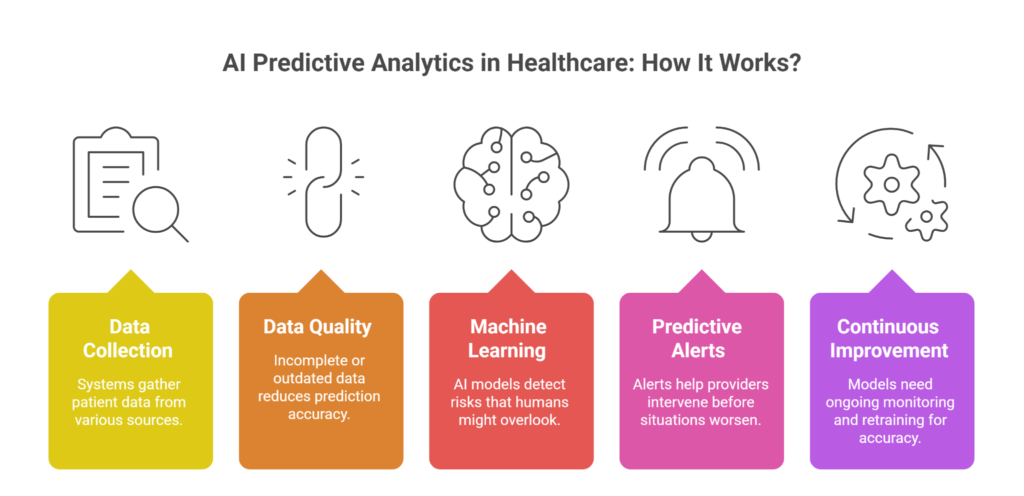
It starts with collecting patient data
Predictive analytics systems pull information from multiple healthcare sources at once.
That includes:
- Electronic health records.
- Claims systems.
- Lab results.
- Imaging platforms.
- Wearables and remote monitoring tools.
- Scheduling and operational systems.
The more connected the healthcare data is, the more accurate the predictions become.
Data quality directly affects prediction accuracy
Bad healthcare data creates bad predictions.
Incomplete records, duplicated information, delayed updates, and disconnected systems can all reduce prediction accuracy fast.
And in healthcare, unreliable predictions create operational risk instead of reducing it.
Machine learning models identify patterns humans miss
Once the data is organized, machine learning models analyze it for patterns tied to specific risks and health outcomes.
That can include:
- Readmission risks.
- Sepsis detection.
- Patient deterioration.
- Medication adherence issues.
- Staffing shortages.
And unlike manual review workflows, AI systems can process massive amounts of healthcare data in seconds.
Predictive alerts help providers act earlier
Most predictive analytics systems generate alerts when risks start increasing.
That could mean a sepsis warning, signs of patient deterioration, or a high readmission risk score before discharge. Even a small delay can escalate quickly.
Predictive models require continuous improvement
Predictive models don’t stay accurate forever. Patient populations change, clinical workflows shift, and healthcare data evolves constantly.
So healthcare organizations need continuous monitoring and retraining to keep predictions reliable over time.
The Most Valuable Use Cases for AI Predictive Analytics in Healthcare
This is where predictive analytics starts becoming very real for healthcare providers.
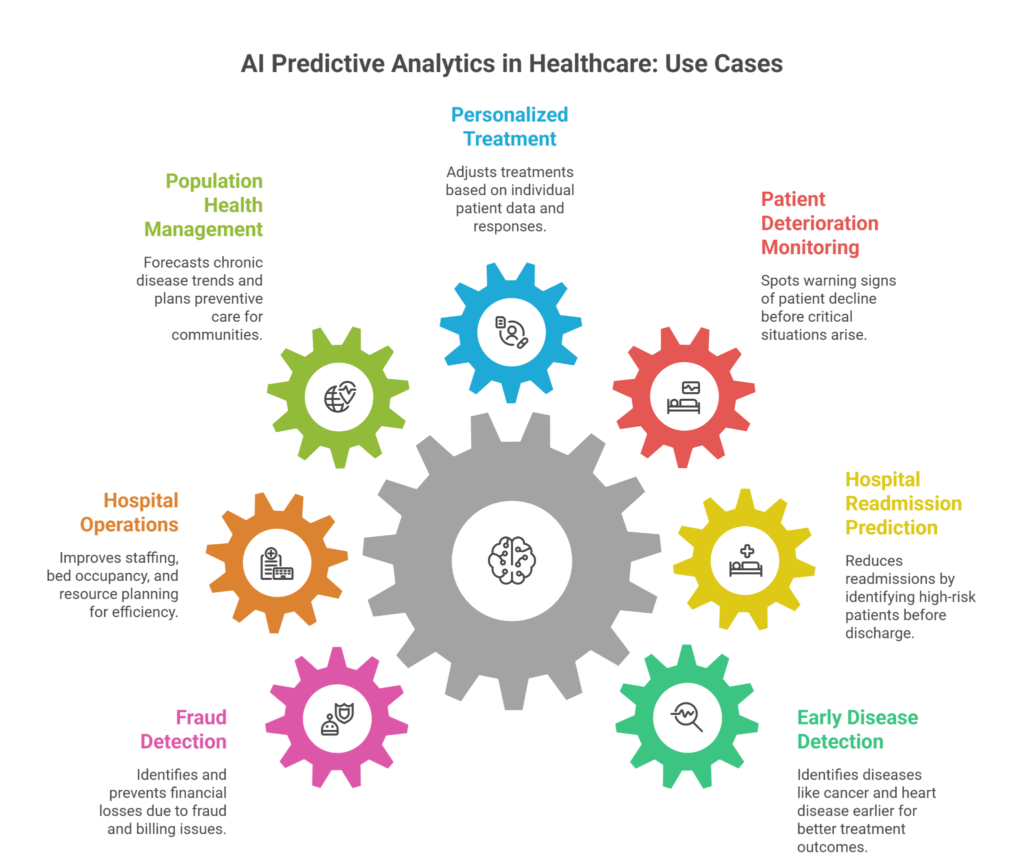
Here are the main use cases of this technology:
Early disease detection and risk prediction
A big advantage of AI predictive analytics in healthcare is catching risks earlier. That includes conditions like:
- Cancer.
- Heart disease.
- Diabetes.
- Sepsis.
Predictive models analyze patient data, lab results, historical trends, and real-time monitoring signals to identify patterns tied to disease progression.
And in healthcare, earlier detection changes everything.
A sepsis diagnosis delayed by a few hours can completely change patient outcomes. The same goes for cancer progression or cardiac events that weren’t identified early enough.
That’s why healthcare organizations are investing so heavily in predictive healthcare analytics right now.
Key Stat: AI diagnostics now achieve 94% accuracy compared to 88% for human physicians alone. Even a small accuracy gap like that can mean catching critical conditions before it’s too late.
Hospital readmission prediction
Readmissions create pressure across the entire healthcare system. Costs increase, bed capacity shrinks, and staff workloads grow even faster.
AI predictive analytics helps providers identify high-risk patients before discharge, so care teams can intervene earlier.
That can include:
- Stronger discharge planning.
- Medication adherence support.
- Follow-up scheduling.
- Remote patient monitoring.
- Post-discharge outreach.
And the results are already measurable. Per reports, hospitals using predictive analytics reduced readmission rates by 10-20%.
Patient deterioration monitoring
Some patients deteriorate slowly, others crash fast.
That’s what makes predictive monitoring so valuable inside hospitals and remote care programs.
AI models can track changes in patient health data continuously and flag deterioration risks earlier, before the situation becomes critical.
That visibility helps a lot in:
- Intensive care units.
- Emergency departments.
- Remote patient monitoring programs.
- Chronic disease management.
Because when clinical teams are overloaded, subtle warning signs are easy to miss manually.
Personalized treatment recommendations
Not every treatment works the same way for every patient.
Using predictive analytics helps personalize care using patient history, medication response patterns, risk factors, and real-time health data.
In practice, that can mean adjusting treatments earlier, reducing adverse reactions, or identifying which patients may struggle with medication adherence before problems appear.
And that last part matters more than people think: AI-driven adherence forecasting improves medication compliance by up to 30% in chronic disease management programs.
Population health management
Managing population health sounds manageable on paper.
Then you look at the reality: thousands of patients, rising chronic disease rates, disconnected care teams, and limited staff trying to keep up with all of it at once.
That’s where predictive analytics starts becoming extremely useful. It helps providers make smarter decisions around:
- Chronic disease forecasting.
- Community risk analysis.
- Preventive care planning.
- Resource allocation.
And across large healthcare systems, those decisions have a massive operational impact over time.
Hospital operations and resource planning
Not every healthcare problem starts in a patient room; a lot of them start operationally.
Poor staffing visibility, bed shortages, scheduling gaps, supply chain delays… All these inefficiencies slowly create chaos across the entire healthcare facility.
Using this type of AI analytics helps providers see those problems earlier instead of reacting once everything bottlenecks at the same time.
That includes:
- Bed occupancy forecasting.
- Staff scheduling optimization.
- Appointment no-show prediction.
- Supply chain forecasting.
And when hospitals can plan ahead more accurately, teams spend less time scrambling during peak demand.
Fraud detection and revenue protection
Healthcare organizations lose huge amounts of revenue through fraud, denied claims, and billing issues every year.
The problem is that many of those patterns stay invisible until the financial damage is already done.
Well, predictive analytics helps providers catch anomalies earlier using claims data, historical billing activity, and machine learning analysis.
That can help identify:
- Insurance fraud risks.
- Unusual billing behavior.
- Claims anomalies.
- Revenue cycle inefficiencies.
And for large healthcare systems processing massive amounts of claims daily, catching those issues earlier makes a very real financial difference.
How Healthcare Organizations Benefit From Predictive Analytics
At first, a lot of providers see predictive analytics as just another AI tool.
Then the operational impact starts showing up. Fewer avoidable complications, faster decisions, better visibility, and less pressure on overloaded teams.
That’s why healthcare organizations keep investing in predictive analytics so aggressively:
Better patient outcomes through earlier intervention
Timing changes everything in healthcare. The earlier providers catch a risk, the easier it becomes to prevent the situation from escalating.
AI models can surface warning signs tied to sepsis, patient deterioration, chronic disease progression, and readmission risks while there’s still time to intervene properly.
Faster and more informed clinical decisions
Most healthcare teams already operate under nonstop pressure.
EHR alerts pile up, imaging reviews keep coming in, and staffing gaps force teams to move even faster while managing admin work at the same time. That environment makes delays almost inevitable.
With machine learning models analyzing healthcare data continuously in the background, providers can prioritize high-risk patients faster instead of manually digging through disconnected systems all day.
Lower operational costs and fewer inefficiencies
Small operational problems rarely stay small inside hospitals.
A staffing gap affects response times. Delayed discharges create capacity issues. And scheduling problems start affecting multiple departments at once.
Catching those patterns earlier gives healthcare organizations more room to respond before operations start falling behind.
That can improve:
- Staffing visibility.
- Scheduling decisions.
- Capacity planning.
- Resource allocation.
And over time, those operational gains create measurable cost savings too.
Smarter resource allocation across healthcare systems
Most healthcare systems are already stretched thin.
Teams are expected to handle growing patient demand with limited staff, limited capacity, and nonstop operational pressure.
Better forecasting gives providers a chance to plan ahead instead of constantly reacting in real time. That becomes especially useful during:
- Seasonal patient surges.
- Emergency response situations.
- Staffing shortages.
- High-demand care periods.
Because once resource allocation starts breaking down, the pressure spreads everywhere else very quickly.
Better patient experiences and personalized care
Patients expect healthcare to feel faster and more personal now.
Long wait times, generic communication, and reactive care models create frustration quickly.
With access to treatment history, behavioral patterns, and patient health data, providers can personalize care much more effectively.
That can support:
- Better follow-up timing.
- More personalized treatment plans.
- Improved chronic disease management.
- Stronger patient engagement.
And when patients feel supported earlier, retention usually improves naturally too.
Stronger support for preventive healthcare strategies
Preventive care gets much easier when providers can identify risks before complications escalate.
That shift is a major reason healthcare organizations keep increasing investment in AI-driven predictive analytics.
And financially, many providers are already seeing the results. As Xtended View also reported, more than 40% of health systems report moderate to significant ROI from generative AI deployments.
For healthcare teams balancing operational pressure, staffing shortages, and patient outcomes all at once, those numbers are getting harder to ignore.

What Healthcare Organizations Need Before Implementing Predictive Analytics
A lot of healthcare organizations jump into predictive analytics too fast.
They buy the platform, schedule the rollout, and expect the AI to magically fix operational problems on its own.
That’s usually where things start going sideways, because predictive analytics is only as strong as the systems, workflows, and teams behind it.
Before implementation starts, healthcare providers need a few things in place first:
- Clear clinical and operational goals: Predictive analytics needs a real purpose from day one. Reducing readmissions, improving staffing visibility, identifying high-risk patients, optimizing workflows… Providers need clarity on what they’re trying to improve before the rollout even begins.
- Reliable healthcare data infrastructure: Bad healthcare data creates bad predictions. It’s that simple. EHR systems, lab results, patient records, and operational data all need to stay connected, accurate, and consistently updated.
- Strong compliance and data governance practices: Patient privacy cannot become an afterthought halfway through implementation. Healthcare organizations need strong HIPAA compliance, cybersecurity protections, access controls, and governance policies before predictive analytics scales across the system.
- Technology that integrates cleanly with existing workflows: If the platform slows teams down or creates extra workflow friction, adoption drops fast. Predictive analytics tools need to fit naturally into how healthcare professionals already work.
- Collaboration between clinical and IT teams: This is where a lot of implementations struggle. Clinical teams understand patient care. IT teams understand infrastructure and integrations. Predictive analytics needs both sides working together from the beginning.
- Staff training and adoption support: Even strong AI tools fail when teams don’t trust the system or don’t fully understand how to use it inside daily workflows. Training matters far more than most organizations expect.
- Continuous performance monitoring: Predictive models need regular monitoring and retraining over time. Healthcare data changes constantly, and prediction accuracy can quietly decline if nobody is paying attention.
Bottom Line: Predictive Analytics Is No Longer Optional in Healthcare
As you can see, AI predictive analytics in healthcare is no longer something providers are “experimenting” with on the side.
For many healthcare organizations, it’s already becoming part of daily operations.
But, at the same time, implementation still requires real preparation. Healthcare providers need the right infrastructure, workflows, and support behind it if they want predictive analytics to create long-term value.
That’s where having a partner like Medical Flow matters. If your team is planning to implement predictive analytics or improve virtual care workflows, let’s talk about what that could look like inside your healthcare system.
FAQs
How does AI contribute to predictive analytics in healthcare?
Healthcare teams already have massive amounts of data. The problem is catching the right signals before something goes wrong.
AI helps by analyzing patient records, lab results, monitoring systems, and historical data fast enough to spot patterns humans can easily miss when things get busy.
How does AI predictive analytics improve patient outcomes?
Mostly through earlier intervention. If providers can identify deterioration risks, sepsis warning signs, or readmission risks sooner, they have more time to respond before the situation escalates.
And in healthcare, even a small timing advantage can change outcomes completely.
Why is predictive analytics important for healthcare providers?
Because most healthcare teams are already overloaded.
More patients, more data, more operational pressure – all happening at once.
Predictive analytics helps providers prioritize faster and reduce some of the constant reactive decision-making that burns teams out over time.
What types of data support AI predictive analytics in healthcare?
Predictive analytics pulls information from multiple systems at the same time.
Electronic health records, lab results, imaging studies, wearable devices, claims systems, remote monitoring platforms… All of that healthcare data helps predictive models identify risks and trends earlier.
How can healthcare organizations protect patient data when using predictive analytics?
Healthcare organizations need strong security from the start, not halfway through implementation.
That includes HIPAA-compliant workflows, encrypted systems, secure integrations, access controls, and clear governance around who can access patient data and how it’s being used.