By
By 
Healthcare data breaches hit a grim all-time record last year: 772 large breaches, about 138.5 million individuals affected, an average of 2.1 every single day. That’s not a spike. That’s a new baseline.
At the same time, remote care has become a structural part of how medicine gets delivered. By 2024, 79% of U.S. hospitals had integrated telemedicine into their daily care models, making uninterrupted internet and software access a clinical necessity for even small ambulatory clinics.
The problem? Every telemedicine provider, remote biller, and virtual care coordinator connects to electronic protected health information (ePHI) from a network the clinic never chose, can’t configure, and can’t monitor. That’s a gaping, unmanaged attack surface that most security programs still treat as an afterthought.
And here’s the 2026 twist: proposed HIPAA Security Rule updates are about to make this a compliance failure, not just a security worry.
Below, we’ll map the five hidden gaps that remote work punches into healthcare security — and approaches worth exploring before gaps widen.
Disclaimer: This article is intended for general informational purposes only and does not constitute legal, compliance, or security advice. Healthcare organizations should consult qualified legal and security professionals regarding their specific HIPAA obligations and cybersecurity needs.
- Why Healthcare Remote Work Is a Unique Security Problem
- Gap #1 — The Unsecured Home Network
- Gap #2 — Credential Theft and Identity Compromise
- Gap #3 — Unmanaged Personal Devices and BYOD Risks
- Gap #4 — Insider Threats Amplified by Distance
- Gap #5 — Unmanaged Third-Party and Vendor Access
- Security Approaches Healthcare Organizations Are Exploring
- Caveats and Counterpoints — Where the Framework Faces Friction
- Conclusion — 2026 Is the Year Clinics Are Watching Closely
Why Healthcare Remote Work Is a Unique Security Problem
The Stakes Are Higher Than Any Other Industry
Healthcare has worn the ugliest crown for 14 years straight — the highest data breach cost of any sector. In 2025, the average breach tallied $7.42 million.
And the volume of exposed records isn’t just high, but accelerating. The number of individuals caught up in healthcare breaches soared 58% in 2024 to more than 289 million — almost 85% of the entire U.S. population. Worse, hacking and IT incidents drove more than 80% of large breaches last year, so the attacks aren’t slowing down.
The damage goes beyond dollars. In 2025, healthcare organizations faced potential patient care disruptions from cyber incidents, including delayed appointments, diverted ambulances, and locked electronic health records.
When a ransomware attack stops a clinic from accessing patient histories, the risk is measured in human terms, not just financial.
Three Forces Make Remote Work Especially Dangerous
First, the telehealth surge isn’t fading. The U.S. telehealth market is racing toward $150.13 billion by 2030, growing at 23.8% each year — this isn’t a temporary pandemic shift; it’s the new clinical delivery model.
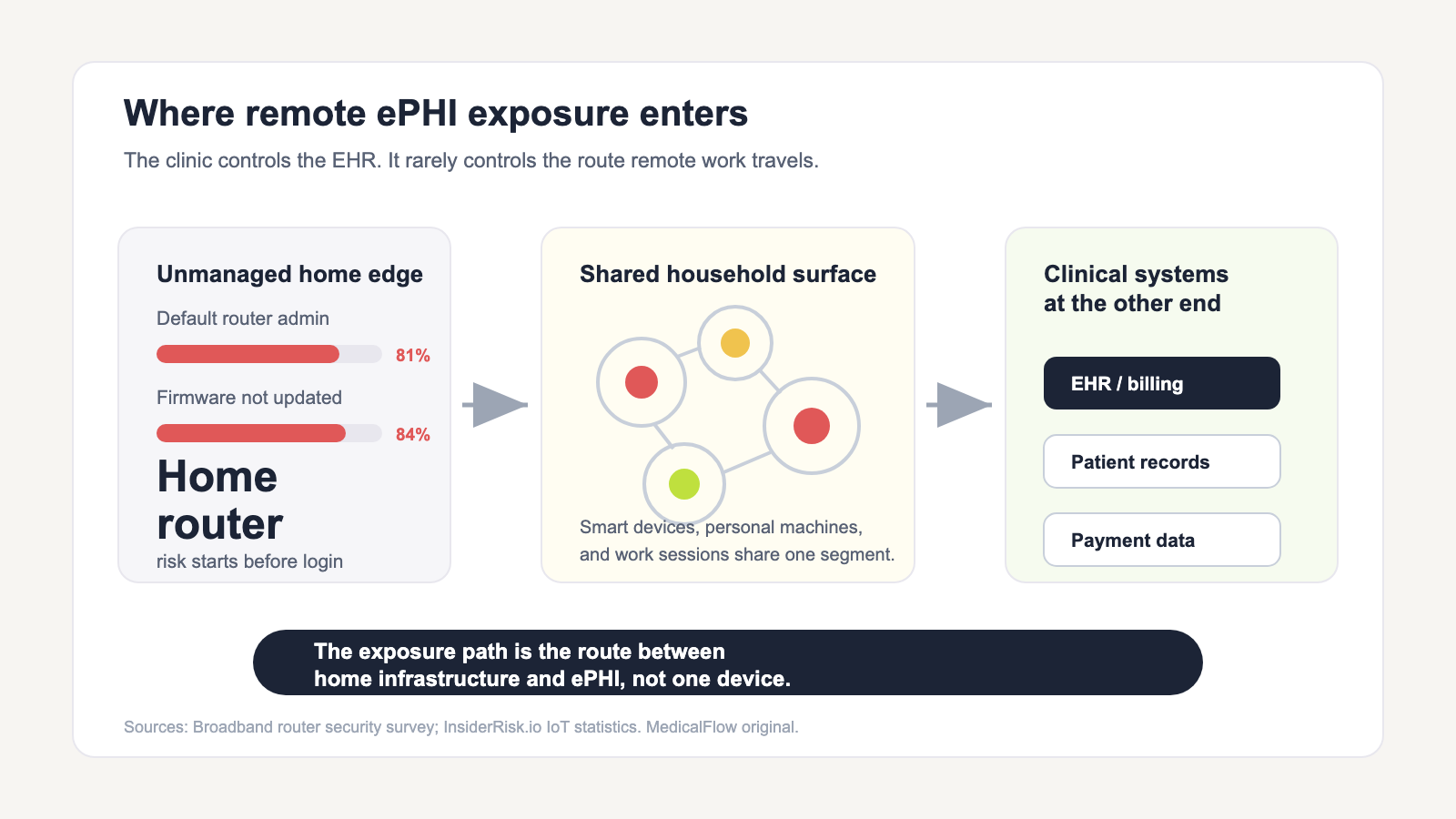
Second, the home network is uncontrolled. A billing coordinator accessing Medicare systems over a residential internet connection shares bandwidth with every unpatched smart speaker, gaming console, and IoT gadget in the household, each one a potential pivot point into your patient data.
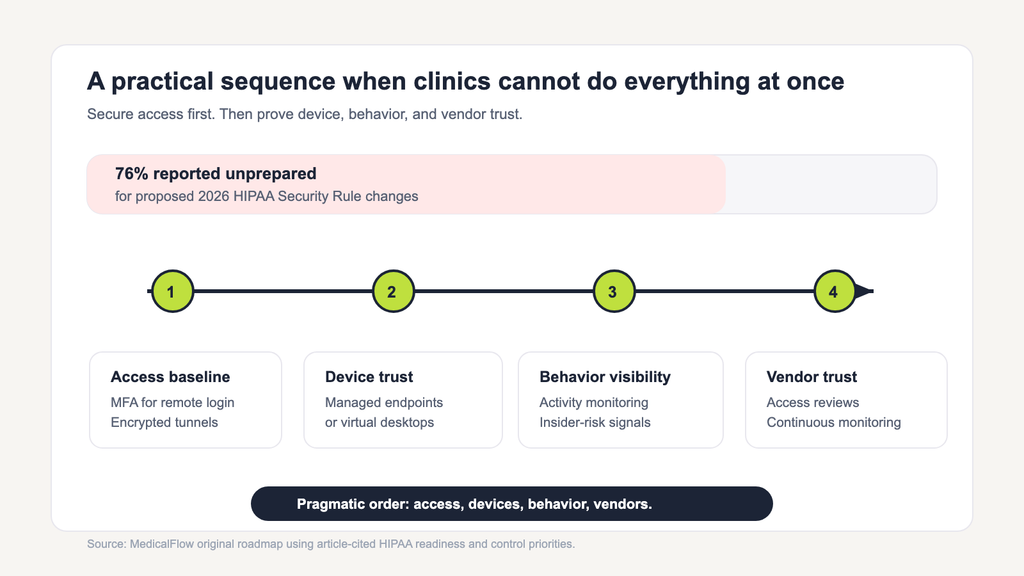
Third, compliance is tightening. 76% of healthcare organizations were unprepared for the proposed 2026 HIPAA Security Rule requirements at the time of assessment, despite the rule’s mandated upgrades to MFA, encryption, and access controls.
Gap #1 — The Unsecured Home Network
Picture it: a clinician logs into the EHR from a laptop connected to the same home WiFi as a smart TV, a handful of IoT devices with unpatched firmware, and maybe a teenager’s gaming rig. That’s not a hypothetical; it’s the daily reality of remote healthcare work.
Now look at how people actually manage their routers. In a 2025 survey of over 3,200 internet users, 81% had never changed the default administrator password, 84% had never updated the firmware, and 47% hadn’t touched a single factory setting.
Those are the gateways your remote workforce uses to handle ePHI. And home routers now account for over 50% of the most exploitable device categories.
More than half of IoT devices carry critical, exploitable vulnerabilities, and one in three data breaches now involves an IoT device — a particular hazard when the smart speaker, doorbell, and work laptop all share one unmanaged WiFi segment.
HIPAA’s Transmission Security standard requires safeguards for ePHI moving over electronic networks — a requirement most home networks violate by default.
Organizations without encrypted tunnels for remote ePHI access may be relying on consumer-grade home routers that carry significant unmanaged risk.
Gap #2 — Credential Theft and Identity Compromise
Stolen credentials are the front door. According to Verizon’s 2025 DBIR healthcare snapshot, 88% of Basic Web Application Attack breaches involved stolen credentials.
The math is simple: if an attacker grabs a single set of valid remote credentials, they’re often inside your systems before anyone blinks.
The Change Healthcare catastrophe proved just how devastating that can be. Attackers exploited weak remote access controls, lurked inside the network for days, then detonated ransomware that exposed data for nearly 190 million individuals.
Phishing remains the delivery engine of choice. The proposed 2026 HIPAA Security Rule updates would introduce MFA requirements for remote access sessions, a development many organizations are already preparing for.
Gap #3 — Unmanaged Personal Devices and BYOD Risks
Bring-your-own-device sounds flexible and cost-effective — until you see the numbers. Despite 95% of organizations allowing personal devices for work, 48% suffered data breaches linked to unsecured BYOD over a recent year.
Remote administrative staff face a triple threat: an uncontrolled home network, a personal laptop the IT team has never touched, and zero physical office security controls.
The consequences are already visible — in 2023 alone, over 40 million patient records were exposed through improper use of communication tools by remote staff, including unapproved video platforms, unencrypted email, and messaging apps without business associate agreements.
And shadow IT makes it worse. Shadow IT represents 42% of all company applications; the average healthcare organization has 975 unknown cloud services against only 108 tracked ones, and 67% of Fortune 1000 employees use unauthorized SaaS apps, all without the security controls that managed tools carry.
When a remote biller uploads patient financial data to a personal file-sharing app, no amount of office firewall policy can catch it.
Gap #4 — Insider Threats Amplified by Distance
Distance doesn’t just make oversight harder — it multiplies the risk. Insider threats rose 58% with the shift to remote work; 83% of organizations reported at least one insider attack in 2024, and remote workers are three times more likely to accidentally expose data than their in-office peers.
Catching these incidents is brutal. 90% of security professionals say remote insider threats are tougher to detect than external attacks, 53% of organizations find it tougher to spot insider attacks in the cloud, and many blame spiraling IT complexity.
The price tag is sobering. The global average annual cost to resolve insider incidents reached $17.4 million per organization in 2025 — a 109% jump since 2018 — with an average of 81 days just to detect and contain each incident.
That’s nearly three months of someone inside your tent, every single time.
Gap #5 — Unmanaged Third-Party and Vendor Access
The business associate breach problem has quietly turned into a crisis. Large breaches involving business associates hit 43% in the first half of 2026 — up from roughly 20% through 2017.
And the pain isn’t theoretical: 74% of healthcare organizations felt the impact of a third-party breach within a recent 24-month window, and HIPAA penalties — ranging from $145 to $2,190,294 per violation — don’t stop at the clinic door.
They apply just as readily to offshore or home-based administrative staff who lack proper training or access controls, flowing through every third-party relationship.
Yet 63% of healthcare organizations do not continuously monitor their digital supply chains, leaving blind spots in third-party access to ePHI.
Security Approaches Healthcare Organizations Are Exploring
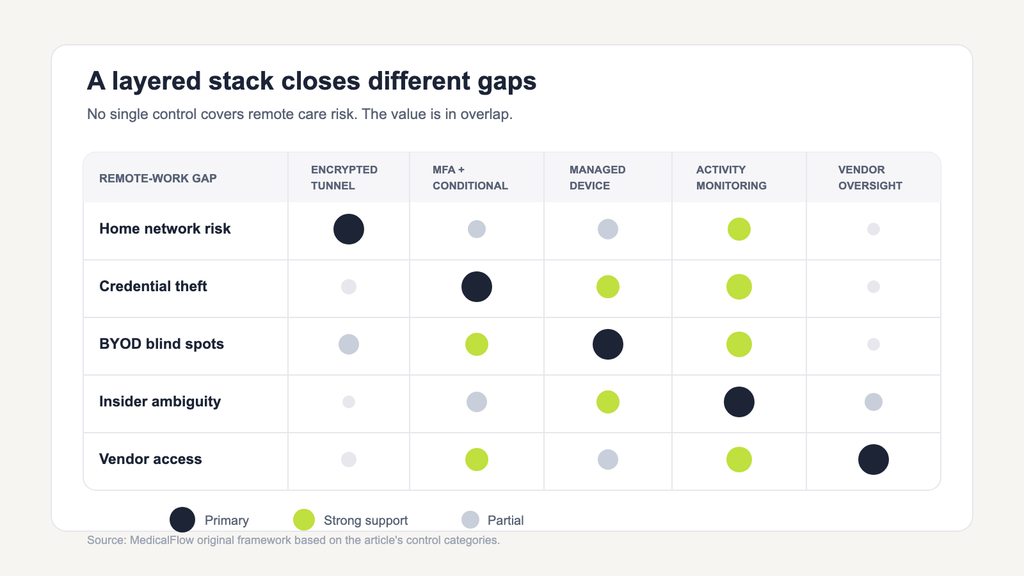
No single tool addresses all five gaps at once. What’s emerging is a stack of complementary controls that tackle the network, the device, the identity, the insider, and the vendor simultaneously.
Network Layer — Zero-Trust Access
Many healthcare organizations are moving toward always-on encrypted tunnels — such as VPNs or Zero Trust Network Access (ZTNA) — to help ensure ePHI is not transmitted over raw residential connections.
Solutions like vpn for business are designed to encrypt traffic end-to-end, which can help reduce exposure of patient data from compromised devices on the same home network or the ISP’s own infrastructure.
Shifting to a zero-trust posture pays off in ways that go far beyond network protection. Organizations implementing Zero Trust, behavioral analytics, and employee-centric security see 67% faster threat detection and 45% fewer insider threat incidents (as of 2025). Organizations implementing Zero Trust architectures report 45% fewer incidents
Identity Layer — MFA and Conditional Access
The proposed 2026 HIPAA Security Rule updates include provisions that would require MFA for remote access sessions, prompting many organizations to evaluate their current authentication practices.
Some organizations are pairing MFA with conditional access policies that trigger extra verification any time a login originates outside the known office network, an approach that can blunt credential theft before it becomes account takeover.
Endpoint Layer — Managed Devices or Secure Virtual Desktops
You can’t secure what you can’t see. Some organizations are addressing BYOD blind spots by issuing managed devices with endpoint detection and response (EDR), or by deploying virtual desktop infrastructure (VDI) to isolate clinical sessions from personal home machines.
Either approach gives organizations visibility and control without telling clinicians to stop using their own coffee table.
People Layer — Policy, Training, and Visibility
Pairing clear remote-access policies with behavioral analytics and user activity monitoring is one approach organizations are using to surface insider-risk patterns that distance can obscure.
Vendor Layer — Continuous Third-Party Monitoring
Addressing the supply-chain monitoring gap — with 63% of healthcare organizations reported to lack continuous monitoring of their digital supply chains — is an area of growing focus.
For clinics exploring expert help threading all these layers together, especially smaller practices without a security team, top telehealth consulting services reviews firms that cover data security, HIPAA compliance, and workflow protection within their telehealth consulting scope.
Caveats and Counterpoints — Where the Framework Faces Friction
A layered control stack isn’t cheap, and it demands expertise that a small ambulatory clinic may not have in-house. For those organizations, a phased rollout — MFA and managed VPN first, then graduated to managed endpoints and behavioral analytics — is often the pragmatic path.
Usability friction is real. Clinicians already weary from EHR overload push back on anything that adds seconds to their login. Risk-based conditional access can help: escalate authentication only when location, device posture, or behavior signals something off.
The regulatory picture is still moving. The proposed 2026 HIPAA Security Rule updates aren’t final yet, so smart organizations prepare without betting the budget on draft language. And let’s be honest: no stack eliminates risk entirely. The goal is to shrink it to an acceptable level, not chase zero.
Conclusion — 2026 Is the Year Clinics Are Watching Closely
Breach volumes are at all-time highs, 76% of healthcare organizations were unprepared for the proposed 2026 HIPAA Security Rule requirements at the time of assessment, and remote care is now permanently stitched into healthcare delivery.
The five gaps — home networks, credential theft, BYOD chaos, insider ambiguity, and unmonitored vendor access — don’t exist in isolation; they compound each other, turning a single weak link into a cascading exposure.
Many in the industry see a comprehensive, layered approach, one that addresses every layer in concert, as the most meaningful way to manage these risks because attackers only need one gap.
Telehealth is sprinting toward a $150 billion reality, and the security infrastructure that makes safe remote care possible is no longer a compliance checkbox; it’s a strategic priority gaining attention across the sector. 2026 is shaping up to be a pivotal year as organizations evaluate how to close these gaps.