By
By 
The share of tracked search queries getting an AI-written answer instead of a list of links grew 58% in a year, from 30% to 48%, according to BrightEdge’s most recent tracking.
Google used to hand a searcher ten links and let them do the work.
Now, for a lot of those searches, especially health-related ones, it does the work itself: reading the question, gathering facts from several sources, and writing a direct answer, called an AI Overview, with links underneath for anyone who wants to dig further.
That’s not a preview of something coming. It’s already happening to patients, probably today.
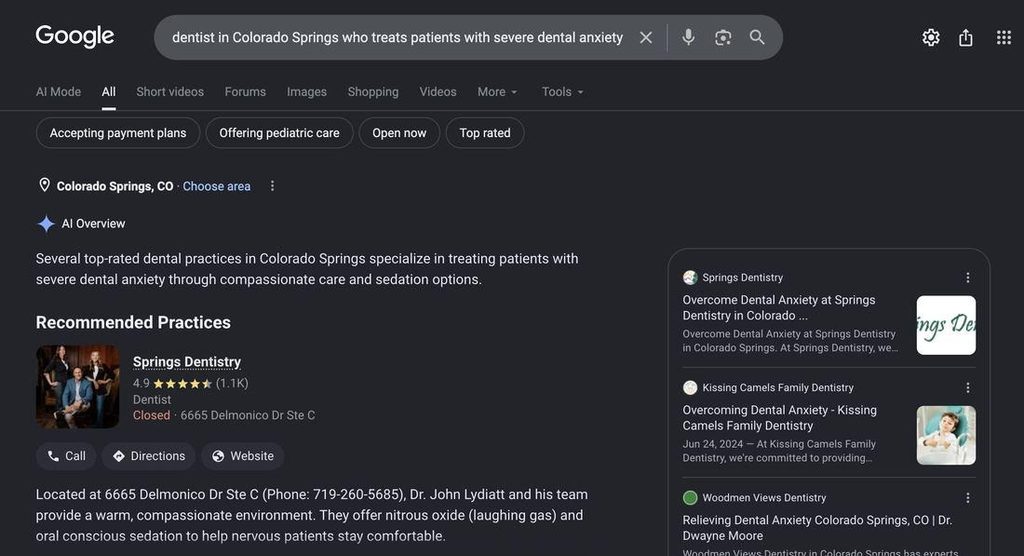
Notice the AI Overview already includes a named practice, its address, phone number, and specific treatment details, pulled straight from that practice’s own listings, before a single website link appears.
- How Does an AI Overview Actually Work?
- Does Getting Cited Require a Famous Brand Name?
- Why Are Patients Searching Differently Now?
- What Can a Practice Actually Do About It?
- How Can a Practice Check Where It Stands Today?
- Why Does Accuracy Matter More in Healthcare?
- What Should a Practice Track Going Forward?
- Conclusion
- FAQ
How Does an AI Overview Actually Work?
Since late January 2026, Google has run AI Overviews on Gemini 3, the same model family behind AI Mode, and it now supports follow-up questions right there on the results page.
Google itself describes the feature as a snapshot with links, sitting alongside traditional search rather than replacing it. In practice, a lot of patients read the snapshot and never click through at all.
The broader discipline of making sure a practice’s information gets pulled into answers like this now has a name: answer engine optimization, or AEO.
It builds on the same fundamentals as regular SEO, accurate information, clear structure, credible sources, but the target shifts from ranking in a list to being the source an AI system chooses to quote.
This fits a broader pattern of AI moving into healthcare from more than one direction. ChatGPT Health is doing something similar on the patient side.
OpenEvidence is doing it for physicians, as a clinical decision-support tool. AI Overviews are simply where that same shift shows up first for a practice’s search visibility.
Either way, a practice’s website now has two readers to satisfy: the patient who eventually calls, and the system deciding whether that practice gets mentioned before the call happens.
Does Getting Cited Require a Famous Brand Name?
Ask most people in healthcare marketing how to win at this, and you’ll hear some version of: get cited by a name patients already trust. Mayo Clinic. WebMD. A hospital system. It’s a reasonable guess.
Google does lean harder on already-established sources for health topics than it does almost anywhere else.
BrightEdge’s review of a full year of AI Overview data found that healthcare has the highest overlap between what gets cited and what already ranks organically of any industry it tracks, about 24%, compared to roughly 11% in finance.
Health information carries real consequences if it’s wrong, and Google treats it accordingly.
So the assumption isn’t crazy. It’s also not what actually happens once you look closer.
A separate analysis examined 825,000 citations pulled from AI answers to health questions, gathered across ChatGPT, Google’s AI Mode and Overviews, Gemini, and Perplexity between April and July 2026.
If the “big trusted brand” theory were right, a handful of familiar names would dominate the list.
They don’t. LLM Pulse’s analysis found Mayo Clinic, Cleveland Clinic, and WebMD each hold well under 1% of citations.
Only 17.3% of all health citations go anywhere a person would call obviously authoritative — a hospital, a medical institution, a government health source.
What that means for a smaller practice or an independent clinic: you are not competing with Mayo Clinic for this. Nobody wins by being famous.
Whoever answers the specific question, accurately and in enough detail, gets the citation. That’s a fight a well-run practice can actually enter.
Why Are Patients Searching Differently Now?
The other half of this is what patients type in the first place. “Dentist Colorado Springs” has quietly become “Colorado Springs dentist who works with patients who have severe dental anxiety.”
Same pattern in behavioral health, where a single search now carries a situation, a location, an insurance plan, and a level of care, all spelled out instead of abbreviated into a keyword.
That shift feeds directly into whether an AI Overview shows up at all. Question-based searches trigger one 57.9% of the time, versus 15.5% for a plain keyword, according to Ahrefs’ analysis of 146 million search results.
Longer searches behave the same way: seven words or more triggers an AI Overview 46.4% of the time, against 9.5% for a single word.
Health queries specifically sit near the top of every category Ahrefs measured, triggering an AI-generated answer 43% of the time, roughly double the average across all searches.
None of that means a practice should chase “find a doctor near me.” That specific phrase, and the traffic behind it, belongs to Zocdoc, Healthgrades, the insurers, and Google’s own map results, and it has for years.
The opening isn’t there. It’s one level down, in the specific, oddly-worded question a real patient actually types.
Ahrefs’ data backs this up: only 7.9% of local searches trigger an AI Overview at all, versus 43% for health queries generally. That’s map-pack territory, not AI Overview territory.
What Can a Practice Actually Do About It?
This is what SEO for healthcare providers actually looks like: not a technical overhaul, but a handful of specific, doable changes a practice with no in-house SEO team can act on this week to get more patients.
- Answer the exact question your front desk already gets asked. If patients call three times a week wondering whether you take a specific insurance plan or whether a specialist is accepting new patients, write that answer down, plainly, on its own page. Don’t fold it into a general “our services” page and hope someone finds it.
- Say the answer first. Whatever the question is, give the direct answer in the first sentence, then explain. Both patients skimming on their phone and the systems generating these answers respond better to a clear answer up front than three paragraphs of setup before the point.
- Build depth instead of one page trying to cover everything. A focused cluster of pages, each answering one real patient question well, tends to outperform a single page trying to do it all. It also gives an AI system more specific passages to pull from.
- Use comparison content where it’s genuinely useful to a patient. In-network versus out-of-network, what a first visit involves versus a follow-up, one treatment option against another. Patients search this way, and it’s easy content for an AI Overview to extract and cite cleanly.
- Make your basic details identical everywhere. Name, address, phone number, and how you describe your services should read exactly the same on your website, your Google Business Profile, and any directory you’re listed on. A phone number that’s one digit off in one place, or a service description worded differently on two pages, is a small thing that quietly costs a practice its citation.
- Add structured data where your site allows it. Schema markup gives the same information, hours, services, insurance accepted, in a format a machine can read directly, rather than making it infer that from paragraph text. This is usually a short conversation with whoever manages the website, not a rebuild.
- Build toward all four E-E-A-T signals, not just accuracy. Google’s own quality guidelines weigh these together:
- Experience, content grounded in real clinical practice, not generic brand copy.
- Expertise, clear credentials and clinical review, especially for anything touching a medical topic.
- Authoritativeness, outside mentions, citations, and links from other credible healthcare sources, often the piece practices skip.
- Trustworthiness, accurate and current information, tying the other three together.
- Keep information current. Insurance panels change, providers leave, hours shift around holidays. Anything referencing those should get checked on a schedule, since stale information undoes the trust the rest of this builds.
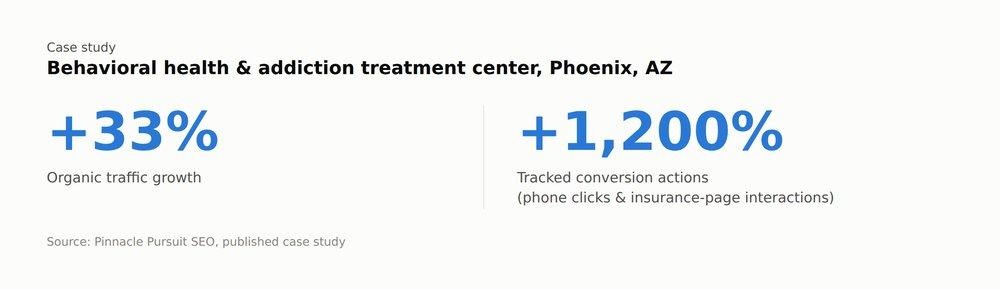
One practice that put this into practice: a behavioral health and addiction treatment center in Phoenix worked with a behavioral health SEO agency to rebuild its content around the specific questions patients were actually asking. Organic traffic grew 33%, and tracked conversion actions, phone clicks and insurance-page interactions, climbed 1,200%.
How Can a Practice Check Where It Stands Today?
Try it for yourself and check. No software required, just sit down with whoever handles your marketing or patient communication and do this once:
- Search the way a patient actually would. Try three or four real questions, “therapist who works with teenagers and takes Medicaid in [your city]” tells you more than “[practice name] reviews.”
- See what comes back. If nothing resembling an AI-generated answer shows up at all, that’s information too. It usually means the content isn’t specific enough to get pulled in.
- If your organization does show up, check it against reality. Right address? Right phone number? Right insurance list? This is exactly the kind of detail that erodes trust before anyone calls.
- Pull up your website footer, your Google Business Profile, and one directory listing side by side. Most practices find at least one mismatch the first time they actually look.
Run this again once a quarter, and any time something changes, a new location, a provider leaving, an insurance update. Small drift is easy to miss until a patient mentions it, or doesn’t, and just goes somewhere else.
Why Does Accuracy Matter More in Healthcare?
Here’s the uncomfortable part. Only 44% of the general public expects AI to improve medical care, compared to 84% of AI experts, according to an analysis of Stanford HAI’s 2026 AI Index Report.
People are leaning on AI-generated answers to make real healthcare decisions while still not fully trusting the systems producing them.
That gap is exactly why accuracy matters more here than it would for a restaurant recommendation. An AI Overview citing an old address or a service you stopped offering isn’t a small glitch.
It’s a first impression, formed before the patient ever calls, and it’s wrong. Someone in leadership, not whoever happens to notice, should own checking it.
What Should a Practice Track Going Forward?
Once the basics are handled, revisit this on a regular cadence rather than treating it as done.
- Whether your practice shows up for your priority patient questions.
- Whether the details are still accurate when it does, especially after any change to hours, providers, or insurance.
- How much traffic comes from unpaid search relative to paid spend, since unpaid visibility tends to compound while paid visibility stops the moment spending does.
- Whether reviews and outside mentions keep accumulating, not just around a single campaign.
A shared document and a recurring calendar reminder, owned by one specific person, is enough to start. Nobody needs a dashboard on day one.
Conclusion
AI hasn’t replaced how patients search for care. It’s compressed the whole thing, symptoms, location, insurance, and all, into a single answer, often before anyone reaches an actual website.
That’s already reshaping which practices patients find, whether or not anyone on staff is paying attention.
The ones that keep their information accurate, specific, and current keep showing up in that answer. The ones that don’t disappear quietly, without ever finding out why.
FAQ
Can a small practice really get cited over a big brand?
Yes. Famous health brands each hold well under 1% of AI citations combined. What wins is answering the specific question accurately and in enough detail — that’s a fight an independent practice can win.
Does schema markup actually help?
It helps, but it’s not required. It gives AI systems the same information, hours, services, insurance, in a format they can read directly instead of inferring from paragraph text. Useful hygiene, not a magic switch.
How do I know if my practice is showing up in AI answers?
Search the way a patient actually would, in the specific, oddly-worded way they’d type it. If nothing resembling an AI-generated answer comes back, or your details are wrong when it does, that’s your answer.
Will AI Overviews cut my website traffic?
Some, especially on informational queries. But the trend is toward more total search activity, not less, and unpaid visibility compounds while paid spend stops the moment you stop paying for it.
What if an AI answer has the wrong information about my practice?
Fix it at the source. AI Overviews pull from your website, Google Business Profile, and directories, so correcting it there is what corrects the citation. There’s no separate place to “edit” an AI answer.
Is AEO the same thing as GEO?
Same idea. Answer engine optimization (AEO) and generative engine optimization (GEO) are two names for structuring content so AI systems can quote it, not just rank it.
Do we need to hire an SEO specialist for this?
Not necessarily to start. A practice can handle the basics of SEO for healthcare providers itself: accurate information, consistent details across every listing, content that answers what patients are actually asking. Where it gets technical, structured data, ongoing tracking, diagnosing why a specific page isn’t getting picked up, a healthcare SEO specialist who does this full-time will generally get there faster and catch things an internal team is more likely to miss. Treat it as a spectrum: do what you can in-house, and bring in outside help for the parts where an experienced professional makes a real difference.
Dillon Loomis is an SEO strategist and the founder of Pinnacle Pursuit SEO, a Colorado-based agency helping healthcare practices show up, stand out, and get chosen. With over 5 years of hands-on experience and 30+ healthcare clients served, he specializes in search strategies that drive real-world growth, not just rankings.