By
By 
Healthcare cybersecurity is now an operations issue, not a background IT concern. A cyberattack can delay appointments, interrupt medication access, lock clinicians out of records, expose protected health information, and force leaders into expensive recovery decisions while care teams are already under pressure.
The risk is especially difficult because modern care depends on connected systems. Electronic health records, patient portals, imaging platforms, connected medical devices, telehealth tools, billing systems, cloud scheduling, and third-party vendor portals all help care move faster. They also create more places for attackers to enter, move, and disrupt.
That is the practical issue for healthcare leaders: cybersecurity is not just about preventing a breach. It is about keeping care available, records trustworthy, staff workflows usable, and patient confidence intact when something goes wrong.
- TL;DR: What Should Healthcare Providers Prioritize?
- Why Cybersecurity Now Sits Inside Patient Safety
- The Data Behind the Cybersecurity Pressure
- Where Healthcare Cyber Risk Usually Builds Up
- What Managed IT Services Can Realistically Solve
- What Should a Layered Healthcare Cybersecurity Program Include?
- How NIST Helps Healthcare Leaders Organize Cyber Risk
- How Cybersecurity Planning Connects to Broader Operations
- How Should Providers Choose a Managed IT or Security Partner?
- What Healthcare Leaders Should Do Next
- Bottom Line: Cybersecurity Is Care Continuity
- Frequently Asked Questions
TL;DR: What Should Healthcare Providers Prioritize?
Healthcare providers should treat cybersecurity as a continuous operating discipline, not a once-a-year compliance exercise.
The strongest programs combine risk assessment, identity controls, endpoint protection, patch management, network segmentation, staff training, vendor oversight, backup testing, incident response planning, and executive-level accountability. For many clinics and healthcare groups, that also means deciding which capabilities belong in-house and which should be handled by a managed IT or security partner.
Specialized support can matter when internal IT teams are already responsible for device support, EHR tickets, onboarding, telephony, printers, network issues, and everyday user problems. The buying question is not simply “who can manage our computers?” It is “who understands the operational and compliance pressure of healthcare?”
Why Cybersecurity Now Sits Inside Patient Safety
Cybersecurity affects patient safety because clinical work depends on digital availability. If a ransomware event shuts down scheduling, pharmacy connections, EHR access, imaging systems, or referral workflows, the damage is not limited to data exposure. It can slow triage, delay treatment, increase manual work, and create safety risks at the point of care.
The healthcare sector remains heavily targeted because attackers understand two things. First, protected health information is valuable. Second, hospitals, clinics, and health systems have low tolerance for downtime. When the network is down, operations do not merely become inconvenient. Care delivery can become unstable.
HHS has repeatedly identified cybersecurity as a sector-wide concern. Those warnings are not abstract. They show up in breach volume, ransomware reporting, and recovery cost.
The Data Behind the Cybersecurity Pressure
The clearest signal is the pace of healthcare breach growth. In its healthcare sector cybersecurity concept paper, HHS reported that large breaches submitted to the Office for Civil Rights increased 93% from 2018 to 2022, rising from 369 to 712 reported large breaches. HHS also reported a 278% increase in large breaches involving ransomware over the same period.
The FBI’s 2023 Internet Crime Report showed why healthcare leaders cannot treat ransomware as a rare edge case. Among ransomware complaints affecting U.S. critical infrastructure organizations, healthcare and public health had the highest count, with 249 reported complaints. That figure only includes incidents reported to IC3, so it should be read as a visible signal, not the full universe of attacks.
The financial exposure is also unusually high. IBM’s 2024 Cost of a Data Breach research found that healthcare had the highest average breach cost across industries for the 14th year in a row, reaching USD 9.77 million. IBM also reported that the global average breach cost reached USD 4.88 million in 2024, which puts healthcare well above the cross-industry average.
These numbers should be read as operational pressure, not just security trivia. They show why cyber risk belongs in board, finance, operations, compliance, and clinical leadership conversations.
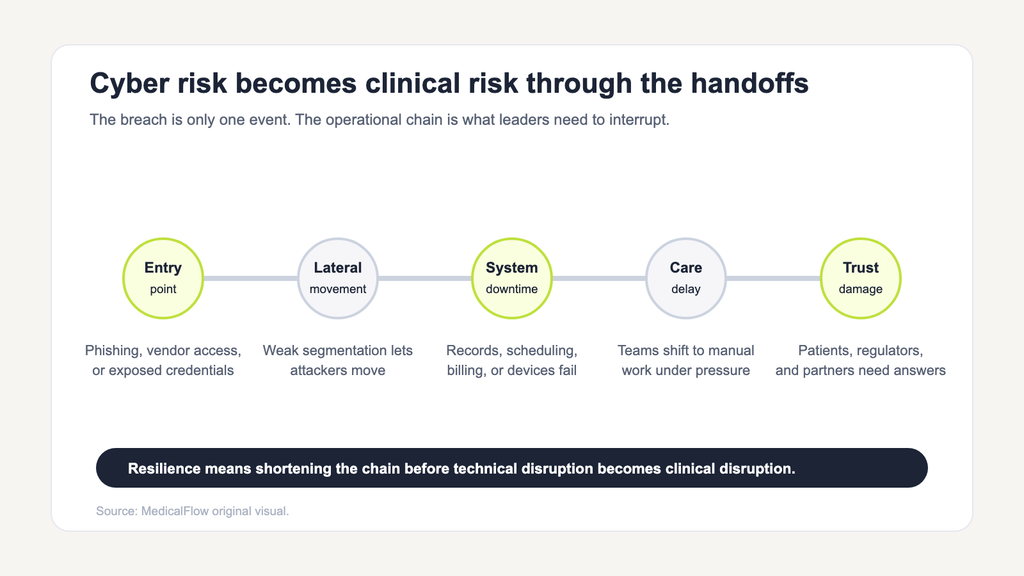
The mistake is treating cybersecurity as a technical problem owned only by IT. IT may implement the tools, but leadership sets the tolerance for downtime, funding, governance, vendor selection, staff training, and recovery readiness.
Where Healthcare Cyber Risk Usually Builds Up
Healthcare cyber risk rarely comes from one dramatic failure. It usually builds through small gaps that accumulate across systems, vendors, devices, and workflows.
Legacy Systems and Unpatched Software
Legacy systems are one of the hardest healthcare risks to manage because they often support essential workflows. A clinic may depend on an older imaging system, billing application, medical device interface, or local server that cannot be replaced quickly without disrupting care.
The problem is that older systems may no longer receive security patches. Even when patches are available, downtime windows can be hard to schedule because clinical teams need the system during operating hours. This creates a familiar healthcare tradeoff: short-term continuity can quietly increase long-term exposure.
Leaders should keep an inventory of systems that are unsupported, difficult to patch, or dependent on outdated operating environments. Each one needs a plan: replace, isolate, monitor, restrict access, or accept the risk with executive awareness. Silence is the dangerous option.
Connected Medical Devices
Connected devices can improve care, but they also expand the attack surface. Imaging equipment, infusion systems, monitoring devices, badge systems, lab interfaces, and other connected assets may sit on the same broader network environment as administrative and clinical systems.
The risk is not only whether a device is directly attacked. The risk is whether it becomes a quiet pathway into other systems. Default credentials, weak segmentation, delayed firmware updates, and unclear ownership between clinical engineering and IT can all create gaps.
Healthcare organizations should know which devices are connected, who manages them, how updates are handled, which network segments they occupy, and what happens if a device behaves unexpectedly.
Identity and Access Weaknesses
Many healthcare breaches begin with compromised credentials. Phishing, password reuse, weak remote access controls, and excessive user permissions give attackers a way into systems that otherwise appear well protected.
Multi-factor authentication is now a baseline control, especially for remote access, email, administrative accounts, cloud applications, and systems containing protected health information. But identity security is more than MFA. It also includes role-based access, timely deprovisioning when staff leaves, privileged account management, and regular review of who can access what.
Here is the practical test: if an employee leaves today, can the organization quickly disable access across every system they used? If the answer is unclear, identity governance needs work.
Third-Party Vendors and Data Flows
Healthcare organizations rely on billing vendors, transcription services, cloud platforms, EHR partners, scheduling tools, patient communication systems, analytics products, payment processors, consultants, and outsourced IT providers. Each vendor can improve operations. Each vendor can also introduce risk.
Vendor risk is not solved by signing a business associate agreement and moving on. Leaders need to understand what data the vendor touches, how access is controlled, how incidents are reported, whether subcontractors are involved, and how the relationship will be managed over time.
The strongest vendor reviews connect security with operations. If a vendor goes down, what workflows stop? Who communicates with patients? How does the clinic continue scheduling, billing, or clinical documentation? What manual fallback exists?
What Managed IT Services Can Realistically Solve
Managed IT services can help healthcare organizations close gaps that internal teams do not have the time, tooling, or specialized expertise to manage alone.
Healthcare organizations comparing external support options may review providers such as Diamond IT when they need managed infrastructure, monitoring, and security support in the Los Angeles market.
The strongest managed support model gives the organization continuous monitoring, patch management, endpoint protection, backup oversight, identity support, user support, and escalation paths for suspected incidents.
This does not remove accountability from the healthcare organization. It changes the operating model. The provider still owns risk decisions, vendor selection, compliance obligations, budget priorities, and clinical continuity planning. The managed IT partner helps execute and monitor the technical environment.
That distinction matters.
Managed IT can usually help with:
- Network monitoring and alerting.
- Endpoint protection for workstations, laptops, and servers.
- Patch management and update coordination.
- Backup monitoring and recovery testing.
- Email security and phishing protections.
- Multi-factor authentication rollout.
- User onboarding and offboarding.
- Device inventory and lifecycle planning.
- Security reporting for leadership.
- Incident response coordination.
Managed IT is less useful when the scope is vague. “Keep us secure” is not an operating model. Healthcare leaders should define responsibilities clearly: what the internal team owns, what the vendor owns, what gets escalated, how fast incidents are handled, and what reporting leadership receives.
What Should a Layered Healthcare Cybersecurity Program Include?
A layered cybersecurity program reduces the chance that one failure turns into a full operational crisis. No single tool can protect a healthcare organization. The goal is to create overlapping controls that prevent, limit, detect, and recover from attacks.
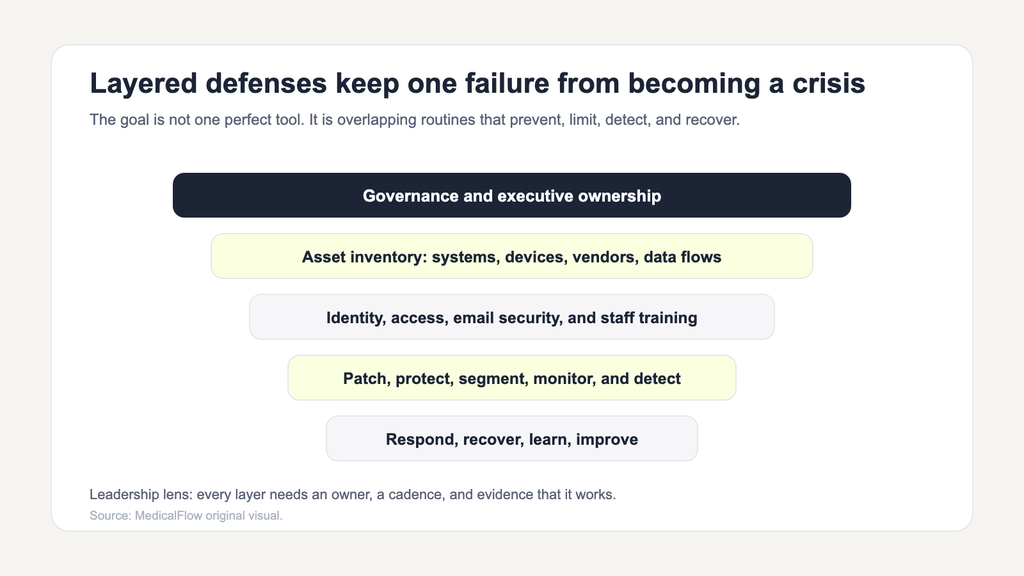
Risk Assessment and Asset Inventory
The first layer is knowing what exists. Healthcare organizations need a current inventory of systems, devices, applications, vendors, users, data flows, and critical workflows.
Without an inventory, leaders cannot prioritize risk. They may spend heavily on visible tools while leaving outdated servers, unmanaged devices, inactive accounts, or risky vendor access untouched.
The inventory should answer:
- Which systems store or transmit protected health information?
- Which systems are essential for patient care, scheduling, medication access, billing, or communication?
- Which devices are unsupported or difficult to patch?
- Which vendors can access sensitive data or core systems?
- Which users have administrative privileges?
- Which workflows need manual downtime procedures?
Identity, Access, and Email Security
Identity controls reduce the likelihood that a stolen password becomes a breach. Healthcare organizations should prioritize MFA, strong password policies, role-based access, privileged account controls, and offboarding discipline.
Email security also deserves special attention because staff are busy and attackers know how to write messages that look operationally urgent. Phishing simulations and training help, but training should be practical and healthcare-specific. Staff need to recognize fake invoice requests, credential prompts, document-sharing links, benefits notices, vendor messages, and patient-themed lures.
Training works best when it respects the reality of clinical work. Busy clinicians and front-desk teams are not careless by default. They are operating under time pressure. Security workflows should reduce risk without making care delivery unnecessarily harder.
Patch Management and Endpoint Protection
Patch management keeps known vulnerabilities from remaining open longer than necessary. Endpoint protection helps detect and contain suspicious activity on devices that staff use every day.
Healthcare organizations should define patch windows, exception processes, emergency update procedures, and accountability for systems that cannot be patched quickly. If a system cannot be updated, leaders need compensating controls such as segmentation, restricted access, or increased monitoring.
The key is visibility. A patch dashboard that shows systems falling behind is more useful than a policy that says updates should happen “regularly.”
Network Segmentation and Backup Resilience
Network segmentation limits how far an attacker can move after gaining initial access. Clinical devices, guest Wi-Fi, administrative systems, servers, and sensitive applications should not all sit in one flat environment.
Backups are equally important, but backup presence is not the same as recovery readiness. Healthcare organizations should test restoration, verify backup integrity, define recovery time expectations, and know which systems must come back first.
The test is simple: if ransomware hits tonight, can the organization restore the systems needed to operate tomorrow?
Detection, Response, and Communication
Prevention is not enough. Healthcare organizations need detection and response capabilities that identify unusual activity early and guide staff through what happens next.
An incident response plan should define:
- Who declares an incident.
- Who contacts legal, compliance, IT, leadership, and insurance partners.
- How clinical downtime procedures are activated.
- How patients, vendors, regulators, and staff are informed.
- Where incident records are kept.
- How systems are prioritized for recovery.
- How lessons learned become control improvements.
The plan should be practiced. A document no one has rehearsed will not hold up well under pressure.
How NIST Helps Healthcare Leaders Organize Cyber Risk
Healthcare providers operate under HIPAA and other privacy and security obligations, but compliance alone is not the same as resilience. Compliance can establish minimum safeguards. A cybersecurity operating model has to help the organization identify, prioritize, manage, and recover from real risk.
Many organizations use the National Institute of Standards and Technology Cybersecurity Framework because it gives leaders a common structure for cyber risk. NIST CSF 2.0 organizes cybersecurity around six functions: Govern, Identify, Protect, Detect, Respond, and Recover.
That structure is useful for healthcare because it moves the conversation beyond tools.
| NIST CSF function | Healthcare leadership question |
|---|---|
| Govern | Who owns cybersecurity risk, budget, policies, and oversight? |
| Identify | What systems, vendors, devices, data, and workflows must be protected? |
| Protect | Which controls reduce the chance or impact of an attack? |
| Detect | How will the organization know something is wrong? |
| Respond | Who acts, communicates, documents, and escalates during an incident? |
| Recover | How will the organization restore care operations and learn from the event? |
The value is not in saying “we follow NIST.” The value is using the framework to expose gaps that leadership can actually act on.
How Cybersecurity Planning Connects to Broader Operations
Cybersecurity investments should not be planned in isolation from the rest of the operating model. Security touches staffing, finance, procurement, vendor management, clinical workflows, patient communication, IT modernization, and growth strategy.
For clinics and healthcare groups making larger technology decisions, structured enterprise resource planning can help connect security needs with implementation priorities, system selection, budgeting, process redesign, and governance. That matters because a security tool added to a broken workflow may create more work without meaningfully reducing risk.
Examples:
- A new EHR rollout should include access-control design, downtime planning, vendor risk review, and staff training.
- A telehealth expansion should include identity verification, secure messaging, device policies, and incident response planning.
- A multi-location growth plan should include network standards, endpoint management, user provisioning, and centralized reporting.
- A billing or revenue cycle vendor change should include data flow mapping, contract review, and business continuity planning.
Better cybersecurity starts before procurement. It starts when leaders define how the organization should work.
How Should Providers Choose a Managed IT or Security Partner?
Selecting a managed IT partner requires more than comparing monthly fees. Healthcare organizations need providers that understand clinical environments, protected health information, downtime pressure, vendor complexity, and regulatory expectations.
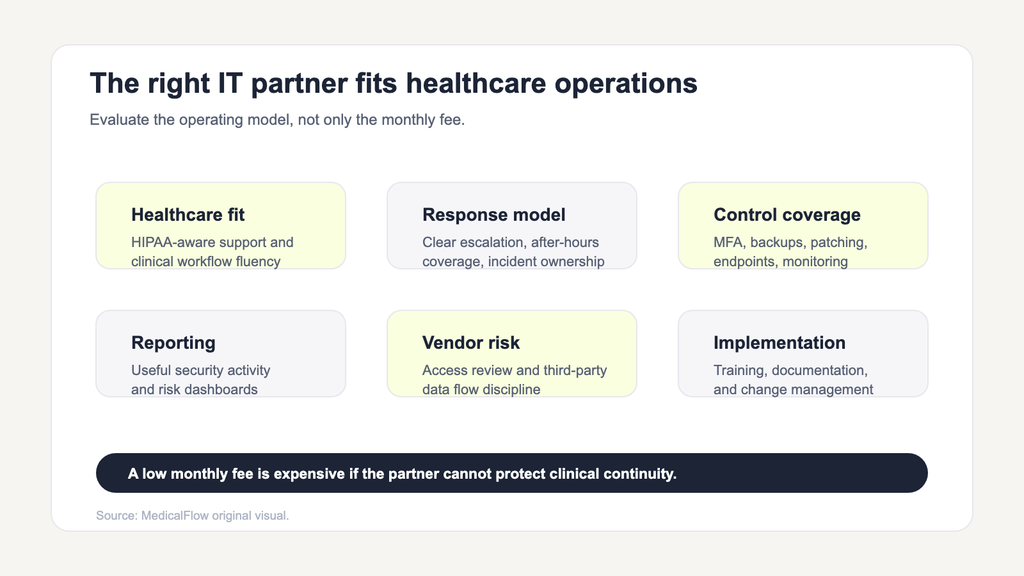
Before signing, leaders should ask:
- What healthcare clients do you currently support?
- How do you handle HIPAA-covered environments?
- What security monitoring is included, and what costs extra?
- What is your response time for suspected incidents?
- How do you document and report security activity?
- How do you support MFA, backups, patching, and endpoint protection?
- How do you manage third-party vendor access?
- What happens after hours?
- Who owns incident communication and escalation?
- Can you support our clinical systems, not just general office IT?
Reference checks matter. A vendor may be technically capable but still unfamiliar with healthcare operations. The right partner should be able to explain how security controls will affect clinicians, front-desk staff, administrators, billing teams, and patients.
What Healthcare Leaders Should Do Next
Healthcare leaders do not need to fix everything at once. They do need a clear sequence.
Start with the controls that reduce the most operational risk:
- Inventory critical systems, vendors, users, and connected devices.
- Require MFA for remote access, email, administrative accounts, and sensitive systems.
- Review patch status and isolate systems that cannot be updated.
- Confirm backups are protected, tested, and restorable.
- Create or refresh the incident response plan.
- Train staff on healthcare-specific phishing and access risks.
- Review vendor access and data flows.
- Define what internal IT owns and what outside support should cover.
- Use NIST CSF functions to organize gaps and report progress.
- Revisit the plan quarterly, not annually.
The goal is not perfect security. The goal is resilient operations: fewer preventable incidents, faster detection, clearer response, and safer recovery when something goes wrong.
Bottom Line: Cybersecurity Is Care Continuity
Healthcare cybersecurity is no longer peripheral. It is part of care continuity, patient trust, staff productivity, regulatory readiness, and financial resilience.
Providers that combine layered technical controls, staff education, vendor oversight, NIST-aligned governance, tested backups, and practical incident response planning are better prepared for the threat environment healthcare now faces. Managed IT support can help, especially when internal teams are stretched, but it works best when the organization defines responsibilities and treats security as an ongoing operating discipline.
The healthcare organizations that handle cyber risk well will not be the ones with the most tools. They will be the ones with the clearest ownership, strongest routines, and fastest path back to safe operations.
Frequently Asked Questions
Why is cybersecurity important in healthcare?
Cybersecurity is important in healthcare because digital systems support care delivery, records, scheduling, billing, communication, and medication access. A cyberattack can disrupt operations, expose protected health information, and create patient safety risks.
What are the biggest cybersecurity risks for healthcare providers?
Common healthcare cybersecurity risks include phishing, ransomware, unpatched systems, weak passwords, excessive user access, connected medical devices, third-party vendor exposure, poor backups, and incomplete incident response planning.
How can managed IT services help healthcare organizations?
Managed IT services can help healthcare organizations with monitoring, endpoint protection, patch management, backup oversight, MFA rollout, user support, device inventory, and incident escalation. The organization still needs clear governance and risk ownership.
Is HIPAA compliance enough for cybersecurity?
No. HIPAA compliance is important, but it should be treated as a baseline. Healthcare organizations also need practical controls, tested response plans, vendor oversight, backup resilience, and leadership visibility into cyber risk.
How does the NIST Cybersecurity Framework apply to healthcare?
The NIST Cybersecurity Framework helps healthcare leaders organize cyber risk across governance, identification, protection, detection, response, and recovery. It gives clinical, operational, IT, and executive teams a shared language for prioritizing security work.