A research-based guide for healthcare executives, healthtech founders, and IT decision-makers evaluating software development partners.
Digital transformation in healthcare is no longer optional.
From interoperability mandates and value-based care models to AI-assisted diagnostics and remote patient monitoring, healthcare organizations face mounting pressure to modernize their technology infrastructure — quickly, securely, and at scale.
Choosing the right software development partner is one of the most consequential decisions a healthcare or healthtech organization will make.
The wrong vendor can introduce compliance risk, delay product launches, or deliver solutions that fail to integrate with existing clinical workflows.
The right partner, by contrast, accelerates time-to-market, reduces technical debt, and helps organizations unlock measurable clinical and operational value.
This article profiles ten leading companies that specialize in healthcare IT product development. Each has been evaluated across five dimensions:
- Healthcare вomain expertise.
- Delivery capabilities.
- Security and compliance posture.
- Digital transformation value.
The list is designed to help decision-makers build a shortlist — not to rank vendors against one another, as the best fit will depend on organizational context, budget, and strategic goals.
Evaluation Criteria
Before reviewing individual companies, it is useful to understand the framework applied across each profile:
- Domain Expertise — Depth of knowledge in healthcare-specific technologies (EHR/EMR, HL7/FHIR, DICOM, clinical decision support, etc.)
- Healthcare Experience — Track record with hospitals, payers, pharma, medical device manufacturers, IT vendors or digital health startups
- Delivery Capabilities — Engagement models, team structure, scalability, and technology stack breadth
- Security & Compliance — HIPAA, HITECH, GDPR (where applicable), SOC 2, and other relevant certifications
- Digital Transformation Value — Ability to support strategic modernization goals beyond individual project delivery
1. Edenlab
- Headquarters: Estonia & USA (global delivery)
- Company Size: Mid-size
- Focus Areas: Healthcare data platforms, interoperability, FHIR-based solutions, AI & Analytics, EHR, EMR & HIS development
Edenlab is a specialized technology company focused on healthcare software product development, with particular depth in health data infrastructure and interoperability standards. The company has built a reputation for designing and delivering FHIR-compliant platforms that enable healthcare organizations to exchange clinical data securely and efficiently across systems.
Edenlab’s engineering teams have hands-on experience with HL7 FHIR R4/R5, SMART on FHIR, CDS Hooks, and IHE profiles — a combination that makes the company well-suited to organizations navigating interoperability requirements introduced by the 21st Century Cures Act and ONC regulations. Their portfolio includes work with digital health startups, regional health systems, and public health agencies.
Key Strengths:
- Healthcare-Exclusive Expertise
12+ years of experience designing and developing healthcare software, digital health products, and enterprise healthcare platforms. - Deep HL7 FHIR® & Interoperability Leadership
Proven expertise in HL7 FHIR®, HL7 v2, openEHR, terminology services, and large-scale interoperability across EHRs, HIEs, laboratories, and payer systems. - Proven National-Scale Healthcare Systems
Experience delivering nationwide health information exchange (HIE) platforms and mission-critical healthcare solutions serving millions of patients and thousands of providers. - FHIR-Native, AI-Ready Platform Expertise
Creator of the Kodjin platform, enabling organizations to build interoperable, governed, and AI-ready healthcare data ecosystems faster and with lower implementation risk. - End-to-End Healthcare Product Development
A strategic partner for healthcare startups, providers, payers, governments, and health IT vendors—from product strategy and architecture to development, compliance, deployment, and long-term support.
Considerations: Best suited for organizations whose primary challenge is data interoperability or platform architecture. Organizations seeking broad enterprise IT outsourcing may need to evaluate scope fit.
2. Cognizant
- Headquarters: Teaneck, NJ, USA
- Company Size: Enterprise (300,000+ employees)
- Focus Areas: Payer/provider IT transformation, clinical analytics, AI, cloud migration
Cognizant is one of the largest IT services firms globally, with a dedicated healthcare and life sciences practice that serves major payers, hospital systems, and pharmaceutical companies. The company brings significant capacity in legacy system modernization, cloud migration, AI-powered analytics, and managed services.
Cognizant’s scale allows it to staff complex, multi-year transformation programs across infrastructure, applications, and data layers simultaneously. Their TriZetto platform — focused on payer operations — is widely used across the U.S. insurance market.
Key Strengths:
- Enterprise-scale delivery capacity
- Strong payer technology portfolio (TriZetto)
- Broad AI, cloud, and analytics capabilities
- Global delivery model with onshore/offshore flexibility
Considerations: Engagement processes may be more complex and slower-moving for smaller organizations or early-stage healthtech companies.
3. Orion Health
- Headquarters: Auckland, New Zealand (offices across North America, Europe)
- Company Size: Mid-to-large
- Focus Areas: HIE, population health, care coordination platforms
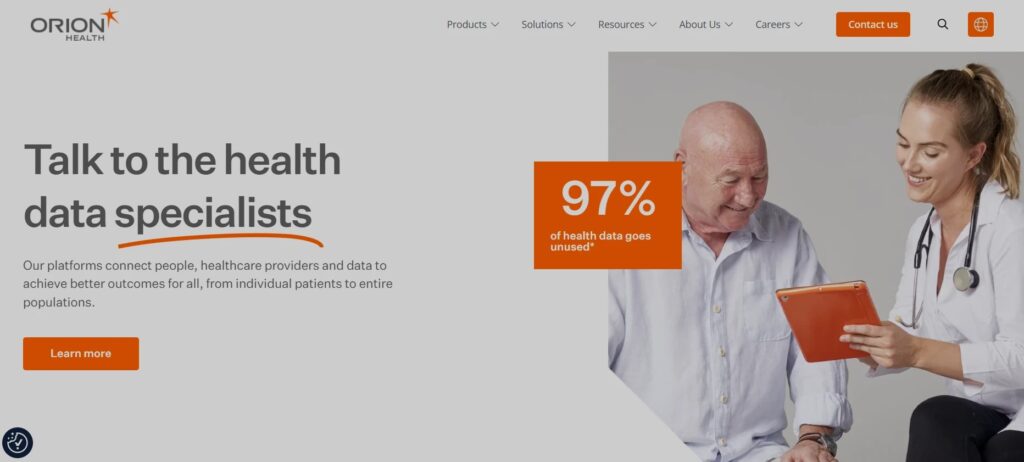
Orion Health is a purpose-built health IT vendor with decades of experience in clinical data sharing and population health management. Their Amadeus platform and HIE solutions are deployed across national and regional health networks in multiple countries, making them a credible choice for organizations building or modernizing care coordination infrastructure.
Key Strengths:
- Long track record in national-scale health data infrastructure
- Strong expertise in population health management and analytics
- International deployment experience
- Clinically informed product design
Considerations: Primarily a product company with implementation services; may not be suitable for organizations seeking custom software development engagements.
4. Inovalon
- Headquarters: Bowie, MD, USA
- Company Size: Large
- Focus Areas: Data-driven healthcare platforms, quality analytics, clinical intelligence
Inovalon operates a cloud-based platform that aggregates data from across the healthcare ecosystem — claims, clinical records, lab data — to deliver analytics that support quality improvement, risk adjustment, and care management programs. The company primarily serves health plans, providers, and life sciences companies that need to operationalize large-scale data insights.
Key Strengths:
- Proprietary database of longitudinal patient data at national scale
- Strong regulatory and quality measure expertise (HEDIS, Stars, etc.)
- Purpose-built SaaS platform for payer and provider analytics
- FDA, HIPAA, and SOC 2 compliance posture
Considerations: Works best as a platform partner rather than a custom development vendor; integration depth with existing systems varies.
5. CitiusTech
- Headquarters: Princeton, NJ, USA (delivery centers in India)
- Company Size: Mid-to-large (4,000+ employees)
- Focus Areas: Healthcare IT consulting, interoperability, digital health engineering, AI/ML
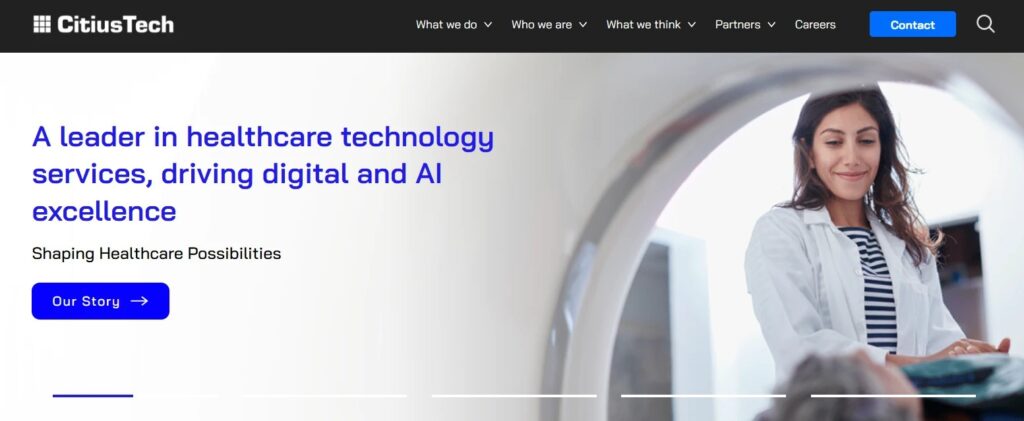
CitiusTech is a healthcare-focused technology services company with a strong consulting and engineering footprint across payers, providers, medical device companies, and healthtech vendors. The company brings a combination of domain consulting and hands-on engineering delivery, which is useful for organizations that need strategy and build capability from a single partner.
Their interoperability practice — covering FHIR, HL7 v2, X12, and DICOM — is among the more mature in the market.
Key Strengths:
- Healthcare-only focus with deep domain expertise
- Strong interoperability and data engineering practice
- Experience across the full healthcare value chain
- Established AI/ML capabilities applied to clinical workflows
Considerations: Mid-size engagements are a sweet spot; very large enterprise programs may require supplemental staffing.
6. Persistent Systems
- Headquarters: Pune, India (global offices including USA, Europe)
- Company Size: Large (20,000+ employees)
- Focus Areas: Digital engineering, cloud, AI/ML, healthcare and life sciences platforms
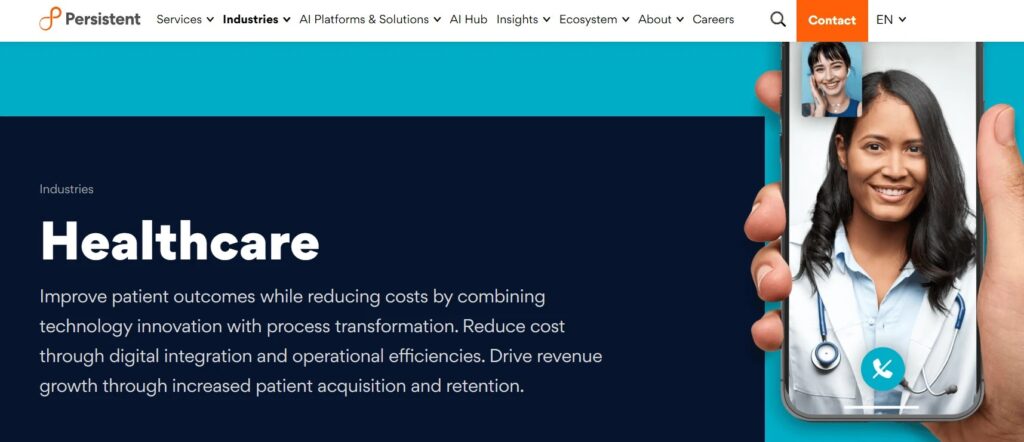
Persistent Systems has built a significant healthcare and life sciences practice focused on digital engineering — building new products, modernizing legacy platforms, and embedding AI into clinical and operational workflows. The company works with ISVs, med-tech firms, providers, and life sciences companies.
Their accelerators and pre-built components for FHIR integration, regulatory submissions, and clinical data management help reduce time-to-market for product companies.
Key Strengths:
- Strong product engineering mindset
- Accelerators for healthcare-specific use cases
- Mature AI/ML and cloud delivery capabilities
- Experience with FDA-regulated software development (SaMD)
Considerations: Delivery is predominantly offshore; organizations requiring significant on-site collaboration should clarify engagement terms.
7. Softeq
- Headquarters: Houston, TX, USA (development centers in Europe)
- Company Size: Mid-size
- Focus Areas: Medical device software, IoT/wearables, embedded systems, mHealth applications
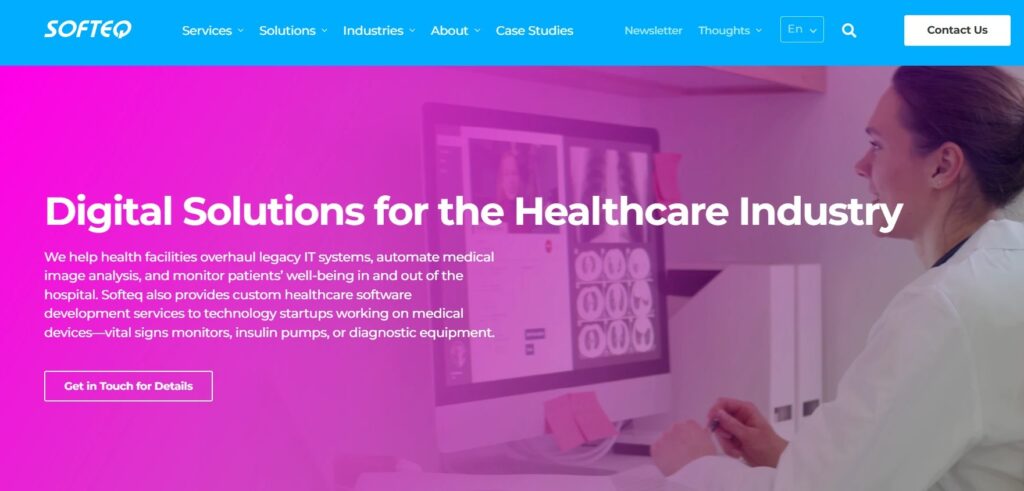
Softeq specializes in hardware-adjacent software development — embedded systems, IoT, wearables, and connected medical devices. This makes them a strong choice for medical device manufacturers and digital health companies developing FDA-regulated Software as a Medical Device (SaMD) or companion applications for physical products.
Their regulatory engineering experience covers IEC 62304, ISO 13485, and FDA 510(k) submission support.
Key Strengths:
- Deep embedded and IoT engineering expertise
- Regulatory compliance engineering for medical devices
- Cross-platform mobile and cloud development
- Agile delivery with strong QA practices
Considerations: Less suited for enterprise health IT or EHR-centric engagements; strongest value for hardware-software integrated product development.
8. Accenture Health
- Headquarters: Dublin, Ireland (global operations)
- Company Size: Enterprise (700,000+ employees)
- Focus Areas: Health system transformation, payer modernization, genomics, AI-enabled care delivery
Accenture’s health practice is among the largest in the world, spanning provider, payer, pharma, and public health segments. The company combines strategy consulting, technology implementation, and managed services — providing end-to-end transformation support for large health systems and national health authorities.
Accenture has made notable investments in AI-driven clinical decision support, genomic data platforms, and consumer health experience design.
Key Strengths:
- Truly end-to-end transformation capability (strategy through operations)
- Global health authority and government health agency experience
- Advanced AI, cloud, and data platform capabilities
- Broad ecosystem of technology alliances (AWS, Microsoft, Google Cloud)
Considerations: Cost structure and engagement complexity are calibrated to large enterprise clients; typically not the right fit for startups or mid-market organizations.
9. Redox
- Headquarters: Madison, WI, USA
- Company Size: Mid-size
- Focus Areas: Healthcare integration platform, EHR connectivity, data normalization
Redox operates as an integration platform-as-a-service (iPaaS) specifically for healthcare, enabling digital health companies and health IT vendors to connect with EHR systems at scale without building and maintaining individual point-to-point integrations. While not a custom development shop, Redox functions as critical enabling infrastructure for product companies.
Their network includes connections to hundreds of healthcare organizations across the USA.
Key Strengths:
- Purpose-built healthcare integration network
- Dramatically reduces EHR integration time-to-market
- Supports FHIR, HL7 v2, and proprietary EHR formats
- Strong developer experience and documentation
Considerations: Functions as a platform partner/middleware layer rather than a full-service development company; best combined with a product engineering partner.
Comparative Summary
| Company | Best For | Healthcare Focus | Custom Dev | Interoperability | Regulatory Expertise |
| Edenlab | End-to-end healthcare product development, EHR, EMR & HIS development, FHIR-based analytics platforms, and interoperability solutions. | Specialized | ✓✓✓ | ✓✓✓ | ✓✓ |
| Cognizant | Enterprise IT transformation | Broad | ✓✓ | ✓✓ | ✓✓✓ |
| Orion Health | HIEs, population health | Specialized | ✓ | ✓✓✓ | ✓✓ |
| Inovalon | Payer analytics, quality programs | Specialized | ✗ | ✓✓ | ✓✓✓ |
| CitiusTech | Mid-market IT & consulting | Specialized | ✓✓✓ | ✓✓✓ | ✓✓ |
| Persistent Systems | Digital engineering, AI/ML | Broad | ✓✓✓ | ✓✓ | ✓✓ |
| Softeq | Medical devices, IoT, SaMD | Specialized | ✓✓✓ | ✓ | ✓✓✓ |
| Accenture Health | Large-scale transformation | Broad | ✓✓ | ✓✓ | ✓✓✓ |
| Redox | EHR integration layer | Specialized | ✗ | ✓✓✓ | ✓ |
Legend: ✓✓✓ = Core strength | ✓✓ = Solid capability | ✓ = Partial | ✗ = Not primary offering
Key Takeaways for Decision-Makers
1. Choose a partner with deep healthcare expertise—not just software engineering skills.
Healthcare software requires far more than technical excellence. Look for a partner with proven expertise in clinical workflows, healthcare interoperability, terminology standards, healthcare data, AI, security, and regulatory compliance. Teams that focus exclusively on healthcare are better equipped to deliver solutions that succeed in real-world clinical environments.
2. Evaluate real-world interoperability experience.
FHIR support alone is no longer a differentiator. Ask whether the company has delivered production-scale HL7® FHIR®, HL7 v2, or openEHR solutions connecting EHRs, HIEs, laboratories, payers, and national healthcare platforms. Experience with enterprise or nationwide interoperability initiatives demonstrates technical maturity that cannot be gained from isolated integration projects.
3. Prioritize AI-ready healthcare data foundations.
Healthcare organizations increasingly need more than application development—they need governed, interoperable data that powers analytics, AI, clinical decision support, and operational intelligence. Look for partners that can build semantic healthcare data platforms, terminology services, and scalable analytics capabilities alongside transactional systems.
4. Validate security, compliance, and scalability.
Healthcare solutions must protect sensitive patient data while meeting evolving regulatory requirements. Verify certifications, security practices, privacy controls, and experience delivering highly available, enterprise-scale healthcare platforms capable of supporting future growth.
5. Select a long-term innovation partner.
Healthcare transformation is an ongoing journey rather than a one-time implementation. The greatest value comes from partners who understand your long-term strategy, continuously evolve your platform, and help you adopt emerging technologies such as AI, interoperability standards, and modern healthcare data architectures.
Conclusion
Selecting the right healthcare software development partner requires more than comparing engineering capacity or hourly rates.
The most successful projects are delivered by companies with deep healthcare domain expertise, proven interoperability experience, and the ability to build secure, scalable, and AI-ready healthcare platforms.
Whether your organization is modernizing legacy systems, building a new digital health product, implementing nationwide interoperability, or creating an analytics platform, choose a partner with demonstrated experience delivering complex healthcare solutions at production scale.
A combination of healthcare knowledge, technical excellence, and long-term collaboration will help reduce implementation risk, accelerate innovation, and maximize the value of your digital transformation investment.