
Patient acquisition in B2B healthcare has become increasingly complex. Decision‑makers today research extensively before choosing a consulting partner, marketing agency, or technology provider.
Digital channels now influence referrals, credibility, and long‑term growth more than ever. To stay competitive, B2B healthcare organizations need a structured, digital‑first acquisition strategy that blends visibility, trust, and technology.
This guide outlines practical digital patient acquisition strategies tailored specifically for B2B healthcare services, with a focus on sustainable growth rather than short‑term wins.
Patient Acquisition vs Patient Retention: What’s the Difference?
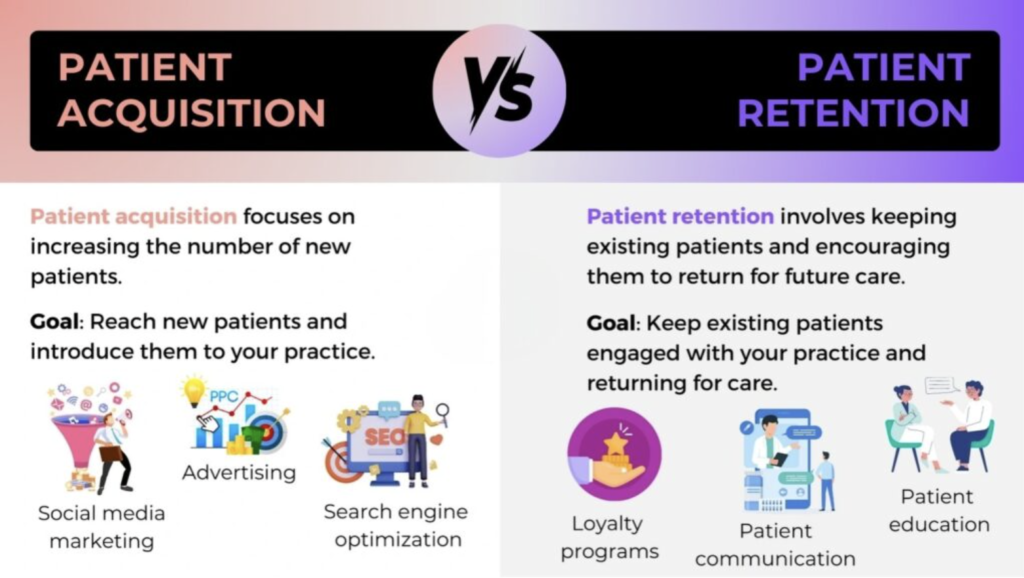
Patient acquisition and patient retention are closely connected, yet they serve different purposes within a healthcare growth strategy.
Patient acquisition focuses on attracting new patients or healthcare clients through visibility‑driven B2B healthcare marketing efforts such as SEO, paid advertising, content marketing, social media, and strategic partnerships.
Patient retention, by contrast, centers on maintaining long‑term relationships with existing patients by delivering consistent experiences, clear communication, and ongoing value before, during, and after care.
Together, acquisition and retention form the foundation of sustainable growth, ensuring both steady pipeline expansion and long‑term revenue stability.
Both approaches are critical. While acquisition drives growth, retention supports stability and long-term revenue. Retained patients are more likely to:
- Return for additional services
- Refer friends, family, or partner organizations
- Leave reviews and testimonials that strengthen trust
Retention efforts can also directly support acquisition, as referrals and positive word-of-mouth often originate from satisfied patients.
This makes retention a natural amplifier of acquisition while also reducing dependency on constantly attracting new leads.
From a cost perspective, acquiring new patients typically requires more time and investment than nurturing existing relationships.
Healthcare organizations that intentionally balance acquisition with retention are better positioned to increase patient lifetime value and maximize returns by combining growth-focused channels with strong experience, communication, and reputation management.
Core Patient Acquisition Strategies
A strong online presence is now essential for healthcare practices to attract, engage, and retain patients in a digital‑first world.
Decision‑makers increasingly evaluate providers and partners based on visibility, credibility, and accessibility across digital channels.
With that foundation in mind, the following core digital strategies play a critical role in building sustainable patient acquisition for B2B healthcare services.
Search Engine Optimization (SEO) & Content Marketing
SEO remains one of the most reliable patient acquisition channels for B2B healthcare services. Buyers actively search for solutions related to operational efficiency, compliance, growth, and patient experience.
Key SEO priorities include:
- Publishing educational content that answers real healthcare business questions
- Optimizing for intent‑based keywords used by healthcare decision‑makers
- Building topical authority within specific healthcare verticals
Healthcare organizations that partner with industry‑focused agencies offering healthcare SEO services are better positioned to compete in a crowded market.
Specialized agencies understand compliance, EEAT requirements, and the nuances of healthcare search behavior.
For a deeper breakdown of execution, these Actionable Steps of Medical SEO provide a practical framework for aligning content and search visibility.
Online Reputation Management
In B2B healthcare, reputation extends beyond patient reviews. It includes:
- Industry credibility
- Thought leadership presence
- Brand consistency across digital platforms
Managing third‑party listings, business profiles, and authoritative mentions strengthens trust signals and influences both referrals and digital decision‑making.
Pay‑Per‑Click (PPC) Advertising
PPC advertising supports faster lead generation, especially for competitive service‑based keywords. When executed correctly, it complements long‑term SEO efforts.
Effective healthcare PPC strategies focus on:
- High‑intent search terms
- Clear service differentiation
- Compliance‑safe ad messaging
Landing pages should be optimized for conversions, not just traffic, with messaging aligned to the specific pain points of healthcare organizations.
Social Media Marketing
While social media may not always generate direct leads, it plays a critical role in awareness and trust.
Recent statistics show that nearly 90% of Americans turn to social media for health-related information, making active participation on these platforms essential for visibility and engagement.
Platforms such as LinkedIn allow B2B healthcare brands to:
- Share insights and case learnings
- Build executive‑level credibility
- Stay visible throughout the buyer journey.
Platforms like TikTok are also becoming increasingly influential in healthcare discovery. Recent research by Charity RX shows that nearly 1 in 5 Americans consult TikTok for healthcare-related advice before speaking with a doctor.
This shift is particularly relevant for behavioral health and wellness-focused services, as younger audiences are more open to discussing mental health topics on social platforms, creating new opportunities for early-stage engagement and trust-building.
Video Marketing
Video content increases engagement and simplifies complex healthcare topics. Educational videos, expert interviews, and short explainers help communicate value quickly and build authority.
As healthcare organizations expand across digital channels, it is equally important to balance growth with compliance.
Marketing efforts should be structured to respect patient privacy, avoid unnecessary data tracking, and ensure that advertising and audience targeting practices align with HIPAA requirements.
Maintaining compliance not only reduces risk but also reinforces trust with patients and partners.
B2B & Referral‑Focused Strategies
1. Strategic Partnerships & Referrals
Digital growth in healthcare often accelerates through partnerships. Collaborating with complementary service providers, platforms, or consultants expands reach while maintaining trust.
A strong digital presence makes partnerships more effective by reinforcing credibility before referrals are even made.
Additionally, referral programs and incentive-based initiatives can encourage existing patients and partners to recommend services, helping healthcare organizations expand their patient base while strengthening long-term loyalty.
2. LinkedIn for Credibility
LinkedIn functions as a credibility engine for B2B healthcare professionals and organizations. Decision-makers often review company pages, leadership profiles, and published insights before considering partnerships or outreach opportunities.
To make LinkedIn more actionable for patient acquisition and business growth, healthcare organizations should:
- Optimize leadership and company profiles with clear positioning, healthcare expertise, and proof points
- Publish consistent thought leadership around industry challenges, compliance, growth strategies, and innovation
- Engage with relevant healthcare conversations, comments, and industry posts to increase visibility
- Leverage LinkedIn case highlights, featured content, and recommendations to reinforce trust
Healthcare leaders frequently assess expertise and authority on LinkedIn before initiating direct conversations or referrals, making it a critical platform for early‑stage decision‑making.
3. Email Marketing
Email remains one of the most cost‑effective nurturing tools for B2B healthcare services, particularly for guiding prospects through longer decision cycles. When used strategically, email supports education, trust‑building, and conversion.
Actionable email marketing approaches for healthcare organizations include:
- Segmenting audiences based on role, specialty, or stage in the buyer journey
- Sharing educational content such as insights, regulatory updates, and growth frameworks
- Using automated nurture sequences to move prospects from awareness to consideration
- Aligning messaging with real operational, compliance, and patient acquisition challenges
The key to success is relevance and consistency—emails should deliver genuine value and insight, not generic promotions or sales‑heavy messaging.
Technology & User Experience
Mobile‑Friendly Website
A healthcare website is often the first touchpoint for decision‑makers. Slow load times, poor navigation, or unclear messaging reduce trust instantly.
A modern B2B healthcare website should prioritize:
- Mobile responsiveness
- Clear service positioning
- Fast performance and accessibility
Digital Booking & Telehealth Integration
For healthcare service providers working directly with clinics or practices, digital booking tools and telehealth integrations improve operational efficiency and user experience.
These features reduce friction and support scalable growth.
CRM & Automation
CRM platforms and automation tools enable healthcare businesses to track leads, nurture relationships, and measure acquisition performance.
When paired with digital marketing, CRM systems ensure no opportunity is lost due to poor follow‑up or manual processes.
Healthcare Marketing Case Study: Cleveland Clinic
Cleveland Clinic publicly shares how digital transformation improved patient access and acquisition through optimized digital experiences, content, and search visibility.
By investing in SEO‑driven content, website optimization, and digital patient pathways, the organization enhanced discoverability and engagement at scale.
Their approach demonstrates how structured digital strategies can support both patient acquisition and brand authority. (Source: Cleveland Clinic digital experience case studies)
Choosing the Right Healthcare Marketing Partner
As competition intensifies, healthcare organizations benefit from working with agencies that focus exclusively on the healthcare sector.
Specialized teams understand compliance, patient behavior, and evolving search technologies.
Agencies like Physicians Digital Services combine traditional healthcare marketing with AI‑driven optimization, helping clinics and healthcare businesses appear not only in search results but also in AI Overviews, answer engines, and large language models.
Selecting a healthcare‑focused partner ensures strategies remain future‑proof while maintaining trust and compliance.
Final Thoughts
Digital patient acquisition for B2B healthcare services is no longer about isolated tactics.
Sustainable growth requires an integrated approach that blends SEO, reputation, technology, partnerships, and emerging AI‑driven discovery channels.
Healthcare organizations should use a combination of healthcare marketing strategies to attract new patients and achieve sustainable revenue goals.
When planning or budgeting for growth, including the cost of starting or scaling a medical practice, it is essential to account for both initial and ongoing patient acquisition efforts to remain competitive in an increasingly digital landscape.