
Every healthcare marketing consultant says they can help you grow. That’s the easy part.
Figuring out who can grow your organization is where things get complicated. Healthcare doesn’t give you much room for trial and error.
At the same time, the stakes keep getting higher.
Digital marketing now represents 52% of total healthcare marketing spend. Also, Deloitte reports that about 70% of health system leaders see digital tools and services as a top investment priority.
In other words, organizations are putting more resources into marketing than ever before, so every decision carries more weight.
Next, you’ll see what healthcare marketing consultants really do, and why choosing one deserves more than a quick comparison between proposals.
Let’s get started.
- TL;DR
- What Healthcare Marketing Consultants Actually Do
- Know What Your Organization Needs Before You Start Looking
- Look for These Qualities in Healthcare Marketing Consultants
- Ask These Questions Before You Make a Decision
- Know the Red Flags Before You Hire a Marketing Consultant
- How Healthcare Marketing Consultants Price Their Services
- Choosing the Right Healthcare Marketing Consultant Starts Here
- FAQs
TL;DR
If you only remember a few things from this guide, make them these:
- Don’t hire a consultant just because they know marketing. Healthcare has its own challenges, and experience in the industry makes a huge difference.
- Know what you’re trying to fix first. More website traffic won’t help much if patients aren’t booking appointments.
- Look for strategy before tactics. A good consultant should explain why something needs to change before recommending new campaigns or channels.
- Ask for proof. Case studies, measurable results, and a clear process tell you much more than a polished sales presentation.
- Don’t compare proposals based on price alone. The right partner should help your organization make smarter decisions long after the first project ends.
What Healthcare Marketing Consultants Actually Do
Hiring a healthcare marketing consultant isn’t the same as hiring someone to manage your ads or redesign your website.
Those things might happen along the way. They’re just not the reason you bring a consultant in.
Most organizations start looking for outside help because something feels off:
- Patient growth has slowed down.
- Marketing is generating activity, but not enough appointments.
- Different teams are working hard, yet everything feels disconnected.
Those are the kind of problems that a consultant is supposed to solve.
How Is Healthcare Marketing Unique? Here Are Key Difference
Strategic guidance beyond campaign execution
A lot of consultants can tell you which channels to invest in.
The better question is: should you be investing in those channels in the first place?
Imagine spending thousands of dollars every month on paid advertising. Traffic and clicks go up, but appointments don’t.
At that point, the ads probably aren’t your biggest problem. Instead, maybe:
- Patients can’t find the information they’re looking for.
- Your website feels outdated.
- People give up halfway through scheduling because the process takes too long.
Throwing more budget at the same problem won’t change the outcome.
Well, a healthcare marketing consultant looks for those gaps first. Once they understand what’s slowing your growth, every recommendation starts making a lot more sense.
Common goals that consultants help healthcare organizations achieve
No two organizations have the same priorities.
A private practice trying to attract new patients has very different goals than a multi-location health system working on brand consistency across dozens of providers.
Even so, the conversations tend to revolve around the same questions:
- How do we attract more of the right patients? More traffic sounds nice, but qualified patients are what keep your organization growing.
- Why aren’t more visitors becoming appointments? Sometimes the issue isn’t visibility. It’s what happens after someone lands on your website.
- How can we stand out from competitors nearby? Trust, reputation, and positioning all influence that decision long before a patient reaches out.
- Where should we invest our marketing budget? Every channel promises results. A consultant helps you separate worthwhile opportunities from expensive distractions.
- What should we be measuring? Likes and impressions don’t pay the bills. The metrics that matter are the ones tied to patient acquisition, retention, and long-term growth.
Notice how none of those questions start with “Which marketing platform should we use?”
That’s because technology is only part of the equation.
Strategy comes first. The tools simply help you put that strategy into action.
How consultants complement in-house marketing teams
Looking for healthcare consulting specialized in marketing doesn’t mean your internal team isn’t capable.
In many organizations, it’s exactly the opposite.
Your team is busy keeping everything moving. Campaigns need attention. The website needs updates. Leadership wants reports. Physicians need support. New projects keep landing on everyone’s desk.
With so much happening, finding time to step back and rethink the overall strategy isn’t always realistic.
That’s where an outside perspective adds value.
A consultant works alongside your internal team instead of competing with it. Depending on your organization’s needs, they can help by:
- Bringing an objective perspective. It’s easier to spot gaps, missed opportunities, or outdated processes when you’re not involved in them every day.
- Helping prioritize what matters most. Instead of chasing every marketing trend, consultants help your team focus on the initiatives most likely to support your growth goals.
- Adding specialized expertise. Maybe your team is strong in content but needs help with SEO, analytics, patient acquisition, or brand positioning. A consultant fills those gaps without requiring a full-time hire.
- Creating alignment across departments. Marketing doesn’t operate in a vacuum. Patient experience, operations, scheduling, and leadership all influence results. Consultants help connect those pieces so everyone is moving in the same direction.
- Supporting better decision-making. Rather than relying on assumptions, consultants use data, market insights, and experience to help your team make more confident marketing decisions.
The strongest partnerships don’t feel like outsourcing.
Your team keeps driving the day-to-day work. The consultant helps make sure that the work is heading in the right direction.
Over time, that usually means fewer disconnected initiatives, clearer priorities, and a marketing strategy that supports the organization’s long-term goals.

Know What Your Organization Needs Before You Start Looking
It’s easy to get excited once you decide to hire a healthcare marketing consultant.
You start comparing websites, reading testimonials, and booking discovery calls.
Hold on for a second.
Before you evaluate anyone else, spend a little time evaluating your own organization. The clearer your priorities are, the easier it’ll be to recognize the consultant who’s genuinely equipped to help.
A few questions can point you in the right direction:
- Define your marketing goals. “We want to grow” isn’t enough. Do you want more new patients? Better patient retention? More referrals? Stronger brand awareness? Every goal calls for a different strategy.
- Identify your biggest growth challenges. Maybe your website isn’t converting visitors into appointments. Or perhaps your patient experience creates friction before people finish booking. Be honest about where things start to break down.
- Decide where you need outside expertise. Your team doesn’t need help with everything. Maybe they’re great at content but need stronger SEO, or your digital marketing strategy has stopped evolving. A consultant should fill the gaps, not replace the work your team already does well.
Healthcare marketing keeps changing, and so do patient expectations.
A few recent numbers make that clear:
- According to a 2025 Mediaocean survey, 88% of healthcare and pharmaceutical marketers expect to increase spending on digital display and video advertising. Meanwhile, another 88% plan to invest more in social media.
- A report by Press Ganey found that 59% of patients use online search to find a new primary care provider. Also, 80% say online scheduling influences their decision, and 24% will choose another provider if booking isn’t easy.
Marketing is only part of the equation. Patients judge the entire experience, from the moment they find your organization online to the moment they book an appointment.
Look for These Qualities in Healthcare Marketing Consultants
Not every consultant approaches healthcare the same way.
Some jump straight into talking about services. The better ones spend more time understanding your organization first. That difference matters.
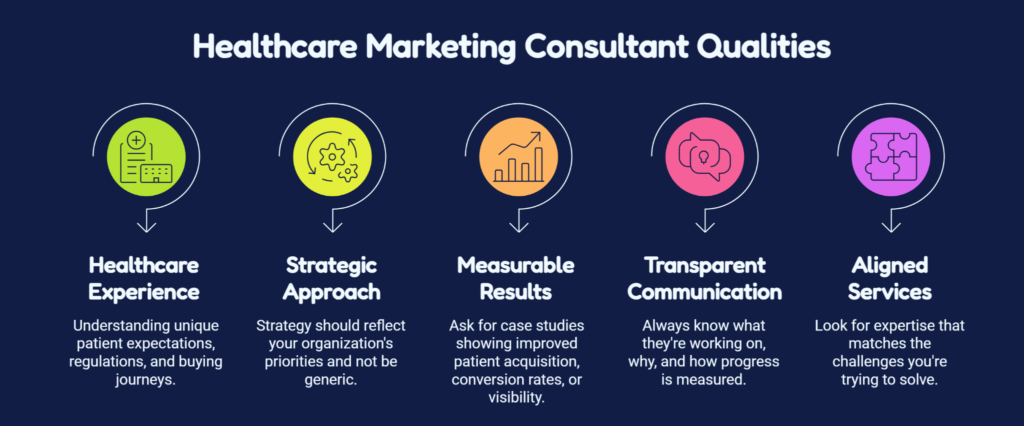
As you compare your options, these are the qualities worth looking for:
- Healthcare industry experience. Healthcare comes with unique patient expectations, regulations, and buying journeys. Someone who’s worked with healthcare organizations before will understand those realities from day one.
- A strategic approach that fits your organization. Be cautious if every client seems to receive the same recommendations. Your organization has its own priorities, and the strategy should reflect them.
- Relevant case studies and measurable results. Ask what changed after they got involved. Better patient acquisition? Higher conversion rates? Stronger online visibility? Real examples tell you much more than a polished sales presentation.
- Transparent communication and reporting. You should always know what they’re working on, why they’re recommending it, and how progress will be measured.
- Services that align with your goals. Some consultants specialize in branding, others in SEO, analytics, digital marketing, or patient acquisition. Look for expertise that matches the challenges you’re trying to solve.
The qualities organizations expect from external partners are evolving, too. Recent research points in the same direction:
- The CMO Barometer 2026 found that marketing leaders value creativity (69%), innovation (61%), proactive thinking (54%), and support with internal transformation (44%) when choosing external partners.
- McKinsey’s research on European marketing leaders identified branding as the top marketing priority for 2026.
- In a separate survey, McKinsey also found that 88% of organizations already use AI in at least one business function. However, only about one-third have started scaling those initiatives across the business.
Put those findings together, and a clear pattern emerges.
Organizations aren’t looking for someone who simply manages campaigns anymore. They want a partner who can strengthen their brand, make smarter use of technology, and connect marketing decisions with long-term business goals.
Healthcare organizations are no different.
Ask These Questions Before You Make a Decision
A discovery call isn’t just for the consultant to evaluate your organization. It’s your chance to evaluate them, too.
A handful of thoughtful questions will tell you much more than an hour-long sales presentation.
- How do you measure success?
Listen carefully to the answer. If the conversation stays focused on impressions, clicks, or website traffic, keep digging. Ask how they connect those metrics to patient acquisition, appointment bookings, retention, or other business goals that matter to your organization.
- Have you worked with organizations like ours?
Healthcare is a broad industry. Marketing for a dental practice isn’t the same as marketing for a specialty clinic or a multi-location health system. Relevant experience usually leads to better recommendations from day one.
- Who will be involved in our account?
Some firms have senior consultants lead the sales process, then hand the work to someone you’ve never met. Make sure you know who you’ll actually be working with and how involved they’ll be throughout the engagement.
- What does your engagement process look like?
A structured process builds confidence. Ask how they approach research, strategy, implementation, reporting, and ongoing adjustments. You should leave the conversation with a clear picture of what working together would look like.
- How will we communicate and review progress?
Regular updates help keep everyone aligned. Ask how frequently you’ll meet, what reports you’ll receive, and how they’ll explain results and next steps.
Pay attention to something beyond the answers themselves: notice the questions they ask you.
A consultant who’s genuinely interested in helping your organization will spend just as much time listening as talking. They’ll want to understand your goals, your challenges, and what’s already happening inside your organization before offering recommendations.
That usually tells you more than the proposal ever will.
Know the Red Flags Before You Hire a Marketing Consultant
Sometimes the warning signs are obvious. Other times, they show up disguised as confidence.
A consultant who promises quick wins or claims they have the perfect formula for every healthcare organization might sound convincing during a sales call.
A few months later, that confidence can turn into frustration, missed expectations, and a marketing strategy that never really fits your organization.
Keeping an eye out for these red flags can save you a lot of time and money:
- Guaranteed results or unrealistic promises. No consultant can honestly promise you’ll rank first on Google or double your patient volume in a few months. Marketing depends on dozens of factors, many of which are outside anyone’s control. Be skeptical of guarantees that sound too good to be true.
- Limited healthcare experience. General marketing knowledge is valuable, but healthcare comes with different patient behaviors, compliance requirements, and trust signals. If they can’t explain those differences, they’re probably learning on your time.
- Unclear deliverables or pricing. You should know exactly what you’re paying for. If proposals feel vague or pricing changes every time you ask a question, don’t ignore it. Confusion early in the process usually doesn’t improve later.
- Little transparency around reporting. Good consultants explain what they’re tracking, why those metrics matter, and how performance will be reviewed. If reporting feels like a mystery, accountability becomes difficult.
- No defined process or strategic framework. Every consultant has their own way of working, but there should be a process. If the plan sounds like “we’ll figure it out as we go,” you’re taking on unnecessary risk.
The right partnership should feel collaborative from the very beginning.
If it already feels rushed or unclear during the sales process, that’s usually a sign of what the working relationship will look like later on.
How Healthcare Marketing Consultants Price Their Services
One of the first questions organizations ask is also one of the hardest to answer.
“How much should a healthcare marketing consultant cost?”
The honest answer is: it depends.
The scope of the work, the consultant’s experience, the size of your organization, and the complexity of your goals all influence pricing. That’s why you won’t find a standard price that fits every engagement.
There’s another reason pricing varies so much: consultants don’t all work the same way.
The three pricing models you’ll see most often are:
- Hourly consulting. Best for organizations looking for expert advice on a specific challenge, such as reviewing a marketing strategy, evaluating a new initiative, or getting a second opinion before making an important decision.
- Monthly retainers. A good fit when you want ongoing strategic guidance. This model allows consultants to understand your organization over time, monitor performance, and adjust the strategy as your priorities evolve.
- Project-based engagements. Common for organizations launching a new service, rebranding, redesigning a website, or tackling another initiative with a clearly defined scope, timeline, and set of deliverables.
Some organizations need a few strategic conversations. Others benefit more from having a long-term partner involved in planning and decision-making.
Bottom line? The right option depends on the type of support you’re looking for.
Factors that influence pricing in 2026
Even within the same pricing model, costs can vary quite a bit.
A few factors usually explain the difference:
- Healthcare experience. Consultants with a strong background in healthcare bring industry knowledge that can shorten the learning curve and reduce costly mistakes.
- Scope of work. Reviewing your strategy is very different from supporting SEO, branding, patient acquisition, analytics, and implementation over several months.
- Organization size. A multi-location health system usually requires more coordination than a single-location practice.
- Level of involvement. Some consultants provide occasional strategic advice, while others work closely with leadership teams throughout the engagement.
One final thought before you compare proposals:
Price tells you what you’ll pay. Value tells you what you’ll get in return.
Those two things aren’t always the same, and the cheapest proposal isn’t necessarily the smartest investment for your organization.

Choosing the Right Healthcare Marketing Consultant Starts Here
As you can see, the right healthcare marketing consultant won’t just look at your marketing.
They’ll take the time to understand your organization first. They also won’t rush the conversation, because good marketing starts with identifying the real problem before trying to solve it.
If you’re looking for a partner who combines healthcare expertise with practical marketing strategy, Medical Flow can help you turn better decisions into long-term growth.
Ready to build a smarter marketing strategy for your healthcare organization? Let’s talk.
FAQs
Why should healthcare providers hire marketing consultants?
Because it’s easy to get too close to your own marketing.
An outside consultant can spot opportunities, gaps, and inefficiencies that are hard to notice when you’re managing day-to-day operations. They also bring experience from working with other healthcare organizations, which helps you avoid expensive trial and error.
How can healthcare marketing consultants improve patient acquisition?
It usually starts long before someone books an appointment.
A consultant looks at your entire patient journey, from online visibility and messaging to your website, scheduling experience, and conversion data. Small improvements across those touchpoints can make a big difference over time.
What qualifications should a healthcare marketing consultant have?
Healthcare experience should be near the top of your list.
Beyond that, look for someone who asks thoughtful questions, explains their recommendations clearly, and shares measurable results. Also, should understand topics like SEO, analytics, branding, and patient acquisition.
How much does a healthcare marketing consultant charge?
There’s no single answer. Some consultants charge by the hour, while others work on monthly retainers or project-based engagements.
The final cost usually depends on the scope of work, the consultant’s experience, and how involved they’ll be throughout the engagement.
What is the difference between a healthcare marketing consultant and a marketing agency?
Think of it this way. A consultant helps you decide where you’re going and why. Meanwhile, healthcare marketing agencies help to execute the plan once that direction is clear.
Many healthcare organizations end up working with both because each one brings something different to the table.
When should a healthcare organization hire a marketing consultant?
Usually, before making a major marketing investment, not after.
If patient growth has slowed, your marketing feels disconnected, or you’re planning a new initiative, bringing in an outside perspective can help you make better decisions from the start.