Medically Reviewed by
Search used to be a simple game of matching keywords. Today, it’s a whole different world.
With the rise of AI tools like Google’s AI Overviews, ChatGPT, Perplexity, and many more, people are getting instant answers without ever clicking a link.
For healthcare organizations, the stakes are especially high as AI in healthcare continues to evolve.
It’s no longer enough to simply rank on page one, you also need to be a trusted source that AI can confidently reference, cite, and recommend.
In a field where accuracy and credibility are literally life-and-death, being “AI-ready” is the new standard for digital authority.
Healthcare AI Search Readiness is about more than just SEO. You need to ensure your content is structured so clearly that an AI can understand, summarize, and vouch for it.
In this guide, we’ll show you how to:
- Adapt to the shift from “blue links” to synthesized AI answers.
- Strengthen the trust signals that AI systems prioritize in healthcare.
- Future-proof your strategy to stay visible as search continues to evolve.
- How People Search for Healthcare Information Today
- Traditional SEO Foundations Still Matter (But Need Evolution)
- What Is Healthcare AI Search Readiness?
- Content Strategy: From Ranking Pages to Answer Engines
- Structuring Content for AI Understanding
- Technical Readiness for AI Search
- Measuring Success Beyond Rankings
- Conclusion
How People Search for Healthcare Information Today
As per the research, 65% of patients search online before contacting a doctor, emphasizing the importance of a strong digital presence for healthcare providers.
Hence, it’s important for healthcare firms to focus on this key marketing channel – Search. But healthcare search has changed a lot.
People aren’t just typing in “diabetes” anymore; they’re asking complex, real-world questions that reflect their specific stage in the patient or provider journey.
To stay visible, your content needs to meet them exactly where they are.
- Symptom-based (The Starting Line): Users start with “why” and “what.” They want clear, accessible explanations for things like “persistent dizziness after meals.” AI favors content that provides context while maintaining clear medical boundaries.
- Outcome-based (The Deep Dive): As they move forward, the focus shifts to results. They’re looking for “recovery time for knee replacements” or “success rates.” Here, AI looks for hard data, clinical evidence, and authoritative proof.
- Comparison-based (The Decision): Whether it’s a patient choosing a hospital or an executive picking an EHR vendor, they are weighing options. AI rewards transparent, balanced content that lays out pros and cons without sounding like a sales pitch.
The Rise of Natural Language
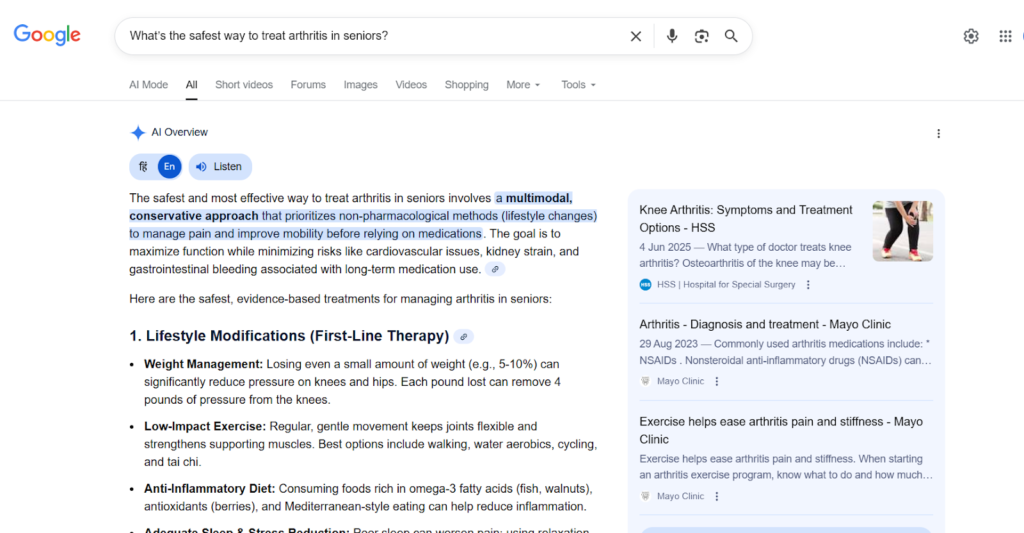
Thanks to voice search and AI chat, queries now sound like real conversations: “What’s the safest way to treat arthritis in seniors?” or “Which exercises to avoid in Piles?”
Your content must be easy for an AI to parse, summarize, and quote.
Zero-Click Search
We’re entering the era of the zero-click search. As per the Search Engine Land’s research, in March 2025, 27.2% of U.S. searches ended without a click compared to 24.4% in March 2024; for the same period in the EU/UK, zero-click searches increased from 23.6% to 26.10%.
Users are getting their answers directly from AI summaries without ever visiting your site.
In this world, success isn’t just about traffic, it’s about being the source the AI trusts and cites. If you aren’t the reference, you’re invisible.
In the image below, you can see that we searched the same query on Google, and instead of showing those traditional blue links, it has summarized the answer in natural language.
Traditional SEO Foundations Still Matter (But Need Evolution)
Traditional SEO isn’t dead. It has evolved from being the “end goal” to being the “baseline.”
Think of it as the foundation of a house: you can’t build a cutting-edge AI strategy on top of a site that’s technically broken.
Why Core SEO Still Matters
Search engines and AI models both need a well-structured site to do their jobs.
The basics are still non-negotiable. Here’s what you need to focus on before jumping to the AI optimization.
- Technical health: If your site is slow or hard to crawl, AI systems won’t bother indexing it.
- On-page structure: Logical headings (H2s, H3s) and clear internal links aren’t just for rankings anymore. They help AI “read” and summarize your content accurately.
- Intent mapping: Keywords are now clues. They tell you whether a user is just curious or ready to book an appointment, allowing you to tailor your content to their specific needs.
Where Traditional SEO Hits a Wall
If you stop at basic SEO, you’re going to be invisible in AI results. Here’s why:
- Keywords vs. topics: AI looks for deep, comprehensive coverage of a subject, not just a page that mentions a keyword five times.
- Optimizing for “understanding”: Many sites are built to “trick” an algorithm. AI, however, prioritizes clarity, expert attribution, and real-world usefulness.
- The “entity” shift: AI doesn’t just see words; it sees Entities (like specific doctors, treatments, or conditions). If you aren’t using structured data (Schema) to define these relationships, AI won’t know how to cite you.
The New Standard: SEO + AI Search Readiness
The winners in this new era will be the organizations that treat SEO as the starting line.
By combining technical excellence with deep authority and structured “machine-readable” data, you ensure that your expertise isn’t just found, it’s used to power the answers.
What Is Healthcare AI Search Readiness?
Think of AI Search Readiness as your organization’s digital “resume” for the age of artificial intelligence, where AI writing tools and search platforms increasingly shape how content is discovered and understood.
While traditional SEO is about appearing in a list of links, healthcare AI Search Readiness is about ensuring your content is prepared for AI-driven answers.
When tools like ChatGPT or Google’s AI Overviews respond to a medical question, the goal is for them to use your information as a trusted source and mention or cite your organization.
What It Means in Practice
AI search engines don’t just “rank” pages; they synthesize information. For a healthcare organization, being ready means your content is:
- Machine-readable: Using structured data (Schema markup) so AI instantly knows who your doctors are, what treatments you offer, and where you’re located.
- Context-rich: Moving from simple keywords to “entities.” Instead of just using the word “cardiology,” you clearly define the relationship between your specialists, their clinical trials, and patient outcomes.
- A “citation magnet”: AI systems are programmed to avoid risk, especially in healthcare. They prioritize sources with clear authorship (E-E-A-T), clinical citations, and verified regulatory alignment.
SEO Vs AI Search
| SEO | AI Search |
| Rank #1 on search engines and get the click | Be the trusted source the AI cites |
| Click-Through Rate (CTR) | Brand mentions & citations in AI answers |
| Keywords and backlinks | Entities, authority, and structured data |
| Navigating a website | Getting an instant, synthesized answer |
Content Strategy: From Ranking Pages to Answer Engines
Here’s what you need to do with your content strategy to improve your AI search presence:
1. Shift From Keywords to Questions
AI-driven search prioritizes content that directly answers real healthcare questions.
Instead of optimizing pages around isolated keywords, healthcare organizations need to focus on symptoms, outcomes, comparisons, and decision-making queries.
Content should reflect how patients actually ask questions, using clear definitions and plain-language explanations.
2. Design Content for AI Consumption
The intention here is to create and design content in a way that helps users, SEO, and AI models at the same time.
AI systems favor content that is easy to extract and summarize. Using clear subheadings, short sections, bullet points, and concise summaries helps ensure key information is accurately understood.
For healthcare content, this also means clearly separating educational information from medical advice and maintaining contextual clarity to reduce risk.
3. Build Authority Through Evidence and Context
Healthcare content must be grounded in credible data, outcomes, and trusted references.
Including statistics, clinical evidence, regulatory context, or real-world examples increases the likelihood that AI platforms will treat the content as reference-worthy.
Clear author attribution and organizational expertise further strengthen trust signals.
4. Move From Standalone Pages to Knowledge Hubs
AI search systems evaluate topical depth, not just individual pages.
Creating interconnected topic clusters, such as condition hubs, service areas, or disease explainers, helps reinforce expertise and provide the context AI relies on.
When content is structured as a knowledge ecosystem, it functions as an answer engine, not just a ranking page.
Structuring Content for AI Understanding
As AI systems increasingly generate answers instead of links, how healthcare content is structured becomes just as important as what it says.
AI search engines rely on clear signals to identify entities, understand relationships, and extract accurate information.
That makes content structure a critical factor in AI search readiness and a growing priority in AI in marketing strategies.
1. Use Semantic Structure, Not Just Keywords
AI models interpret meaning through context. Healthcare content should consistently use standardized terminology, define key concepts clearly, and avoid unnecessary variation that can create ambiguity.
Structuring content around entities, such as medical conditions, treatments, organizations, and regulations, helps AI systems understand what a page is truly about and how it connects to broader healthcare topics.
This is especially important when using AI tools for keyword search, as these tools increasingly rely on context, relationships, and content clarity to surface the most relevant information.
2. Reinforce Context Through Internal Linking
Internal links do more than pass SEO value; they help establish topical relationships.
Linking related pages, such as symptoms to treatments, provides AI systems with contextual reinforcement.
This interconnected structure signals depth, coherence, and subject-matter authority.
3. Apply Structured Data Where It Adds Clarity
Schema markup helps AI systems extract and classify healthcare information more reliably.
Using appropriate schema, such as Article, FAQ, Organization, Author, and relevant medical schemas, reduces ambiguity and strengthens trust signals.
While schema does not guarantee AI citations, it improves interpretability and consistency across AI-driven platforms.
4. Prioritize Clarity and Consistency
AI systems favor content that is easy to parse and unlikely to be misinterpreted. Clear headings, logical content flow, consistent naming conventions, and up-to-date information reduce the risk of incorrect summaries.
For healthcare organizations, this clarity is essential not only for visibility but also for accuracy, compliance, and trust.
Technical Readiness for AI Search
AI systems don’t just “search”; they “parse.” Even the most authoritative healthcare content is invisible if an AI can’t technically access or interpret it.
To be ready, your website needs to be more than functional; it needs to be machine-readable.
1. Build a “Crawlable” Blueprint
A messy site structure is a dead end for AI. If a bot gets lost in broken links or buried pages, it won’t trust you as a source.
- Keep it flat: Ensure your most important content (specialties, provider bios) is no more than three clicks from the homepage.
- Clean URLs: Use descriptive paths like yourdomain.com/treatments/knee-replacement instead of yourdomain.com/pageID-12345.
- Logical hierarchy: Use H1, H2, and H3 tags as a roadmap. AI uses these “chapter titles” to slice your content into usable answers.
- Make sure you haven’t blocked AI bots from crawling your website through the robots.txt file.
2. Prioritize Speed and Accessibility
AI platforms favor websites that are fast and reliable. In healthcare, accessibility isn’t just a legal requirement, it’s a trust signal.
- Core web vitals: Aim for a “Largest Contentful Paint” (LCP) of under 2.5 seconds. Slow sites are often skipped by AI models during training.
- Mobile-first: Most AI search happens on the go. If your buttons are too small or your text doesn’t scale, your authority takes a hit.
3. Security is Your Reputation
In a high-stakes field, security equals credibility.
- HTTPS is mandatory: AI systems are programmed to prioritize secure connections to protect users from misinformation or data breaches.
- Compliance: Following HIPAA and privacy standards reinforces your status as a “safe” source for AI to recommend.
4. Content Freshness (The “Expiration Date”)
Medical info changes fast. If you’re still citing 2018 guidelines, AI will flag your content as outdated.
- Regular audits: Set a “Review Date” for every page. AI looks for “Last Updated” metadata to verify accuracy.
- Manage indexing: Use your robots.txt file and XML sitemaps to guide AI toward your newest, most accurate pages while retiring old ones.
Measuring Success Beyond Rankings
In the era of AI, a #1 ranking on Google is no longer the only way to win. If an AI summarizes your expert advice but the user never clicks your link, did you still “succeed”?
In healthcare, the answer is yes if you influenced the decision.
To track this, we have to move beyond old-school traffic reports and start measuring Authority and Influence.
1. Shift From Rankings to Visibility and Influence
Traditional SEO tracks how many people clicked a link. AI Search Readiness tracks how often your brand is the “brain” behind the answer.
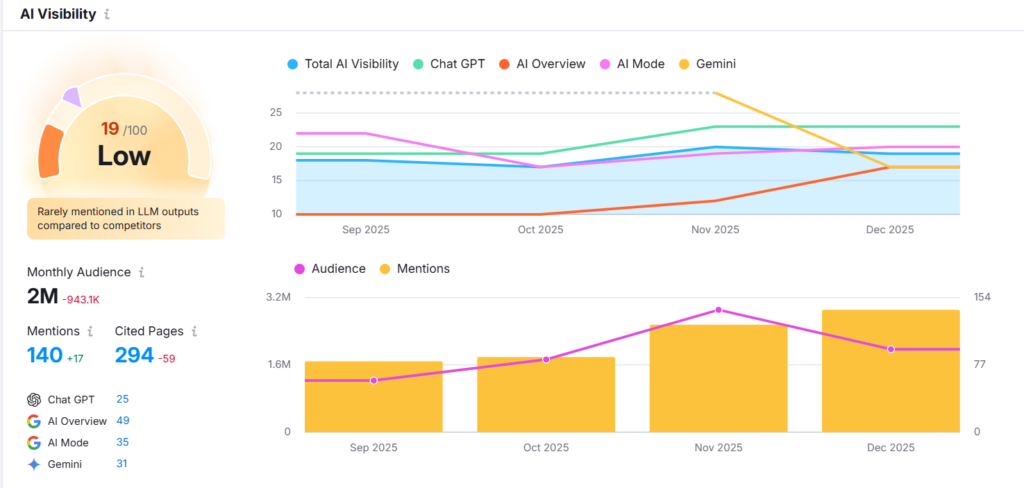
(snapshot from Semrush AI toolkit that shows complete AI search analysis for a website)
- AI mentions: How often does ChatGPT or Google Gemini name your hospital or doctors when answering a health query?
- Citation rate: Is the AI linking to your research or patient guides as its primary source?
- Sentiment tracking: Is the AI framing your organization as a “leader” or a “specialist” in the field?
P.S.: Tracking AI Mentions and citations for your brand isn’t too easy manually. Hence, you may consider using tools like Semrush AI Toolkit, Ahrefs Brand Radar, etc.
Such tools not only help you with tracking, but they also provide suggestions to improve the AI visibility.
2. Measuring the “Zero-Click” Impact
Since users are getting answers directly on the search page, we need new ways to prove value:
- Branded Search Volume: If AI mentions you, are more people searching for you by name? You can check this in your search console report.
- Assisted Conversions: Use “last-touch” attribution to see if patients who eventually book an appointment were first “introduced” to you via an AI summary.
- Entity Strength: Track how often your specific clinicians or specialized treatments appear in “Knowledge Panels” or AI snapshots.
3. The New Search Scorecard
| Old Metric | New AI Metric | Why it Matters |
| Keyword Ranking | Citation Frequency | Being the “source” is more valuable than being a “link.” |
| Organic Traffic | Branded Demand | AI visibility drives people to search for you specifically. |
| Bounce Rate | Content Confidence | AI favors content that is so clear it can be easily summarized. |
Conclusion
Search is no longer just about rankings. It also requires trust and visibility in AI-generated answers.
As search evolves into an answer-first experience, healthcare organizations must go beyond traditional SEO and focus on clarity, authority, and accuracy.
SEO remains the foundation, but healthcare AI Search Readiness determines whether your content is understood, cited, and trusted.
Organizations that adapt early will not only stay visible but also influence how healthcare information is discovered and relied upon.
The future belongs to healthcare organizations that move from ranking pages to becoming trusted sources of answers.