
Artificial intelligence is no longer experimental in healthcare. It’s already shaping day-to-day decisions, clinical workflows, and long-term planning.
In fact, 94% of healthcare organizations say AI is now core to their operations. And 86% are already using it in some form.
But while adoption is clearly growing, so is the risk of getting it wrong.
Well, healthcare AI consulting helps teams avoid that misstep. It connects the dots between strategy and execution. That way, it ensures AI solutions are safe, compliant, and built around how clinical teams actually work.
Because here’s the reality: leaders want fast results. Clinicians need tools that fit into their workflow. And no one has time for systems that slow things down or create compliance issues.
Next, we’ll break down what healthcare AI consulting involves, who it supports, and how the right expert input can turn AI from an abstract idea into something that actually works.
Let’s get into it.
- TL;DR
- What is Healthcare AI Consulting?
- Why AI Projects in Healthcare Often Fail Without Expert Guidance
- The Business and Clinical Value of Healthcare AI Consulting
- What Healthcare AI Consulting Typically Includes
- Real-World Use Cases For Healthcare AI Consulting
- When Healthcare Organizations Should Consider AI Consulting?
- Choosing the Right Healthcare AI Consulting Partner: What to Consider
- Bottom Line: Making AI Work in Healthcare is Not Optional
- FAQs
TL;DR
Pressed for time? Here’s what you need to know:
- Healthcare AI consulting turns ideas into real, working systems: safe, compliant, and usable in clinical settings.
- AI adoption is growing fast, but most teams aren’t ready to roll it out effectively.
- The biggest failures usually come from bad data, weak execution, or compliance gaps; not from the tech itself.
- The right consultants speed up results, improve governance, and tie AI to real clinical and business goals.
- The best outcomes happen when healthcare know-how meets hands-on AI implementation experience.
What is Healthcare AI Consulting?
Healthcare AI consulting helps your team apply AI in ways that make sense inside a clinic.
That means choosing the right use cases, working around messy data, setting up the right workflows, and staying compliant every step of the way.
Basically, it’s hands-on support to help you move faster, avoid blind spots, and make sure the tools you’re building or buying actually work in practice.
And it’s not just for hospitals with massive budgets. Clinics, health networks, and care providers of all sizes are bringing in AI consultants to help them get it right the first time.
How AI is Revolutionizing Medicine
How Healthcare AI Consulting Differs From Traditional AI Consulting
Healthcare isn’t just another business. One bad decision can affect a patient’s life, trigger a liability issue, or land you in regulatory trouble.
That’s why traditional AI consulting often falls short. It may focus on cost savings, automation, or efficiency. But in healthcare, those come second to safety, trust, and explainability.
Healthcare AI consulting takes a different approach. It focuses on:
- Clinical context and decision-making workflows.
- Regulatory frameworks such as HIPAA, GDPR, and local health data laws.
- There is a need for transparency in AI models used for diagnosis, triage, or risk prediction.
- Integration with EHRs and legacy systems that were never designed for AI-driven workloads.
You can have a model that performs well in testing. But if it doesn’t fit into your daily workflows, it creates more problems than it solves.
Who Healthcare AI Consulting Is Built For
This isn’t just for big hospital systems with massive budgets. If you’re serious about using AI but not sure how to do it safely or effectively, consulting gives you a way forward.
In short, this specialized consulting is a good fit for:
- Clinics and hospitals are starting to test AI in patient care.
- Health networks using machine learning for population health or predictive analytics.
- Payers and providers who are experimenting with generative AI for admin tasks or patient support.
- Healthcare IT teams that expect to move fast while staying compliant and secure.
And the interest is growing: 70% of payers and providers are already exploring generative AI, according to Vention Teams.
So, basically, consulting helps close the gap between the hype and a working solution that fits your reality.
Why AI Projects in Healthcare Often Fail Without Expert Guidance
What are the risks of using AI in healthcare?
There’s a lot of pressure to adopt AI. Healthcare leaders know they can’t sit still, even if the short-term return isn’t clear yet.
As Vention Teams also reports, 85% of healthcare organizations are already working on AI initiatives, even with uncertainty around ROI. That urgency drives action, but it also leads to avoidable mistakes.
Many teams jump in without a clear plan, no strong governance, and unrealistic expectations. So projects stall, pilots don’t scale, and nothing ever makes it into daily use.
Here’s where most projects break down:
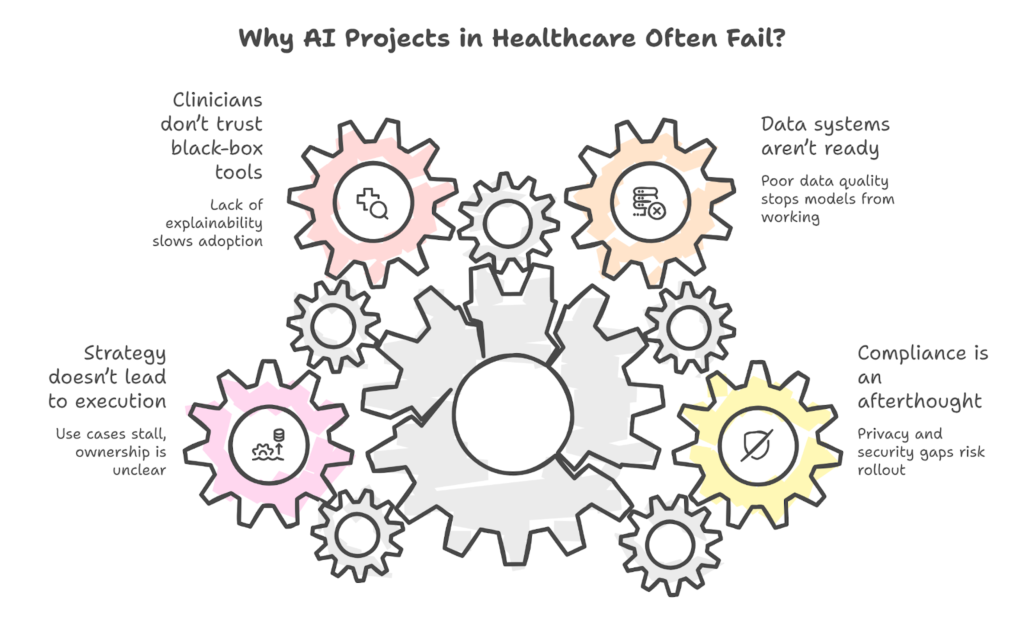
Regulatory and Compliance Risks
In healthcare, you can’t leave compliance for later.
AI touches sensitive data, clinical decisions, and regulated workflows from day one. If privacy, security, or oversight come second, the entire rollout is at risk.
HIPAA, GDPR, and similar regulations demand clear data controls and accountability. But most healthcare teams still lack formal AI governance.
That’s a problem, especially when 91% of executives say human oversight is essential, yet few have the safeguards in place.
Without expert input, teams often move too fast and skip key steps. And that kind of oversight gap is expensive.
Fragmented Data and System Limitations
AI only works if the data does. And in healthcare, data is a mess.
EHRs are scattered across systems. Formats don’t match, interoperability is limited, and historical records are often incomplete or poorly structured.
Even the best machine learning model will fail if it’s trained on bad input.
This disconnect explains a major gap. 97% of healthcare organizations feel pressure to adopt AI quickly, but only 14% believe they’re ready to do it right (according to the American College of Health Data Management).
The infrastructure just isn’t there yet. Not without serious support.
Clinical Safety and Trust Concerns
Clinicians won’t use tools they can’t understand. And they shouldn’t have to.
Black-box AI systems that spit out results without context create hesitation, especially in high-stakes decisions around diagnosis or treatment.
If teams can’t see why a recommendation was made, they pause. Adoption slows, and patient care suffers. That’s why explainability is mandatory.
Key Insight: 82% of healthcare executives cite clinician trust in AI systems as a key factor for successful adoption, yet many clinicians feel available tools aren’t designed around their workflows.
Gaps Between Strategy and Execution
A lot of healthcare organizations have bold AI strategies on paper. But that momentum dies in execution.
Use cases don’t translate into working systems. Roles are unclear, ownership is scattered, and no one’s responsible for making the tools usable day to day.
As a result, AI tools stay disconnected from real workflows, and pilots accumulate without providing value.
That’s why industry reports show that more than 80% of AI projects in healthcare fail. Not because AI doesn’t work, but because execution gets treated like an afterthought.
The Business and Clinical Value of Healthcare AI Consulting
When AI projects stall, it’s rarely because the tech isn’t good enough. The real issue? Misalignment. And healthcare AI consulting helps fix that.
Here is how that value shows up in practice:
Faster Path From AI Strategy to Production
A lot of teams lose progress between planning and rollout. Use cases get approved, but then things stall due to compliance delays, unclear ownership, or integration headaches.
Consulting helps you skip that standstill. With clear roadmaps, defined roles, and governance from the start, teams move faster without cutting corners.
It’s simple: speed without structure leads to failure. Speed with structure leads to adoption.
More Reliable Clinical and Operational Insights
Healthcare data is complex and inconsistent. If you skip the foundational work, AI will create more confusion.
Consultants focus on data readiness, model validation, and making sure insights are actually usable in context. That way, predictive tools support decision-making instead of becoming just another ignored dashboard.
And it pays off. Google Cloud found that 73% of healthcare and life sciences leaders saw a positive return on generative AI within the first year when it was implemented correctly.
Cost Control Without Compromising Care Quality
AI is frequently positioned as a cost-cutting tool. In healthcare, that mindset can backfire.
What works is reducing admin overload, trimming inefficiencies, and improving workflows. All without making care riskier for patients or harder on staff.
Think smarter scheduling, automated documentation, and better resource allocation. All of it frees up time for what matters most: patient care.
Consulting keeps cost control aligned with clinical quality, not in conflict with it.
Pro Tip: You don’t have to choose between saving money and doing things right. This breakdown of the cost of implementing AI in healthcare shows how to manage both.
Stronger AI Governance and Transparency
Without proper governance, AI hits a ceiling. Trust breaks down, and projects stall.
Consulting helps build that structure early. That way, leadership knows what’s going on, clinical teams trust the outputs, and developers work within clear boundaries.
That shared foundation makes it easier to scale AI across the organization instead of keeping it stuck in small pilots.
What Healthcare AI Consulting Typically Includes
The real value of healthcare AI consulting is in the hands-on support across every stage of implementation.
Here’s what that process usually looks like:
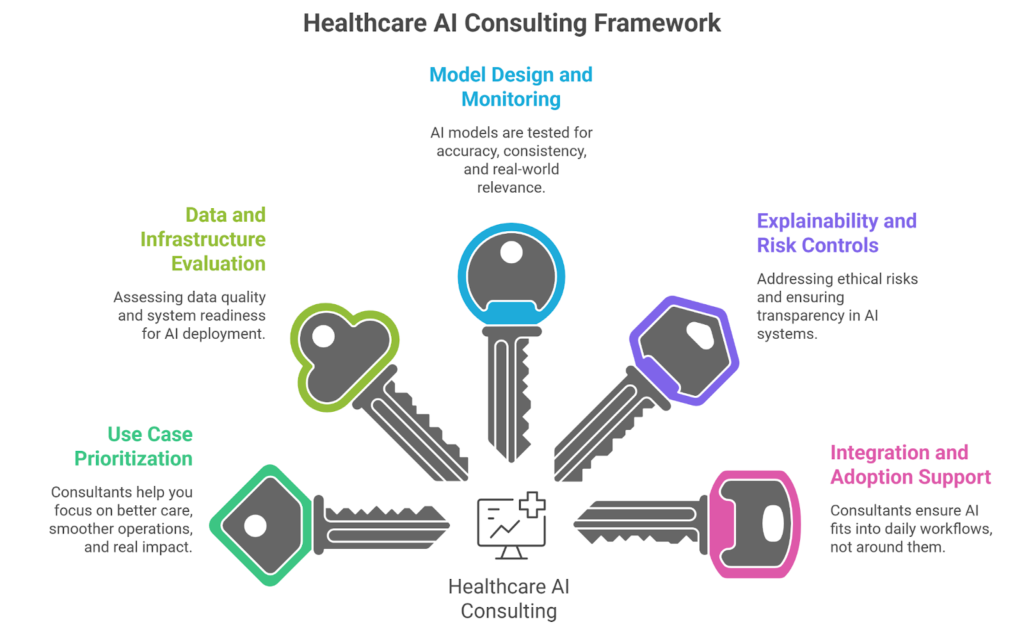
AI Use Case Prioritization and Roadmapping
Not every AI idea is worth your time or your budget. And in healthcare, choosing the wrong use case can do more harm than good.
This is where consulting brings clarity. Potential projects are reviewed based on clinical impact, feasibility, data availability, and regulatory risk.
From there, a roadmap takes shape. One that prioritizes what matters most: better care, smoother operations, or a stronger patient experience. Not ideas driven by hype.
Starting here sets clear expectations and keeps teams focused. Resources go where they can make a real difference.
Data Readiness and Infrastructure Evaluation
Even the strongest AI model will fail if the data behind it is weak. In healthcare, data readiness is rarely guaranteed.
Consultants take a close look at data quality, completeness, interoperability, and access across EHRs, imaging, and backend systems.
Weak spots are flagged before you start building, not after results fall apart. They also assess if your current infrastructure can handle machine learning without creating new security or performance risks.
This step matters more than most teams expect. Only 44% of healthcare leaders say they are moderately capable of securely and effectively managing large datasets for AI applications. Fixing this early avoids rework later.
Model Design, Validation, and Oversight
In healthcare, accuracy isn’t enough. Your AI model has to be relevant, reliable, and monitored over time.
Consulting teams help with model selection, training, and testing against the right benchmarks.
Validation confirms that outputs stay consistent across different populations and real-world scenarios. Also, oversight plans are put in place early. That way, if something goes off, you’ll catch it before it spreads.
Explainability, Ethics, and Risk Controls
Most healthcare leaders agree: AI needs human oversight. But very few have formal systems to manage it.
That’s where consulting fills the gap. Explainability standards are defined from the start. Ethical risks are flagged before launch. Lastly, risk controls are part of the design, not a scramble after something goes wrong.
This protects patients, supports clinical teams, and keeps organizations out of trouble.
Deployment, Integration, and Adoption Support
AI only works if it fits into daily routines. Tools that sit outside real workflows won’t last.
Consultants help integrate AI with what you already use: EHRs, scheduling platforms, and patient engagement systems. They also support training and change management, so staff know how to use AI outputs and when to rely on human judgment instead.
But that’s not all. Adoption is monitored closely to make adjustments without disrupting care.
And this is no longer optional. According to a 2025 Gitnux report, 35% of healthcare IT contracts now include specific AI implementation clauses. Deployment and consulting now go hand in hand.
Real-World Use Cases For Healthcare AI Consulting
AI consulting delivers real value when it tackles the actual problems care teams deal with every day. The following use cases are already live in hospitals and clinics, helping improve both care delivery and operations:
High-tech hospital uses artificial intelligence in patient care
Clinical Decision Support And Risk Prediction
In clinical settings, timing is everything.
AI-powered decision support helps teams spot patient risks earlier and focus attention where it matters most. Predictive models flag patients with higher chances of complications, deterioration, or readmission, surfacing patterns that are easy to miss manually.
But the value doesn’t come from the model alone. What matters is how those insights are delivered.
Consulting makes sure these tools are built around the way clinicians actually work. The alerts add clarity, supporting clinical judgment. That’s what builds trust and improves adoption.
Medical Imaging And Diagnostic Support
AI is already well established in medical imaging, especially in radiology and pathology. It helps flag anomalies, prioritize cases, and support image review.
But a model on its own isn’t enough. Consulting ensures that it’s validated with real-world data, properly integrated into imaging systems, and monitored over time.
When done right, this improves diagnostic accuracy and turnaround times. All without introducing the risks of untested or poorly governed automation.
Revenue Cycle And Financial Operations
The admin burden in healthcare keeps growing, and billing is one of the hardest-hit areas.
AI can help reduce the load. It supports coding, claim reviews, denial prediction, and payment forecasting. But only if it fits the existing workflows.
Consultants help make that happen. They align tools with current revenue cycle processes and compliance rules. That means fewer errors, faster reimbursements, and less time spent fixing mistakes.
Operational Planning And Resource Optimization
Staffing, bed availability, patient demand… nothing in healthcare stays stable for long.
AI models can help predict what’s coming: staffing needs, capacity shifts, and resource bottlenecks. But the models only work if they reflect reality.
Consulting teams fine-tune these tools using real operational patterns (like seasonal surges or local constraints) so leaders get more than just projections. They get visibility they can actually use to plan.
Patient Engagement And Virtual Care Enablement
This is where AI meets the front line.
Virtual triage, scheduling, follow-ups, and remote monitoring all play a role in keeping patients connected and care continuous. But if these tools are disconnected from the clinical team, they don’t work.
Consulting makes sure that doesn’t happen. It helps build systems that are intuitive, secure, and linked to real care pathways. Patients get timely responses, staff stay informed, and everyone knows when to escalate to a human touch.
When Healthcare Organizations Should Consider AI Consulting?
AI consulting is most useful before things go off track, not after. But many healthcare teams wait too long, only bringing in support when projects stall or risks pile up.
These are the signs it’s time to bring in expert help:
- AI initiatives fail to scale or deliver ROI. Early pilots show promise but never make it into production. Results stay limited, and leadership starts questioning the investment.
- Compliance, privacy, or risk exposure increases. As AI touches more data and decisions, the pressure to get governance right grows. Gaps in oversight, documentation, or security get harder to manage alone.
- Internal teams face skill or alignment gaps. IT, clinical, and data teams aren’t always moving in sync. Priorities clash, roles blur, and no one’s steering the ship.
These challenges are becoming more common. As Gitnux also reported, 40% of healthcare execs plan to increase their AI budgets next fiscal year. As spending rises, so does the cost of missteps.
Strategic guidance helps you invest smartly and avoid backtracking later.
Choosing the Right Healthcare AI Consulting Partner: What to Consider
AI adoption in healthcare is moving fast. And most organizations know they can’t do it all on their own. The complexity is too high, and the risks are too real.
That’s why choosing the right consulting partner is a strategic move.
You can already see the shift happening. In a McKinsey survey, 61% of healthcare orgs working on generative AI said they plan to partner with external vendors. Only 20% are building fully in-house.
The takeaway? Execution takes collaboration.
Here’s what to look for in a healthcare AI consulting partner:
- Deep healthcare and clinical expertise. They need to understand how care really works. That real-world context makes solutions easier to adopt and less likely to hit walls post-launch.
- Clear focus on explainability and responsible AI. If teams don’t trust the outputs, they won’t use them. The right partner builds in transparency, validation, and human oversight from the start, not after something breaks.
- Ability to tie AI to measurable outcomes. You need more than ideas. Look for someone who can connect AI to real clinical, operational, or financial results and adjust based on what’s proven to work.
Pro Tip: Need a shortlist of partners who’ve done this before? Meet the top healthcare AI consulting firms making AI work on the ground.
Bottom Line: Making AI Work in Healthcare is Not Optional
AI is moving quickly across the healthcare industry, but speed alone doesn’t create results.
What matters is how well these tools fit into care delivery, daily workflows, and compliance requirements. Without that alignment, even the most advanced systems stall.
That’s why the focus should stay where it counts: better care, confident teams, and solutions that can grow over time.
At Medical Flow, we help healthcare organizations get AI right from the start. Our support is hands-on and grounded in how healthcare actually works.
If you’re ready to move beyond pilots and apply AI with purpose, let’s talk.
FAQs
What is healthcare AI consulting, and how does it benefit medical organizations?
It’s expert help to make sure AI fits into real clinical and operational workflows, not just slides or demos. These consulting services help you choose what’s worth building, stay compliant, and avoid wasting time on tools no one ends up using.
Why is healthcare AI consulting important for modern healthcare systems?
Because getting AI right in healthcare is hard. There’s too much at stake to figure it out as you go. A good consultant helps you move faster, avoid blind spots, and build something your team can actually trust and use to improve patient care where it matters most.
What types of AI technologies are commonly used in healthcare consulting?
That depends on the problem you’re solving, but most projects involve predictive models, natural language tools, or generative AI. The goal isn’t to use the latest trend; actually, it’s about finding what really works and helps optimize how care is delivered across teams.
How do healthcare AI consultants address data privacy and security concerns?
They build privacy in from day one. That means setting the right controls, documenting everything properly, and making sure your AI integration meets HIPAA, GDPR, and anything else that applies before things go live.